
The best paint for countertops can transform an outdated kitchen or bathroom surface without the expense of replacing the entire countertop. Whether you have laminate, ceramic tile, wood, or another compatible material, choosing the right coating can give your space a cleaner, more modern appearance.
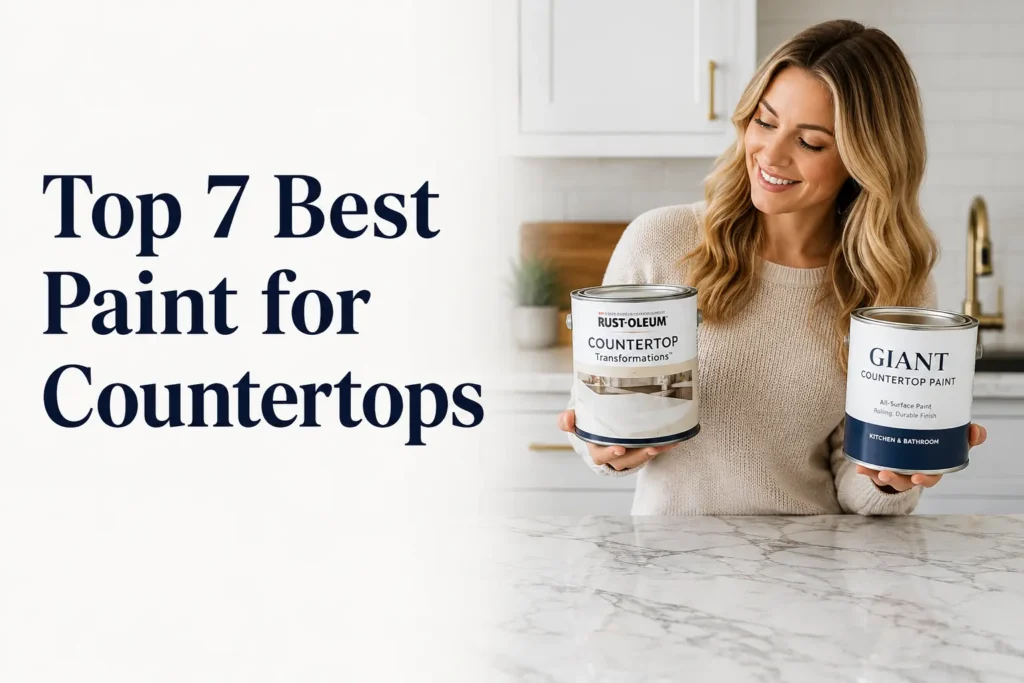
However, ordinary wall paint is rarely suitable for countertops because these surfaces experience frequent contact with water, food, cleaning products, and everyday wear. Countertop-specific coatings, decorative refinishing kits, and epoxy systems are better options when used according to their instructions. This guide compares seven options to help you find a suitable product for your project.
Affiliate disclosure: As an Amazon Associate I earn from qualifying purchases.
Top Picks: 7 Paints for Countertops
- Rust-Oleum HOME Countertop Coating Kit – Best overall for countertop updates
- Giani Granite Countertop Paint Kit 2.0 – Best for a granite-inspired appearance
- Daich SpreadStone Mineral Select Countertop Kit – Best for a textured stone-like finish
- Nuvo Countertop Paint Kit – Best for a solid-color makeover
- Stone Coat Countertops Epoxy Kit – Best for custom epoxy designs
- Leggari Countertop Epoxy Kit – Best for decorative transformations
- Beyond Paint Countertop Makeover Kit – Best for a straightforward painted finish
Comparison Table: Paints for Countertops
| Product Name | Best For | Check Price |
|---|---|---|
| Rust-Oleum HOME Countertop Coating Kit | Overall countertop refinishing | Check on Amazon |
| Giani Granite Countertop Paint Kit 2.0 | Granite-inspired decorative finish | Check on Amazon |
| Daich SpreadStone Mineral Select Countertop Kit | Textured stone-like appearance | Check on Amazon |
| Nuvo Countertop Paint Kit | Solid-color countertop makeover | Check on Amazon |
| Stone Coat Countertops Epoxy Kit | Custom epoxy designs | Check on Amazon |
| Leggari Countertop Epoxy Kit | Decorative epoxy transformations | Check on Amazon |
| Beyond Paint Countertop Makeover Kit | Simpler painted appearance | Check on Amazon |
Shopping note: These are tagged Amazon search links rather than verified direct product listings. Check the exact product name, kit contents, surface compatibility, coverage, and current availability before purchasing. Some systems require separate preparation materials or protective coatings.
Top 7 Best Paint for Countertops Reviews
1. Rust-Oleum HOME Countertop Coating Kit – Best Overall
Rust-Oleum HOME Countertop Coating Kit is a practical option for homeowners who want to update an existing countertop without removing the entire surface. Unlike ordinary wall paint, it is specifically designed as a countertop refinishing system.
The product uses a base coat and a protective topcoat. The manufacturer’s instructions list several compatible surfaces, including laminate, ceramic tile, porcelain tile, melamine, and wood. This makes it worth considering for different kitchen and bathroom renovation projects.
One of its main advantages is the relatively straightforward application process. The manufacturer describes it as a two-step system that does not require stripping, sanding, or priming on approved surfaces. You still need to clean the countertop properly and follow all label directions.
What makes it appealing
- Designed specifically for countertop refinishing
- Includes a base coat and protective topcoat
- Suitable for several listed countertop materials
- Available in different decorative appearances
- Convenient for DIY renovation projects
Things to consider
Do not confuse the product’s initial drying time with its complete curing period. Follow the current instructions before returning the countertop to regular use. Also, protect the finished surface from hot cookware, sharp knives, and harsh cleaning methods.
Best for: Homeowners looking for a countertop-specific coating system for an existing compatible surface.
2. Giani Granite Countertop Paint Kit 2.0 – Best for a Granite-Inspired Appearance
Giani Granite Countertop Paint Kit 2.0 is worth considering if you want to give an outdated countertop the appearance of granite without installing a new stone surface.
Instead of applying one uniform color, this decorative kit uses multiple layers to create a granite-inspired pattern. The process generally involves applying a base color and then adding decorative mineral colors to create the appearance of natural stone.
This makes it a good choice for homeowners who want a more detailed finish than ordinary solid-color countertop paint can provide. You can compare different available color styles to find one that complements your cabinets, backsplash, and flooring.
What makes it appealing
- Designed for decorative countertop refinishing
- Creates a granite-inspired appearance
- Layered application adds visual depth
- Useful for updating compatible laminate surfaces
- Offers different color and style options
Things to consider
Creating a convincing stone pattern takes patience. The final appearance depends on how evenly you apply and blend the decorative layers. Follow the instructions for the exact kit, including the recommended protective finish and curing schedule.
Best for: Homeowners who want an older countertop to resemble granite without replacing the existing surface.
3. Daich SpreadStone Mineral Select Countertop Kit – Best for a Textured Stone-Like Finish
Daich SpreadStone Mineral Select Countertop Kit is an interesting option if you prefer a textured, natural-stone-inspired appearance instead of a smooth painted surface.
The system uses mineral-based decorative materials to create a more substantial stone-like finish. This can be appealing when an old laminate countertop looks plain or no longer matches the rest of your kitchen.
The kit is designed as a countertop finishing system rather than a simple can of paint. Its components are intended to work together to create the decorative surface, so it is important to follow the complete application process.
What makes it appealing
- Designed for countertop refinishing
- Creates a textured stone-like appearance
- Offers several decorative color choices
- Provides an alternative to plain solid-color paint
- Useful for selected kitchen and bathroom surfaces
Things to consider
The application process may involve more steps than a basic paint project. Review the instructions to understand the required preparation, coating stages, and finishing materials. Confirm that your existing countertop material is suitable before purchasing.
Best for: People who want a decorative stone-inspired finish with more visible texture.
4. Nuvo Countertop Paint Kit – Best for a Solid-Color Makeover
Nuvo Countertop Paint Kit is worth comparing if you prefer a clean, solid-color countertop rather than a decorative granite or marble pattern.
A solid-color finish can help make an older kitchen look simpler and more contemporary. Neutral shades can work particularly well with white cabinets, darker hardware, and modern backsplash designs.
This type of countertop makeover kit may also appeal to DIY users who do not want to spend time creating decorative patterns with several colors.
What makes it appealing
- Designed for countertop makeover projects
- Useful for solid-color transformations
- Offers an alternative to stone-inspired patterns
- Suitable for homeowners planning a DIY update
- Can complement different kitchen color schemes
Things to consider
Check the current kit contents and the manufacturer’s surface-compatibility instructions. Do not assume that every countertop material can be coated without preparation. Also, verify whether the selected kit includes the required protective finish.
Best for: Homeowners who want a simpler, solid-color countertop makeover.
5. Stone Coat Countertops Epoxy Kit – Best for Custom Epoxy Designs
Stone Coat Countertops Epoxy Kit is a suitable option to explore if you want to create a custom decorative countertop. Epoxy systems are popular for refinishing projects because they can produce a smooth, glossy appearance and support different artistic effects.
Depending on the selected materials and application technique, you may be able to create marble-inspired patterns, metallic effects, contrasting veins, or solid-color finishes.
This flexibility makes epoxy appealing to DIY enthusiasts who want more control over the final appearance. However, applying epoxy is more involved than using a conventional countertop paint kit.
What makes it appealing
- Designed for countertop epoxy applications
- Supports custom decorative effects
- Can create a smooth, glossy appearance
- Offers flexibility in color and design
- Suitable for creative refinishing projects
Things to consider
Two-part epoxy products require accurate measuring and mixing. Working time may be limited, so prepare the surface and tools before mixing. Review the manufacturer’s safety information, ventilation requirements, application conditions, and complete curing schedule.
Best for: DIY users who want a customized epoxy countertop design and are comfortable with a more involved application process.
6. Leggari Countertop Epoxy Kit – Best for Decorative Countertop Transformations
Leggari Countertop Epoxy Kit is another option for homeowners interested in changing the appearance of an existing countertop with a decorative epoxy finish.
Epoxy systems can create dramatic patterns that resemble marble or other premium materials. Leggari offers decorative coating products and systems intended for customized surface transformations, making it worth comparing with other countertop epoxy options.
This approach may be especially attractive when the countertop is a major visual feature of the room. You can explore different pigments and effects to create a distinctive appearance.
What makes it appealing
- Designed for decorative epoxy projects
- Allows customized color combinations
- Suitable for stone-inspired visual effects
- Can produce a glossy finished appearance
- Offers creative flexibility for DIY refinishing
Things to consider
Check exactly what the selected kit includes. Some projects require additional pigments, tools, primer, or protective materials. You should also account for surface preparation, ventilation, mixing instructions, and the time required for complete curing.
Best for: DIY enthusiasts who want a customized epoxy countertop finish.
7. Beyond Paint Countertop Makeover Kit – Best for a Straightforward Painted Finish
Beyond Paint Countertop Makeover Kit is worth considering if you prefer a painted countertop update without creating an elaborate stone pattern.
A solid or lightly decorative finish can be a good way to refresh an outdated surface while keeping the overall appearance simple. This may suit smaller kitchens, bathroom vanities, laundry areas, and other spaces where you want a visual improvement without a major renovation.
Before ordering, check the exact kit contents. Beyond Paint offers different coating products, so make sure the listing is for the countertop makeover system rather than a different paint or sealer.
What makes it appealing
- Designed for countertop makeover projects
- Suitable for a simpler painted appearance
- Offers an alternative to epoxy pouring
- Useful for selected renovation projects
- Can help refresh an outdated countertop
Things to consider
Review the current manufacturer’s instructions for approved surfaces, preparation, coverage, and protective finish requirements. Do not assume that every countertop can be coated without cleaning or other preparation.
Best for: Homeowners who want a relatively straightforward countertop painting project.
How to Choose the Best Paint for Countertops
The right countertop coating depends on your existing material, the appearance you want, and how heavily the surface will be used. Consider these factors before purchasing.
1. Identify Your Countertop Material
Not every coating works equally well on every countertop. Start by identifying the existing surface.
- Laminate: A common candidate for countertop-specific coatings and properly prepared paint systems.
- Ceramic or porcelain tile: Requires a coating suitable for smooth tile surfaces.
- Wood: Can accept compatible coatings, but consider whether painting is preferable to refinishing and sealing the natural wood.
- Concrete: May be paintable with an appropriate system designed for mineral surfaces.
- Cultured marble: Requires careful preparation and a coating compatible with the existing finish.
- Granite, marble, and quartz: Generally poor candidates for ordinary DIY paint. Their polished surfaces can make adhesion difficult.
Always check the product label for the exact surface you intend to coat.
2. Choose the Right Type of Coating
Countertop products come in different forms, and each has its own application requirements.
| Coating Type | Main Advantage | Best For |
|---|---|---|
| Countertop coating kit | Designed for countertop refinishing | Listed compatible surfaces |
| Epoxy coating | Smooth, glossy decorative finish | Custom countertop transformations |
| Stone-look kit | Decorative patterns and texture | Granite-inspired appearances |
| Solid-color countertop paint | Simple painted appearance | Basic countertop makeovers |
| General-purpose paint | Broad color availability | Not recommended as a standalone countertop finish |
For a frequently used kitchen, prioritize a complete system designed for countertop wear rather than choosing paint based on color alone.
3. Consider Durability
Countertops experience more wear than ordinary walls. They are exposed to water, spills, cleaning products, utensils, and occasional impacts.
Look for a system with clear information about:
- Adhesion to your countertop material
- Resistance to stains and everyday cleaning
- Water exposure limitations
- Scratch and abrasion resistance
- Recommended protective topcoat
- Full curing time
Even a durable coating can be damaged by knives, hot pans, harsh chemicals, or heavy impact. Painted countertops should not be treated like an indestructible stone slab.
4. Decide on the Finish
The finish has a major effect on the appearance of your kitchen or bathroom.
- Matte: A softer, understated appearance.
- Satin: A balanced finish with moderate sheen.
- Glossy: A reflective look that can resemble polished stone.
- Textured: A decorative surface that creates more visual depth.
- Granite-inspired: A layered appearance with contrasting colors and mineral-like details.
Think about your cabinets, backsplash, flooring, and room lighting before selecting a color and finish.
5. Check Whether Primer Is Required
Primer helps a coating bond to a surface, particularly when the existing countertop is smooth or nonporous.
A compatible bonding primer may be necessary for laminate, tile, or other slick materials. Some countertop kits include their own base coat or are designed to work without a separate primer on approved surfaces.
Do not combine unrelated primers, paints, and sealers without confirming that they are compatible.
6. Consider the Protective Topcoat
The topcoat is an important part of many countertop refinishing systems. It provides the exposed wear surface and helps protect the decorative layer underneath.
Before buying, check whether the kit includes a protective finish or whether you need to purchase one separately. Use only a topcoat approved for the selected paint or epoxy system.
For food-preparation areas, verify the manufacturer’s suitability and food-contact guidance. Do not assume that a product is food-safe simply because it is marketed for countertops.
7. Calculate the Coverage
Measure the countertop before ordering a kit or paint. Include the main surface and any edges that you plan to coat.
Compare the manufacturer’s stated coverage with your measurements. Porous or textured surfaces, application technique, and the number of required coats can affect the amount needed.
Buying enough material from the beginning is particularly important for decorative kits, where matching the finish across separate purchases may be difficult.
How to Paint Countertops for a Better Finish
A successful countertop project depends heavily on preparation and following the coating manufacturer’s instructions. The exact steps differ between products, but the general process below can help you plan.
Step 1: Clear and Protect the Area
Remove appliances, utensils, food, and other objects from the countertop. Cover nearby cabinets, floors, sinks, walls, and appliances with suitable protective materials.
Use painter’s tape around areas that should remain uncoated. If you are working in a kitchen, plan alternative arrangements for food preparation while the countertop is unavailable.
Step 2: Clean and Degrease the Surface
Remove grease, food residue, soap, and other contamination using a cleaner approved for the countertop material and coating system.
Pay particular attention to areas around the stove and sink, where oil and moisture can accumulate. Wipe away cleaner residue as directed and allow the surface to dry completely.
Step 3: Repair Surface Damage
Inspect the countertop for chips, cracks, loose laminate, and other defects.
Repair minor damage using a suitable material recommended for the substrate and coating system. If laminate is bubbling, separating, or damaged by moisture, painting may not provide a reliable repair.
Step 4: Sand or Prepare the Surface as Directed
Some coating systems require light sanding to improve adhesion. Others are specifically designed to be applied without sanding or separate priming on approved surfaces.
If sanding is required, use the recommended abrasive and avoid damaging the underlying countertop. Remove dust thoroughly before continuing.
Step 5: Apply the Recommended Primer or Base Coat
Use the primer or base coat specified for your selected system. Apply it evenly and allow the required drying time.
If the product requires a separate bonding primer, make sure it is suitable for the countertop material and compatible with the topcoat.
Step 6: Apply the Paint or Decorative Layer
Use the recommended roller, brush, sponge, or application tool. Apply thin, even layers and avoid leaving thick puddles or uneven edges.
For stone-look kits, follow the instructions for creating the decorative pattern. For epoxy products, measure and mix the components exactly as directed.
Step 7: Apply the Protective Topcoat
If the system requires a clear protective finish, apply the recommended product after the decorative layer has reached the specified stage.
Use even coats and observe the manufacturer’s instructions for recoat intervals. The topcoat should be compatible with the base coating.
Step 8: Allow the Full Cure Time
Drying and curing are not the same. A surface may feel dry before it has reached the hardness required for normal use.
Keep the countertop free from water, food, appliances, and heavy objects until the manufacturer says it is ready. Do not shorten the curing period to get the kitchen back into service sooner.
Common Mistakes to Avoid When Painting Countertops
Using Ordinary Wall Paint
Standard wall paint is not designed to withstand the repeated contact, cleaning, moisture, and abrasion that countertops experience. Choose a countertop-specific coating or a compatible multi-step system.
Skipping Surface Preparation
Grease, dust, loose coatings, and moisture can interfere with adhesion. Follow the cleaning and preparation instructions carefully.
Applying Thick Coats
Thick layers can dry unevenly and create visible marks or curing problems. Use the recommended application thickness and allow the correct drying time between coats.
Mixing Incompatible Products
A primer, paint, and topcoat should be designed to work together. Combining unrelated products can lead to poor adhesion, soft finishes, or peeling.
Ignoring Heat and Cutting Damage
Painted countertops are not a substitute for heat-resistant trivets or cutting boards. Always protect the surface from hot cookware, sharp knives, and heavy impacts.
Using the Countertop Too Soon
A coating that has not fully cured may be vulnerable to scratches, stains, and water damage. Follow the complete cure schedule before returning the surface to normal use.
Frequently Asked Questions
What is the best paint for countertops?
Rust-Oleum HOME Countertop Coating Kit is a strong option for homeowners who want a product designed specifically for countertop refinishing. Giani and Daich are worth considering for decorative stone-inspired finishes, while Stone Coat and Leggari offer choices for custom epoxy projects.
Can you paint laminate countertops?
Yes. Laminate is one of the more common countertop materials to update with paint or a refinishing kit. Choose a coating specifically approved for laminate and follow the required cleaning, sanding, priming, and sealing instructions.
What type of paint is most durable for countertops?
Countertop-specific coating systems and properly applied epoxy systems are generally better choices than ordinary wall paint. Durability depends on the substrate, preparation, application, protective finish, and how heavily the surface is used.
Do painted countertops need a clear coat?
Many countertop painting systems require a protective topcoat. Some kits include one, while other paint systems require a separately purchased compatible sealer. Follow the manufacturer’s complete instructions rather than choosing an unrelated clear coat.
Can I paint kitchen countertops without sanding?
Some countertop coating systems are designed for approved surfaces without sanding. Other products require light sanding to improve adhesion. Check the exact product instructions before skipping this step.
Is epoxy paint good for countertops?
Epoxy is a popular option for countertop refinishing because it can produce a hard, smooth, decorative finish. However, it requires careful preparation, accurate mixing, suitable ventilation, and sufficient curing time.
Can I paint granite or quartz countertops?
Although specialized coating systems may be marketed for difficult surfaces, painting polished granite or quartz is generally not recommended as a simple DIY update. Adhesion can be challenging, and you may cover a valuable surface that could otherwise be maintained or professionally refinished.
How long do painted countertops last?
There is no universal lifespan. It depends on the coating system, preparation, countertop material, traffic, cleaning habits, and exposure to heat and water. Painted countertops generally require more care and maintenance than many factory-finished countertop materials.
Can I put hot pans on painted countertops?
No. Unless the specific coating manufacturer explicitly states otherwise, use trivets or heat-resistant pads. Direct contact with hot cookware can damage a painted or epoxy-coated surface.
Are painted countertops safe for food preparation?
Do not assume that countertop paint is food-safe. Check the manufacturer’s documentation for food-contact suitability and any restrictions. Use cutting boards and avoid direct food contact unless the complete coating system is explicitly approved for that use.
What is the easiest way to update old countertops?
A countertop-specific refinishing kit can be a convenient option because it may include several materials needed for the project. Rust-Oleum HOME is worth considering for its base-coat and topcoat system, while decorative kits offer more elaborate finishes.
Final Words
The best paint for countertops depends on your existing surface, desired appearance, and how much wear the finished countertop will experience. Rust-Oleum HOME is a practical overall option, Giani and Daich offer decorative stone-inspired finishes, and Stone Coat and Leggari provide choices for custom epoxy projects. Nuvo is worth comparing for a solid-color makeover, while Beyond Paint offers another option for a straightforward countertop update.
Before purchasing, confirm surface compatibility and whether the product includes the necessary primer and protective topcoat. Careful preparation, correct application, and full curing are essential for getting a more reliable result. Remember that painted countertops need gentle use and should be protected from hot cookware, sharp knives, and harsh cleaning methods.
Helpful Resources
- Rust-Oleum: HOME Countertop Coating Kits – Manufacturer information about approved surfaces, kit contents, application steps, and product use.
- Daich Coatings: SpreadStone Mineral Select Countertop Finishing Kit – Product details, available finishes, and the components included in the countertop refinishing system.