
Can you ceramic coat single stage paint? Yes, you can. Ceramic coating can be applied to properly prepared single-stage automotive paint and can provide useful protection against environmental contamination, UV exposure, water, and everyday grime. However, single-stage paint requires more careful preparation than a modern basecoat-and-clearcoat system because the color and protective surface are combined in one layer.
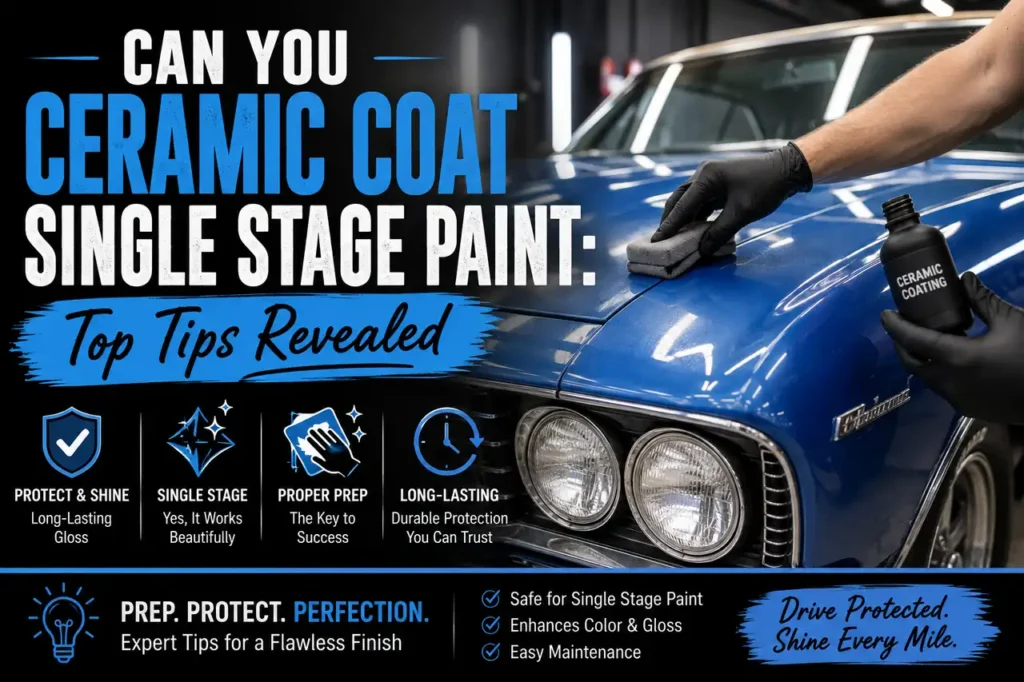
The biggest factor is preparation. Ceramic coating does not magically repair neglected paint. It preserves the condition underneath it, so oxidation, stains, swirls, and other defects should be addressed before the coating is applied. Proper washing, decontamination, paint correction when needed, and residue removal help create a clean surface for the coating to bond to.
What Is Single Stage Paint?
Single-stage paint is an automotive paint system in which the color and protective finish are combined into one layer.
This differs from a modern two-stage system, where a colored basecoat is covered with a separate clear coat.
Single-stage paint was commonly used on many older vehicles and is still used on some specialty applications.
One important characteristic is that the paint can be more vulnerable to oxidation because there isn’t a separate clear coat protecting the color layer.
Single-stage paint can also behave differently during polishing. Depending on the paint system, color may transfer onto the polishing pad because you are working directly on the colored paint rather than a transparent clear coat.
Can You Ceramic Coat Single Stage Paint?
Yes, single-stage paint can be ceramic coated.
In fact, ceramic coating can be particularly useful for older vehicles with properly restored single-stage paint because it adds a protective layer over the paint.
However, the condition of the paint should be evaluated before coating.
If the surface is heavily oxidized, chalky, contaminated, or covered in significant defects, applying ceramic coating immediately isn’t the best approach.
The coating could preserve those problems rather than eliminate them.
Why Ceramic Coat Single Stage Paint?
There are several reasons vehicle owners choose ceramic coating for single-stage paint.
1. Protection From Environmental Contamination
A ceramic coating can create a protective barrier between the paint and everyday environmental contaminants.
This can help make the surface easier to maintain.
2. Water Repellency
A quality ceramic coating can create strong hydrophobic behavior.
Water beads and runs away from the surface rather than spreading across the paint.
This can make washing and drying easier.
3. UV Protection
Single-stage paint can be vulnerable to oxidation and fading, particularly when a vehicle spends significant time outdoors.
Ceramic coatings can provide additional UV resistance and help protect the finish from environmental exposure.
4. Easier Maintenance
The smoother, more hydrophobic coated surface can make it easier to remove dirt and road grime during routine washing.
5. Improved Appearance
A properly prepared single-stage finish can look dramatically better after correction and coating.
The coating itself doesn’t replace paint correction, but it can enhance the appearance of a well-prepared surface.
Single Stage Paint vs Clear-Coated Paint
Understanding the difference helps explain why preparation matters.
| Feature | Single Stage Paint | Basecoat + Clear Coat |
|---|---|---|
| Color and protection | Combined | Separate layers |
| Separate clear coat | No | Yes |
| Oxidation sensitivity | Generally higher | Generally lower |
| Polishing behavior | Color may transfer | Clear coat is polished |
| Ceramic coating possible | Yes | Yes |
| Preparation importance | Very high | Very high |
| Correction approach | More delicate | More predictable |
Single-stage paint needs special attention because polishing directly affects the colored paint layer.
How to Tell If Your Vehicle Has Single Stage Paint
If you’re unsure what type of paint your vehicle has, don’t immediately start polishing a visible panel.
Check the vehicle’s documentation or paint information first.
Another traditional detailing method involves testing a small, inconspicuous area with a mild polish and clean microfiber.
If the towel or pad picks up the color of the vehicle, that can indicate you’re working directly on a single-stage paint layer. If there is no color transfer, the vehicle may have a clear coat.
However, paint systems can vary, so a professional assessment is preferable when you’re uncertain.
How to Prepare Single Stage Paint for Ceramic Coating
Preparation is arguably the most important part of the entire process.
Step 1: Inspect the Paint
Start by examining the vehicle in good lighting.
Look for:
- Oxidation
- Swirl marks
- Scratches
- Water spots
- Stains
- Faded areas
- Previous repairs
- Embedded contamination
Don’t decide on the correction process until you understand the condition of the paint.
Step 2: Wash the Vehicle
Thoroughly wash the vehicle to remove loose dirt and road grime.
Use a gentle washing method that minimizes unnecessary contact with the paint.
Don’t begin polishing a dirty vehicle because contamination can create additional defects.
Proper washing should come before decontamination and correction.
Step 3: Decontaminate the Surface
Washing alone may not remove everything.
Depending on the vehicle’s condition, you may need to address:
- Iron particles
- Tar
- Industrial fallout
- Tree contamination
- Embedded road grime
Use appropriate chemical and mechanical decontamination methods carefully.
Avoid unnecessarily aggressive treatment on older or delicate paint.
Step 4: Evaluate Oxidation
Oxidation is particularly important with single-stage paint.
A heavily oxidized surface may look:
- Dull
- Chalky
- Hazy
- Faded
- Uneven
Ceramic coating isn’t a replacement for restoring badly oxidized paint.
If the surface needs correction, do that before coating.
Should You Polish Single Stage Paint Before Ceramic Coating?
Usually, yes, if the paint needs correction.
However, single-stage paint should be polished carefully.
Unlike a clear-coated vehicle, you’re directly removing material from the colored paint layer.
A light polish may be enough to restore clarity on a vehicle with minor oxidation and swirls.
More severe oxidation may require a stronger correction process.
The goal isn’t to remove every possible imperfection. The goal is to achieve an appropriate finish while preserving as much original paint as reasonably possible.
Current detailing guidance emphasizes that coatings preserve the condition underneath them, making paint inspection and correction important before application.
How to Polish Single Stage Paint
If you’re experienced with machine polishing, use a conservative approach.
Start With a Test Spot
Choose a small section.
Test your least aggressive combination first.
For example, begin with a finishing polish and appropriate pad before moving to a stronger compound.
Check the Results
Inspect the test area under good lighting.
Ask:
- Did the oxidation improve?
- Did the gloss return?
- Are swirls reduced?
- Is the paint still healthy?
- Is additional correction necessary?
Increase Aggressiveness Only If Needed
Don’t immediately reach for the strongest compound.
Single-stage paint can require careful material management because there is no separate clear coat to work through.
Monitor the Pad
Color transfer can occur during polishing.
That’s normal with many single-stage paint systems, but excessive heat or aggressive polishing should still be avoided.
What If the Single Stage Paint Is Heavily Oxidized?
This is where you should slow down.
Heavily oxidized paint may require substantial correction before coating.
You may need:
- Thorough washing
- Chemical decontamination
- Careful mechanical decontamination
- Paint inspection
- Oxidation removal
- Refinement polishing
- Residue removal
- Final inspection
- Ceramic coating
If the paint is extremely thin, damaged, cracking, or failing, polishing may not be the appropriate solution.
In that situation, professional evaluation is recommended.
How to Prepare the Paint After Polishing
Once correction is finished, don’t immediately apply ceramic coating.
The surface needs to be clean and free from polishing residue.
Polishing can leave behind:
- Oils
- Abrasive residue
- Dust
- Lubricants
- Product residue
These materials can interfere with coating bonding.
A dedicated panel-preparation product or the coating manufacturer’s recommended preparation method can help create a clean surface.
How to Ceramic Coat Single Stage Paint
Once the paint is properly prepared, the coating can be applied.
Step 1: Work in a Controlled Environment
Ideally, work in a:
- Clean garage
- Dry environment
- Dust-controlled area
- Shaded location
Avoid direct sunlight.
Temperature and humidity can affect how quickly a coating flashes and cures.
Step 2: Read the Coating Instructions
Don’t assume every ceramic coating works the same way.
Check the manufacturer’s requirements for:
- Temperature
- Humidity
- Application method
- Flash time
- Wipe-off timing
- Curing
- Water exposure
Step 3: Work in Small Sections
Apply the coating to a manageable section rather than attempting an entire vehicle at once.
Step 4: Apply Evenly
Use the recommended applicator and application pattern.
Avoid excessively heavy application.
Step 5: Monitor the Flash
Watch the coating carefully.
The correct wipe-off timing varies between products and environmental conditions.
Step 6: Level the Coating
Use clean microfiber towels to remove excess coating according to the manufacturer’s instructions.
Step 7: Inspect the Panel
Check for:
- Streaks
- Smears
- High spots
- Uneven residue
- Missed sections
Good lighting is extremely useful here.
Step 8: Allow It to Cure
Keep the vehicle protected during the initial curing period.
Follow the specific coating manufacturer’s instructions rather than using a generic curing time.
Top Tips for Ceramic Coating Single Stage Paint
Tip 1: Don’t Coat Dirty Paint
Even small amounts of contamination can interfere with the coating process.
Tip 2: Don’t Rush Oxidation Removal
If the paint is heavily oxidized, spend time determining the safest correction approach.
Tip 3: Start With Gentle Polishing
Test a mild combination before using an aggressive compound.
Tip 4: Preserve Original Paint
Single-stage paint can be limited, especially on older vehicles.
Don’t chase every deep scratch if doing so would require excessive material removal.
Tip 5: Use Proper Surface Preparation
A clean, residue-free surface is critical for coating performance.
Tip 6: Work Panel by Panel
This gives you greater control over application and wipe-off.
Tip 7: Watch for High Spots
Inspect the coating from multiple angles before it fully cures.
Tip 8: Don’t Work in Direct Sunlight
Direct sunlight can make the coating flash too quickly and make leveling difficult.
Tip 9: Use Clean Towels
Keep multiple clean microfiber towels available.
A contaminated towel can create additional problems.
Tip 10: Follow the Coating Instructions
The manufacturer’s instructions should always take priority over generic detailing advice.
Can Ceramic Coating Fix Oxidized Single Stage Paint?
No.
Ceramic coating is a protective product, not an oxidation-removal system.
If the paint is oxidized, the surface should generally be restored first.
Some products can be used to restore heavily oxidized single-stage surfaces before additional protection is applied, but the process depends on the condition and type of paint.
A ceramic coating is best viewed as a way to protect a properly prepared surface rather than a way to repair neglected paint.
Can Ceramic Coating Make Single Stage Paint Look Better?
Yes, but most of the visual improvement comes from proper preparation and correction.
If an old single-stage vehicle is:
- Cleaned
- Decontaminated
- Carefully polished
- Properly refined
- Thoroughly prepared
the difference can be dramatic.
The ceramic coating then helps preserve that finish and adds water-repellent and protective properties.
In other words, don’t expect the bottle of ceramic coating to perform the restoration work.
Can You Ceramic Coat Old Single Stage Paint?
Yes, provided the paint is in suitable condition.
Age alone doesn’t automatically prevent ceramic coating.
However, older vehicles may have:
- Oxidation
- Previous repainting
- Thin paint
- Failing paint
- Uneven repairs
- Contamination
A careful inspection should come before coating.
For classic or collectible vehicles, preserving original paint may be more important than achieving maximum correction.
Is Ceramic Coating Safe for Single Stage Paint?
Generally, yes, when the coating is intended for automotive paint and the surface is properly prepared.
The more important question is whether the paint itself is healthy enough to receive the coating.
If the paint is failing or severely degraded, coating may not solve the underlying problem.
Always follow the coating manufacturer’s compatibility and application instructions.
Ceramic Coating vs Wax for Single Stage Paint
Both can protect paint, but they offer different approaches.
| Feature | Ceramic Coating | Wax |
|---|---|---|
| Durability | Generally longer | Generally shorter |
| Water repellency | Strong | Moderate to strong |
| Application | Requires careful prep | Usually simpler |
| Maintenance | Easier after curing | Requires more frequent reapplication |
| Appearance | Gloss and clarity | Warm gloss depending on product |
| Correction before application | Very important | Important but less demanding |
| Best for | Long-term protection | Traditional protection and appearance |
For a carefully restored single-stage vehicle, ceramic coating can be an attractive long-term protection option.
Ceramic Coating vs Paint Sealant
A paint sealant generally provides shorter-term protection than a ceramic coating, although the exact performance depends on the product.
For owners who enjoy regularly detailing their vehicle, a sealant may be perfectly adequate.
For someone seeking longer-lasting hydrophobic protection and reduced maintenance, ceramic coating can be more appealing.
Common Mistakes to Avoid
Applying Ceramic Coating Over Oxidation
Don’t use ceramic coating as a shortcut around paint restoration.
Skipping Decontamination
Embedded contaminants can remain underneath the coating.
Using Too Much Polish
Single-stage paint should be corrected conservatively.
Chasing Every Scratch
Deep scratches may not be worth aggressively removing if preserving paint is the priority.
Leaving Polishing Oils Behind
Residue can interfere with coating bonding.
Applying Too Much Coating
More product doesn’t necessarily mean more protection.
Ignoring Flash Time
Incorrect timing can create high spots and uneven areas.
Working in Direct Sunlight
Heat can make application much more difficult.
Using Dirty Microfiber Towels
Always use clean towels throughout the process.
How to Maintain Ceramic-Coated Single Stage Paint
After the coating has cured, maintenance is relatively straightforward.
Wash Regularly
Regular gentle washing prevents heavy contamination from building up.
Use a Suitable Car Shampoo
Choose a shampoo that is compatible with ceramic-coated surfaces.
Avoid Automatic Brushes
Aggressive brushes can introduce unnecessary marring.
Dry Carefully
Use clean microfiber drying towels or an appropriate touchless drying method.
Remove Bird Droppings Quickly
Don’t allow aggressive contaminants to sit on the surface unnecessarily.
Avoid Abrasive Polishes
Once the coating is installed, don’t polish the vehicle casually.
Polishing can remove or compromise the coating.
Inspect the Finish Regularly
Watch for changes in water behavior, contamination, or coating performance.
Is Ceramic Coating Worth It for Single Stage Paint?
For many owners, yes.
It’s particularly appealing if you’ve already invested time restoring the paint.
Single-stage paint can benefit from additional protection because the colored paint layer is directly exposed to the environment.
A properly applied coating can help reduce contamination, improve water behavior, make maintenance easier, and provide additional environmental protection.
However, the quality of the result depends heavily on preparation.
A mediocre coating on beautifully prepared paint can still perform reasonably well, while an expensive coating applied over contaminated or oxidized paint can disappoint.
When Should You Hire a Professional?
Consider professional installation if:
- The vehicle is a classic
- The paint is heavily oxidized
- The paint has been repeatedly polished
- You aren’t sure whether the vehicle has single-stage paint
- The vehicle has valuable original paint
- You have never polished automotive paint
- You have never installed ceramic coating
- The paint has significant defects
- You don’t have a suitable controlled workspace
Single-stage paint can be less forgiving than modern clear-coated finishes, particularly when correction is involved.
FAQs
Can you ceramic coat single stage paint?
Yes. Single-stage automotive paint can be ceramic coated when it is properly cleaned, corrected if necessary, and prepared according to the coating manufacturer’s instructions.
Does ceramic coating protect single stage paint?
Yes. It can provide additional protection against environmental contamination, water, UV exposure, and everyday grime.
Should you polish single stage paint before ceramic coating?
If the paint has oxidation, swirls, or other defects, correction is generally recommended before coating. The coating will preserve the condition of the surface underneath it.
Can ceramic coating remove oxidation?
No. Oxidation should be addressed before the coating is applied.
Does single stage paint need a clear coat before ceramic coating?
No. Ceramic coating can be applied directly to properly prepared single-stage paint. A separate clear coat isn’t required simply to install ceramic coating.
Can you ceramic coat old single stage paint?
Yes, provided the paint is structurally sound and suitable for coating. Heavily degraded or failing paint should be professionally evaluated first.
Will ceramic coating make single stage paint glossy?
It can enhance the appearance and gloss of a properly prepared finish, depending on the coating, but the biggest improvement usually comes from cleaning and paint correction.
Can you polish single stage paint?
Yes, but polishing needs to be approached carefully because you’re working directly on the colored paint layer.
Why does paint color transfer when polishing single stage paint?
Because the color is part of the exposed paint layer rather than being protected beneath a separate clear coat. Color transfer can therefore occur during polishing.
Can ceramic coating prevent scratches?
No. Ceramic coating can provide some resistance to light surface marring, but it does not make automotive paint scratch-proof.
Can ceramic coating prevent rock chips?
No. If rock-chip protection is your priority, paint protection film is a more appropriate solution.
How long does ceramic coating last on single stage paint?
Longevity depends on the coating, preparation, environmental conditions, vehicle use, and maintenance. Always use the manufacturer’s stated durability as the reference for a particular product.
Final Verdict
Can you ceramic coat single stage paint? Yes, and it can be an excellent way to protect a properly restored finish. The key is understanding that single-stage paint requires more careful preparation because there is no separate clear coat protecting the color layer.
Start with a thorough wash and decontamination, inspect the paint carefully, correct oxidation and defects only as necessary, and remove polishing residue before applying the coating. Ceramic coating should be the final protective step, not a substitute for paint restoration. Proper preparation has a major influence on coating bonding, appearance, and durability.
If you’re working on a classic or valuable vehicle, take an especially conservative approach. Preserve as much original paint as possible, test your polishing method before committing to the entire vehicle, and follow the ceramic coating manufacturer’s application and curing instructions. With the right preparation and technique, ceramic coating can help keep single-stage paint looking richer, cleaner, and better protected for longer.