
The human heart is one of the most fascinating organs in the body and a popular subject for artists, students, and medical illustrators. Unlike the simple heart symbol often used in designs and greeting cards, a real human heart has a unique structure with chambers, vessels, curves, and textures that make it both challenging and rewarding to draw.
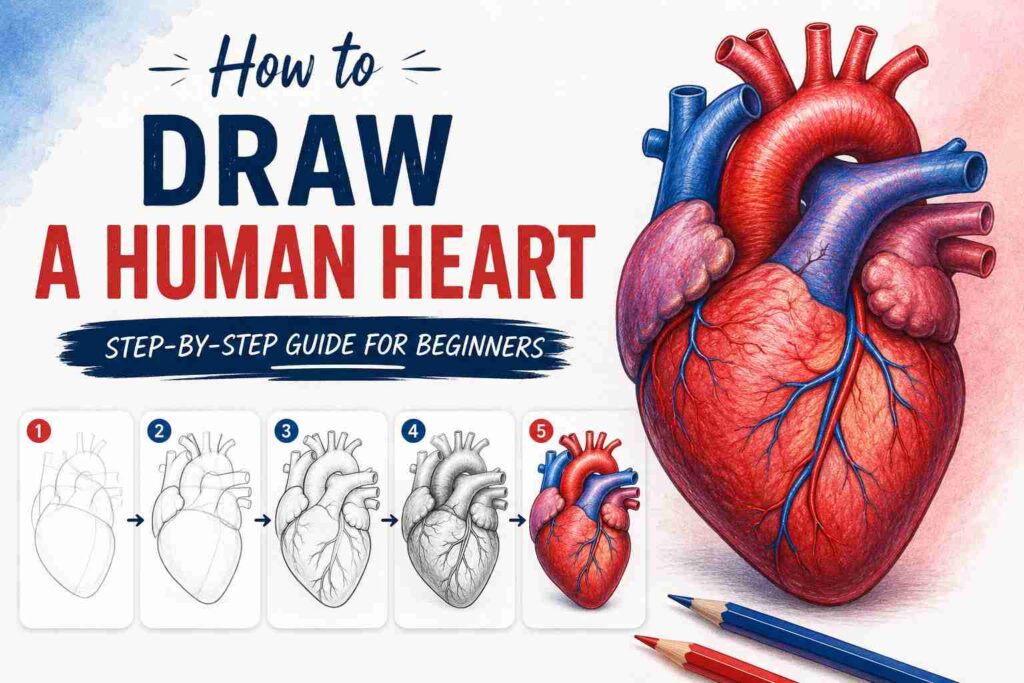
Learning how to draw a human heart can improve your understanding of anatomy while helping you develop observation, shading, and sketching skills. By breaking the heart into simple shapes and adding details gradually, even beginners can create an impressive anatomical drawing.
Things You’ll Need
Before you begin, gather the following materials.
Essential Drawing Supplies
- Pencil
- Eraser
- Drawing paper
- Sharpener
- Ruler (optional)
Optional Supplies
- Colored pencils
- Markers
- Fine-tip black pen
- Charcoal pencils
- Digital drawing tablet
Different Ways to Draw a Human Heart
There are several artistic approaches you can take.
Simple Anatomical Heart
Perfect for beginners learning basic heart structure.
Realistic Human Heart
Focuses on anatomy, texture, and shading.
Medical Illustration
Includes detailed labels and scientific accuracy.
Cartoon Anatomical Heart
Simplifies the structure while keeping recognizable features.
Tattoo-Style Heart
Uses bold outlines and decorative elements.
Educational Diagram
Designed for biology projects and classroom use.
Digital Heart Illustration
Uses advanced lighting and rendering techniques.
Why Learn How to Draw a Human Heart?
Drawing a human heart helps artists and students develop valuable skills.
Benefits include:
- Understanding basic anatomy
- Improving observation skills
- Practicing organic shapes
- Learning shading techniques
- Developing attention to detail
- Building confidence in scientific illustration
Because the heart combines structure and organic forms, it provides excellent drawing practice.
Understanding Human Heart Anatomy
Before drawing, it helps to understand the major parts of the heart.
Key features include:
- Left ventricle
- Right ventricle
- Left atrium
- Right atrium
- Aorta
- Pulmonary arteries
- Major veins
- Muscular walls
You don’t need to memorize every part to create a recognizable heart drawing, but understanding the overall structure will improve accuracy.
How to Draw a Human Heart Step by Step
Step 1: Sketch the Basic Shape
Begin by drawing a large irregular oval.
The bottom should taper slightly to form a rounded point.
This creates the overall heart structure.
Step 2: Define the Upper Section
Draw two rounded bulges near the top.
These areas represent the upper chambers and provide the characteristic shape of the heart.
Keep the lines soft and organic.
Step 3: Sketch the Main Outline
Refine the outer contour of the heart.
Notice that a real heart is asymmetrical and slightly tilted.
Avoid making it perfectly balanced.
Step 4: Draw the Aorta
At the top center, sketch a large curved tube extending upward.
The aorta is one of the most recognizable blood vessels connected to the heart.
Step 5: Add Major Blood Vessels
Draw additional tubes branching from the top portion.
These represent arteries and veins entering and leaving the heart.
Vary their sizes slightly.
Step 6: Shape the Ventricles
Add gentle contour lines within the lower section.
These help indicate the muscular chambers.
Keep the details simple at first.
Step 7: Add Surface Contours
Sketch curved lines across the heart’s surface.
These lines suggest the natural folds and divisions of the organ.
Step 8: Refine the Vessel Connections
Connect the major vessels smoothly to the main body of the heart.
Avoid sharp angles.
Organic transitions appear more realistic.
Step 9: Add Texture Details
Draw subtle grooves, folds, and muscular patterns.
Real hearts have visible surface textures that add depth.
Step 10: Clean Up the Sketch
Review the proportions and erase unnecessary construction lines.
Refine any areas that appear uneven.
Step 11: Ink the Drawing
Trace the final outline using a fine-tip pen or darker pencil.
Allow the ink to dry before erasing remaining pencil marks.
Step 12: Add Base Colors
Color the heart using shades such as:
- Dark red
- Crimson
- Burgundy
- Pink-red
Use slightly different tones for vessels and surrounding structures.
Step 13: Apply Shading
Darken recessed areas and regions beneath overlapping structures.
Use gradual shading to create a realistic three-dimensional effect.
Step 14: Add Highlights
Leave lighter areas where light naturally strikes the surface.
Highlights help create volume and realism.
Step 15: Finish the Artwork
Review the drawing and strengthen important details.
Add labels if creating an educational illustration.
Your human heart drawing is now complete.
Easy Human Heart Drawing Ideas
Need inspiration? Try one of these creative projects.
Simple Anatomy Study
Focus on the basic structure and major vessels.
Medical Diagram
Label the heart chambers and arteries.
Realistic Heart Illustration
Use detailed shading and textures.
Educational Poster
Create a classroom-friendly anatomy chart.
Tattoo-Inspired Design
Combine anatomy with decorative artwork.
Mixed Media Heart Art
Use watercolor, ink, and colored pencils together.
Common Mistakes to Avoid
Drawing a Symbol Instead of an Anatomical Heart
A real heart has a complex, asymmetrical shape.
Making the Vessels Too Small
Major arteries and veins should be clearly visible.
Ignoring Surface Texture
Subtle grooves help create realism.
Using Flat Shading
Layered shading gives the heart depth and dimension.
Overcomplicating the First Sketch
Start with simple shapes before adding details.
Tips for Drawing a Realistic Human Heart
Study Anatomical References
Reference images improve accuracy and understanding.
Build With Basic Shapes
Begin with simple forms before refining details.
Focus on Proportions
The heart should appear balanced and naturally shaped.
Use Layered Shading
Gradual value changes create a realistic appearance.
Practice Frequently
Anatomical drawing improves with repetition and observation.
Final Thoughts
Learning how to draw a human heart is a rewarding project that combines art and anatomy. Whether you’re creating an educational illustration, practicing realistic drawing techniques, or exploring medical art, understanding the heart’s structure will help you produce more accurate and impressive artwork.
By following this step-by-step guide and practicing regularly, you’ll gain confidence in drawing one of the most important and recognizable organs in the human body.
Frequently Asked Questions
Is a human heart difficult to draw?
It can seem complex at first, but breaking it into simple shapes makes it much easier for beginners.
What is the most important part of a heart drawing?
The overall shape and major blood vessels are the key features that make an anatomical heart recognizable.
What colors should I use?
Most anatomical heart illustrations use shades of red, burgundy, crimson, and pink-red.
Do I need to know anatomy to draw a heart?
Basic knowledge helps, but beginners can create a recognizable heart by following simple step-by-step instructions.
Can students use this guide for school projects?
Yes. This guide is suitable for educational and biology-related assignments.
How do I make a heart drawing look realistic?
Use accurate proportions, subtle textures, smooth shading, and well-placed highlights to create depth and realism.
its was so easy to draw