
Drawing an iris flower is a beautiful way to practice curves, layering, and delicate details. Its unique petal shapes make it both challenging and rewarding for beginners.
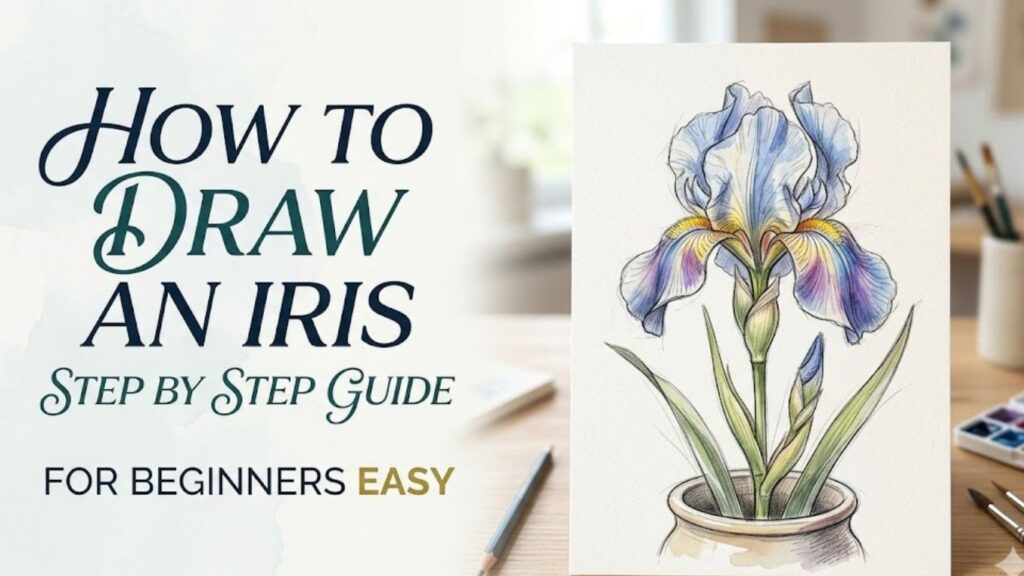
In this guide, you’ll learn how to draw an iris step by step in a simple and enjoyable way. With practice, you’ll be able to create elegant and realistic floral drawings.
Essential Drawing Supplies You Should Have
Sketchbook
HB and 2B pencils
Eraser
Black fineliner pen
Colored pencils or markers
Simple Tips Before You Start Drawing
Before you begin, practice drawing soft curves and wavy lines. Iris petals have flowing edges, so smooth strokes are important.
Keep your lines light at first so you can easily fix mistakes. Focus on the overall shape before adding details.
How to Draw an Iris Step by Step Guide for Beginners
1. Understanding the Structure of an Iris
Learn the Basic Form
An iris flower has three upright petals and three outer petals that curve downward.
The petals are layered and slightly ruffled, giving the flower a unique appearance.
At the center, there is a small structure that connects all petals.
Breaking the iris into these parts makes it easier to draw.
Understanding the structure helps you place each petal correctly and create a balanced drawing.
2. Drawing the Basic Guidelines
Start with Simple Shapes
Begin by drawing a small circle in the center. This will guide the placement of petals.
Then sketch light lines extending outward to mark where each petal will go.
These guidelines help maintain symmetry and balance.
Keep your lines light and simple.
This step creates a strong foundation for your drawing.
3. Drawing the Upright Petals
Add the Top Layer
Draw three upright petals extending from the center.
Each petal should have a slightly pointed tip and wavy edges.
Keep the shapes soft and natural.
These petals form the top layer of the iris.
Take your time to make them balanced and evenly spaced.
4. Adding the Outer Petals
Create Flowing Shapes
Now draw three outer petals that curve downward.
These petals are larger and more open than the upright ones.
Use flowing, curved lines to create a natural look.
The outer petals add volume and depth to the flower.
This step helps your iris look full and realistic.
5. Refining the Petal Shapes
Smooth and Adjust
Go over your sketch and refine the shapes of the petals.
Add gentle curves and adjust proportions if needed.
Erase unnecessary guidelines.
Make sure all petals connect naturally to the center.
This step turns your rough sketch into a cleaner drawing.
6. Drawing the Stem and Leaves
Complete the Structure
Draw a long, thin stem extending downward from the flower.
Add long, narrow leaves on either side of the stem.
Leaves should be slightly curved for a natural look.
This step completes the basic structure of your iris.
It also adds balance to your composition.
7. Adding Petal Details
Enhance Texture
Draw fine lines inside each petal to show texture and veins.
These lines usually flow from the base outward.
Keep them light and subtle.
Adding these details makes your drawing more realistic.
Small touches can greatly improve the overall look.
8. Refining the Outline
Clean Up Your Drawing
Erase any remaining guidelines and smooth out your lines.
Go over the final outline with a darker pencil or pen.
Make sure all shapes are clear and well-defined.
This step gives your drawing a polished appearance.
9. Shading and Depth
Make It Look 3D
Decide where your light source is coming from.
Add shading along the folds and edges of the petals.
Use soft strokes and blend gently.
Shading adds depth and dimension to your drawing.
It helps your iris look more realistic.
10. Coloring Your Iris
Bring It to Life
Iris flowers are often purple, blue, or yellow.
Use multiple shades to create depth and highlights.
Blend colors smoothly for a natural look.
Coloring enhances your drawing and adds vibrancy.
Take your time and enjoy this step.
11. Drawing Different Iris Styles
Explore Creativity
Try drawing irises in different angles or stages of bloom.
You can also experiment with different color combinations.
Practicing different styles helps improve your skills.
It also allows you to develop your own artistic style.
The more you practice, the more confident you’ll become.
12. Common Mistakes to Avoid
Learn and Improve
One common mistake is drawing petals too stiff. Keep them flowing and natural.
Another mistake is uneven spacing between petals.
Avoid adding too many details too early.
Skipping shading can make your drawing look flat.
Being aware of these mistakes helps you improve faster.
13. Practice Tips for Beginners
Build Your Skills
Practice drawing iris flowers regularly using simple shapes.
Start with quick sketches to build confidence.
Observe real flowers to understand their structure.
Try different tools like pencils, pens, and markers.
Consistency is key to improvement.
Frequently Asked Questions
Is drawing an iris difficult for beginners?
It may seem complex, but breaking it into simple steps makes it manageable.
What is the first step in drawing an iris?
Start with basic guidelines and a center point for the petals.
How can I make my drawing look realistic?
Focus on smooth curves, petal details, and shading.
Should I draw every detail?
No, keep details simple and add more as you improve.
How long does it take to learn?
With regular practice, you can improve within a few days.
Final Words
Drawing an iris is a wonderful way to practice curves, layers, and details. By following step-by-step techniques, you can create elegant and realistic floral drawings.
Keep practicing, experiment with styles, and enjoy the process. Every drawing you complete helps you grow as an artist.