
Learning how to draw a flamingo is a fun way to practice elegant curves, long legs, and graceful animal proportions. Flamingos have a distinctive curved neck, long slender legs, large wings, and a uniquely shaped beak. Although their anatomy may look complicated at first, you can break the bird into simple shapes and lines.
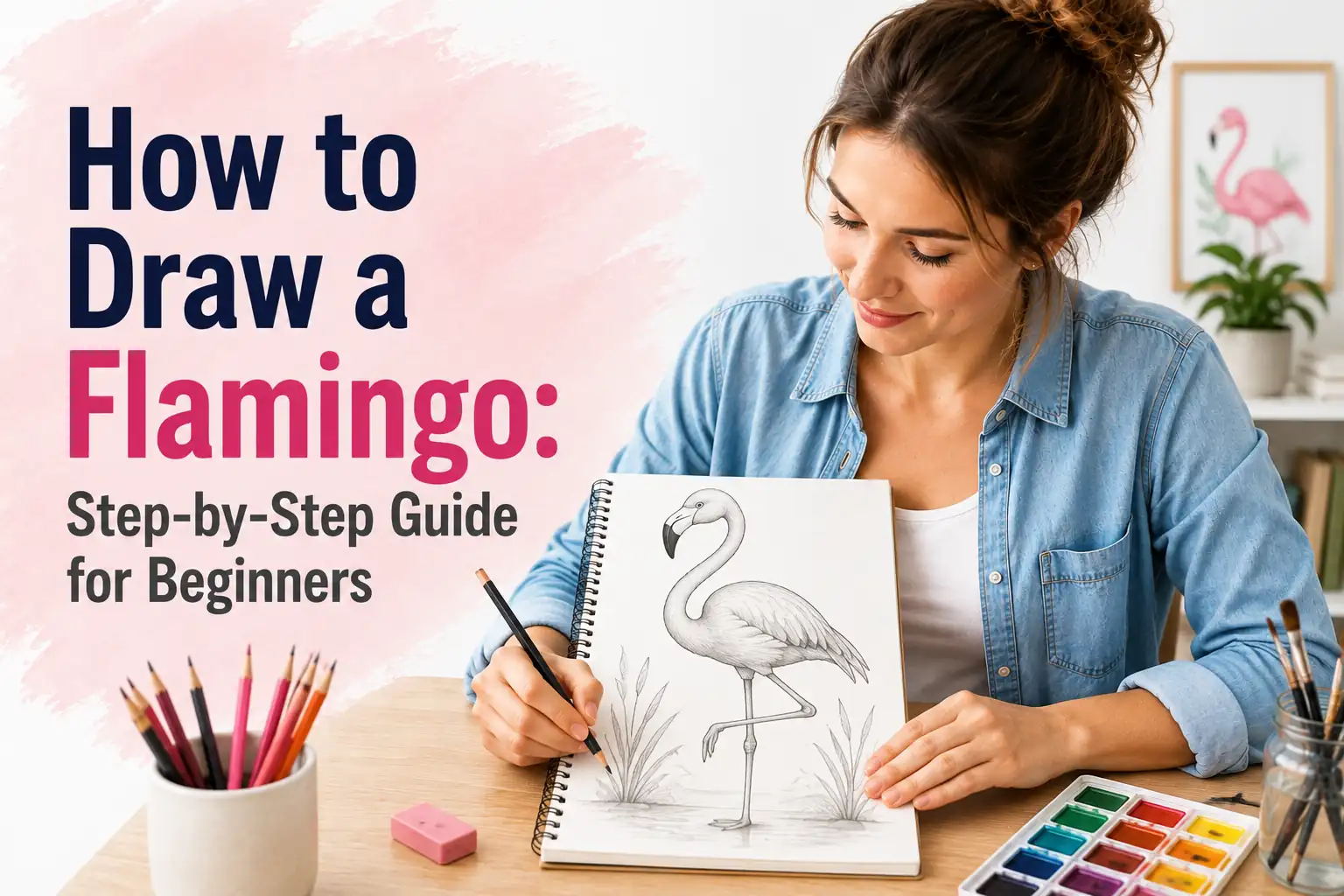
The easiest approach is to sketch the body first, then build the neck, head, beak, wings, and legs around it. After the basic structure is complete, add feathers, shading, and color. Whether you want a cute cartoon flamingo or a more realistic bird, these beginner-friendly steps will help you create a beautiful illustration.
Items to Buy
- Drawing paper
- HB pencil
- 2B pencil
- 4B pencil
- Eraser
- Kneaded eraser
- Sharpener
- Fine-tip black pen
- Pink colored pencil
- Light pink colored pencil
- Dark pink colored pencil
- Orange colored pencil
- Black colored pencil
- White colored pencil
- Blue colored pencil
- Green colored pencil
Why Draw a Flamingo?
Flamingos are excellent subjects for learning how to draw birds with unusual proportions.
Drawing one can help you practice:
- Curved lines
- Bird anatomy
- Long legs
- Feather shapes
- Beak structure
- Body proportions
- Balance
- Shading
- Color layering
- Simple backgrounds
The curved neck and long legs also make flamingos instantly recognizable.
How to Draw a Flamingo Step by Step
Step 1: Sketch the Main Body
Begin with a large oval for the flamingo’s body.
Keep it slightly tilted depending on the pose you want. A horizontal or slightly diagonal oval works well for a standing flamingo.
Use light pencil strokes because you’ll build the rest of the bird around this shape.
Step 2: Draw the Curved Neck
Flamingos have long, graceful necks.
From the upper body, draw two long curved lines that rise upward and then bend forward.
Keep the neck relatively narrow.
The two lines should follow similar curves while leaving enough space between them for the neck.
Step 3: Add the Head
Draw a small rounded head at the end of the neck.
Keep the head noticeably smaller than the body.
A slight forward tilt can make the flamingo look more natural and graceful.
Step 4: Draw the Beak and Eye
Flamingos have long, curved beaks.
Extend the beak forward from the head and curve its tip downward.
Divide the beak into two sections, then darken the lower or tip portion to create the characteristic black marking.
Add one small eye above the beak.
Step 5: Add the Wing
Sketch a large wing over the side of the body.
Use a curved outer shape that follows the body’s contour.
Then add several layered feather shapes inside the wing.
Keep the feather lines flowing in the same direction.
Step 6: Draw the Long Legs
Add two long, slender legs beneath the body.
Use narrow, slightly curved lines.
Flamingo legs are much longer than their body width, so don’t be afraid to make them tall.
Depending on the pose, one leg can remain straight while the other bends backward.
Step 7: Add the Feet and Refine the Shape
At the bottom of each leg, add the webbed feet.
Keep the feet relatively small but recognizable.
Now refine the body, neck, head, and wing. Erase construction lines that are no longer needed.
Step 8: Add Feathers and Details
Use short, curved strokes to suggest feathers across the body.
Add smaller feathers around the neck and wing.
Don’t outline every feather individually. Grouping them into layers will create a cleaner and more natural appearance.
Step 9: Add Color, Shading, and Highlights
Begin with a light pink base.
Layer darker pink around the wing, underside of the body, neck, and legs.
Use orange or coral tones around the beak and legs.
Keep some areas lighter to create highlights.
For realistic artwork, use several pink shades instead of one flat color.
Step 10: Finish the Background
Complete your flamingo with a simple environment.
You could place it:
- In shallow water
- Beside a lake
- On a tropical beach
- Among reeds
- In a wetland
- Against a sunset
Add reflections in the water if your flamingo is standing in a pond or lake.
How to Draw a Cute Flamingo
For a cute cartoon flamingo, make the head slightly larger and the eyes bigger.
Use a simplified body and exaggerated curved neck.
You can add a cheerful expression, tiny flowers, hearts, or a colorful tropical background.
Bright pink colors work especially well for a playful illustration.
How to Draw a Realistic Flamingo
For a realistic flamingo, focus on proportions and the graceful shape of the neck.
Pay attention to the transition between the body and legs.
Use layered feather strokes instead of solid blocks of color.
Add darker pink around the wing and areas where feathers overlap.
How to Draw a Flamingo Standing on One Leg
Start with the body and neck as usual.
Draw one long leg straight beneath the body.
Then bend the second leg backward and tuck it close to the body.
Keep the tucked leg slightly thinner so the pose looks natural.
This is one of the most recognizable flamingo poses.
How to Draw a Flamingo in Water
Draw the flamingo standing with its feet partially submerged.
Add gentle horizontal lines around the legs to show ripples.
A reflection beneath the bird can add depth.
Use soft blue and green tones for the water while keeping the flamingo’s pink body as the focal point.
How to Draw a Flamingo With Colored Pencils
Start with a light pink base layer.
Add darker pink to the wing and underneath the body.
Use coral or orange around the legs and upper beak.
The beak tip can be shaded black.
Layer colors gradually instead of pressing heavily from the beginning.
How to Draw a Flamingo With Watercolors
Begin with a light pencil outline.
Apply a pale pink wash across the body.
Once dry, layer stronger pink around the wing and shadows.
Use a fine brush for feather details.
Add orange, gray, or black to the beak and soft blue-green washes to the background.
How to Make Flamingo Feathers Look Realistic
Avoid drawing every feather as an individual shape.
Instead, create overlapping groups of feathers.
Use lighter strokes on the upper body and darker strokes underneath the wing.
Follow the direction of the feathers as they curve around the body.
This creates texture without making the drawing look crowded.
Common Mistakes to Avoid
Making the Neck Too Thick
Keep the neck long and relatively slender.
Making the Legs Too Short
Long legs are one of the flamingo’s defining characteristics.
Forgetting the Curved Beak
The beak should curve downward toward the tip.
Making the Head Too Large
For realistic drawings, keep the head relatively small compared with the body.
Using Only One Pink Shade
Layering different pink tones gives the bird much more depth.
Drawing Every Feather Individually
Use grouped feather shapes for a cleaner result.
Easy Flamingo Drawing Ideas
Cute Cartoon Flamingo
Use oversized eyes, simplified shapes, and bright pink colors.
Flamingo on One Leg
Create the classic balanced standing pose.
Flamingo in Water
Add ripples and a reflection beneath the bird.
Tropical Flamingo
Place it among palm leaves, flowers, and tropical plants.
Sunset Flamingo
Use a warm sunset background behind the bird.
Realistic Flamingo
Focus on feather layering, proportions, shading, and natural colors.
FAQs
Is a flamingo easy to draw?
Yes. Although flamingos have unusual proportions, their body can be simplified into an oval, curved neck, long legs, and a few basic shapes.
What should I draw first?
Start with the body, then establish the curved neck before adding the head, beak, wing, and legs.
How do I draw a flamingo’s neck?
Use two long, smooth curved lines that rise from the body and bend forward toward the head.
How do I draw a flamingo’s beak?
Create a long beak that curves downward. Add a darker section toward the tip.
What colors should I use?
Pink, coral, orange, black, white, and soft gray work well for a flamingo illustration.
How do I make a flamingo look realistic?
Pay attention to its long proportions, graceful neck, layered feathers, curved beak, slender legs, and subtle pink shading.
How do I draw a cute flamingo?
Make the eyes larger, simplify the feathers, round the body, and use bright pink colors.
Can beginners draw a flamingo?
Absolutely. Start with basic shapes and gradually add the characteristic neck, beak, wings, legs, and feathers.
What pencil should I use?
An HB pencil is ideal for the initial sketch, while 2B and 4B pencils are useful for darker details and shading.
Final Words
Learning how to draw a flamingo becomes much easier when you break its elegant shape into simple forms. Begin with the rounded body, build the long curved neck, and then add the small head, distinctive beak, large wing, and slender legs. Once the proportions look right, feather details, pink layers, and gentle shading can bring your flamingo to life.
After mastering the basic standing pose, try drawing a flamingo balancing on one leg, wading through water, or standing against a tropical sunset. With regular practice, you’ll become more comfortable creating graceful curves, long animal proportions, layered feathers, and colorful backgrounds.