
Finding the best markers for drawing depends on the kind of artwork you enjoy creating. Some markers are designed for smooth color blending and illustration, while others are better for precise outlines, expressive brush strokes, or adding opaque details. Choosing the right type can make sketching, character design, comic illustration, and everyday drawing much more enjoyable.
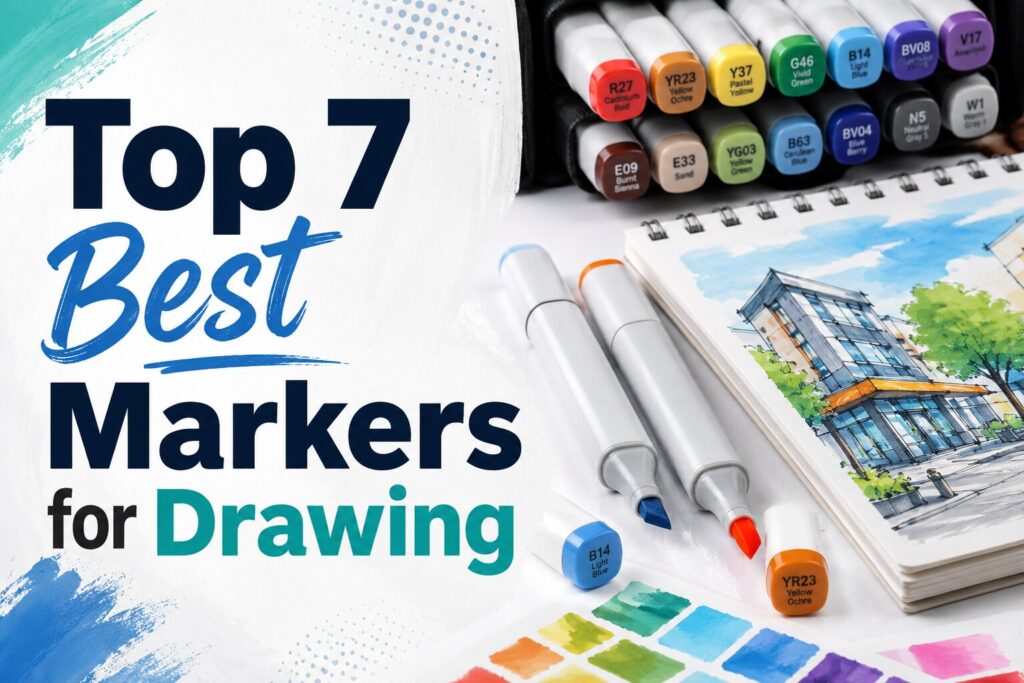
Alcohol markers are excellent for filling large areas and creating gradients, while pigment fineliners help produce crisp outlines. Water-based brush pens offer flexible strokes, and acrylic paint markers add bold colors to different surfaces. In this guide, we’ll explore seven drawing markers from different brands and explain what each one does best.
Top Picks: Best Markers for Drawing
- Best Overall: Ohuhu Honolulu Alcohol Markers – A versatile option for colorful illustrations, blending, and character artwork.
- Best Premium Markers: Copic Sketch Markers – Professional-style refillable markers for detailed illustrations and smooth color transitions.
- Best for Versatile Illustration: Winsor & Newton ProMarker – Dual-ended markers for coloring, sketching, and controlled line work.
- Best for Fine Details: Sakura Pigma Micron Pens – Pigment fineliners for precise outlines, hatching, and intricate details.
- Best Acrylic Paint Markers: Uni POSCA Paint Markers – Opaque paint markers for bold artwork, highlights, and mixed-media projects.
- Best Brush Pens: Tombow Dual Brush Pens – Flexible brush tips for expressive drawing, lettering, and colorful illustrations.
- Best for Sketching and Inking: Faber-Castell Pitt Artist Pens – Pigment-based artist pens for expressive lines, outlines, and detailed drawings.
Affiliate disclosure: As an Amazon Associate I earn from qualifying purchases.
Comparison Table: Best Markers for Drawing
| Product Name | Best For | Check Price |
|---|---|---|
| Ohuhu Honolulu Alcohol Markers | Blending and colorful illustrations | Check on Amazon |
| Copic Sketch Markers | Premium illustration work | Check on Amazon |
| Winsor & Newton ProMarker | Versatile drawing and coloring | Check on Amazon |
| Sakura Pigma Micron Pens | Fine lines and intricate details | Check on Amazon |
| Uni POSCA Paint Markers | Opaque color and mixed media | Check on Amazon |
| Tombow Dual Brush Pens | Brush strokes and lettering | Check on Amazon |
| Faber-Castell Pitt Artist Pens | Sketching and inking | Check on Amazon |
These links lead to Amazon product searches rather than verified individual product listings. Check the current listing for the exact set, tip styles, color count, and package contents before purchasing.
1. Ohuhu Honolulu Alcohol Markers – Best Overall
Ohuhu Honolulu Alcohol Markers are a popular option for artists who want to create colorful illustrations with smooth-looking transitions between shades. Alcohol-based ink is especially useful for blending, layering, and coloring larger areas without the slower drying associated with some water-based markers.
The Honolulu range is available in different color collections and configurations. Depending on the set, you may find brush and chisel tips, making it possible to switch between detailed strokes and broader coverage.
The brush tip is useful for drawing curved shapes, clothing folds, hair, and character illustrations. The chisel tip helps cover larger sections more quickly. This combination makes the markers practical for beginners who want to explore different drawing techniques as well as experienced hobby artists.
One important consideration is paper. Alcohol ink can bleed through ordinary sketchbook pages, so marker paper or a suitable heavyweight sheet is a better choice. Place a protective sheet behind your artwork to prevent ink from transferring to the next page.
Pros
- Suitable for colorful illustrations and character art
- Alcohol ink supports blending and layering
- Different tip styles offer drawing flexibility
- Available in multiple color collections
- Useful for beginners and hobby artists
Cons
- Can bleed through ordinary paper
- Some colors may look different after drying
- Large sets require more storage space
Best For: Artists who want versatile alcohol markers for illustration, coloring, shading, and creative sketching.
2. Copic Sketch Markers – Best Premium Markers
Copic Sketch Markers are a premium choice for artists who regularly create illustrations, character designs, comics, and professional-style artwork. They are known for their blendable alcohol-based ink and flexible brush tips.
A major advantage is their refillable design. Instead of replacing an entire marker when the ink runs out, compatible Copic ink refills can extend the life of the marker. Replacement nibs are also available for compatible models.
The flexible brush nib is useful for creating both broad and narrow strokes. The opposite end has a chisel nib for filling larger areas and making more controlled marks. This dual-ended arrangement gives artists several ways to work with one marker.
Copic Sketch markers are particularly useful when color consistency matters. Artists can build layered shading, blend related colors, and develop more detailed illustrations. However, the initial investment is higher than many beginner marker sets.
Pros
- Refillable marker design
- Replaceable nibs
- Flexible brush and chisel tips
- Suitable for detailed illustration and blending
- Available in an extensive color range
Cons
- More expensive than many beginner alternatives
- Requires suitable paper to control bleeding
- A large collection can be costly to build
Best For: Serious hobbyists, illustrators, comic artists, and professionals who want a refillable marker system.
3. Winsor & Newton ProMarker – Best for Versatile Illustration
Winsor & Newton ProMarker is a versatile option for artists who want alcohol-based markers for sketching, coloring, and illustration. Its dual-ended design provides two different ways to apply color, making it useful for both smaller details and broader areas.
The fine bullet tip is helpful for controlled lines, small shapes, and precise coloring. The broader chisel tip can cover larger sections and create wider strokes. This combination is convenient when drawing objects, fashion illustrations, architectural sketches, and decorative artwork.
Alcohol-based ink can be layered to create depth and shading. You can start with lighter colors, add darker shades to areas that need definition, and blend related tones while the ink is workable.
ProMarker is worth considering if you want an established art-marker range without necessarily choosing a refillable premium system. As with other alcohol markers, use suitable paper and test the colors before applying them to finished artwork.
Pros
- Dual-ended design
- Fine and broad marking options
- Suitable for illustration and coloring
- Alcohol ink supports layering
- Available in individual colors and sets
Cons
- Can bleed through regular paper
- Does not offer the same refill system as Copic Sketch
- Some blending techniques require practice
Best For: Artists who want dual-ended markers for everyday illustration, sketching, and coloring.
4. Sakura Pigma Micron Pens – Best for Fine Details
Sakura Pigma Micron Pens are designed for precise line work rather than broad areas of colorful coverage. They are especially useful when drawing requires clean outlines, small details, controlled hatching, or intricate patterns.
These fineliners use pigment-based ink and are available in different tip sizes. Smaller tips help create delicate lines, while wider options are useful for stronger outlines and more noticeable details.
They are particularly valuable for illustration workflows that combine ink outlines with colored markers. For example, you can draw the outline of a character using a Micron pen and then add color with alcohol markers. Allow the ink to dry fully and check compatibility on a test sheet before coloring over it.
Micron pens are also useful for architectural sketches, botanical drawings, comic details, technical-style illustrations, and handwritten annotations.
Unlike alcohol markers, these pens are not designed to fill large areas quickly. Their strength is precision.
Pros
- Designed for precise line work
- Available in multiple tip sizes
- Pigment-based ink
- Useful for outlines, hatching, and details
- Works well alongside many coloring tools
Cons
- Not intended for large color areas
- Fine tips require careful handling
- Small nibs can wear if used on rough surfaces
Best For: Illustrators, sketch artists, and anyone who needs clean outlines and intricate details.
5. Uni POSCA Paint Markers – Best Acrylic Paint Markers
Uni POSCA Paint Markers are different from ordinary alcohol and water-based drawing markers. They use opaque water-based paint ink, making them useful when you want colors that stand out clearly rather than transparent layers.
They are available in different tip sizes, from fine points for small details to broader tips for filling larger areas. This makes them suitable for illustrations, lettering, decorative artwork, and mixed-media projects.
One of their main advantages is the ability to create visible marks on dark or colored surfaces when the surface is compatible with the marker. White POSCA markers are particularly useful for adding highlights to drawings, creating small reflective details, and emphasizing areas that need brighter color.
The paint-like ink needs to be shaken and primed according to the manufacturer’s instructions. It is important to test the marker on your intended material because surface compatibility and permanence can vary.
Pros
- Opaque paint-style colors
- Useful for highlights on dark surfaces
- Available in different tip sizes
- Suitable for mixed-media artwork
- Can be used on various compatible surfaces
Cons
- Requires proper preparation before use
- Not ideal for smooth alcohol-marker blending
- Paint flow needs to be controlled
- Drying and permanence depend on the surface
Best For: Artists who want opaque colors, bright highlights, and paint-marker effects in their drawings.
6. Tombow Dual Brush Pens – Best Brush Pens
Tombow Dual Brush Pens are a good option for artists who enjoy expressive lines and flexible brush strokes. They combine a flexible brush tip with a fine tip, giving you two different marking styles in one pen.
The brush tip responds to pressure. Light pressure creates thinner strokes, while greater pressure produces broader lines. This makes the pens useful for lettering, decorative illustrations, floral drawings, and expressive sketching.
Their water-based ink can also be used for certain blending and watercolor-style techniques. With a suitable paper and a little water, you can soften colors and create gentle transitions. However, results depend on the paper and how much moisture you use.
These markers are particularly helpful when you want more movement in your drawing rather than the consistent line width of a traditional fineliner.
Pros
- Flexible brush tip
- Fine tip for smaller details
- Useful for lettering and illustration
- Water-based ink supports selected blending techniques
- Available in a wide range of colors
Cons
- Brush control takes practice
- Not designed for alcohol-marker-style blending
- Excess water can damage thin paper
Best For: Artists interested in brush lettering, floral illustrations, expressive lines, and colorful sketchbook work.
7. Faber-Castell Pitt Artist Pens – Best for Sketching and Inking
Faber-Castell Pitt Artist Pens are useful for artists who want dependable pigment-based pens for drawing and sketching. They are available in different nib styles, including fine, brush, and broader options, depending on the specific pen and collection.
The range is particularly suitable for line drawings, outlines, cross-hatching, and expressive illustrations. Brush versions can create varied line widths, while smaller tips help with controlled details.
Pitt Artist Pens are also useful for mixed-media artwork because their pigment-based ink is designed for lasting, water-resistant marks after drying under the appropriate conditions. If you plan to combine them with watercolor or other wet media, test the exact pen and paper combination first.
One benefit of this range is that you can choose the nib style according to your drawing technique rather than relying on one type of marker for every task.
Pros
- Pigment-based artist ink
- Different nib styles available
- Useful for sketching and inking
- Suitable for detailed illustrations
- Brush versions offer expressive line variation
Cons
- Not intended for smooth alcohol-marker blending
- Individual nib styles serve different purposes
- Fine tips need careful handling
Best For: Artists who create line drawings, sketches, illustrations, and detailed ink artwork.
Buying Guide: How to Choose the Best Markers for Drawing
The right markers depend on your drawing style, preferred paper, and the kind of results you want. Consider these important factors before choosing a set.
1. Understand the Different Marker Types
Markers use different ink formulas, and each type has its own strengths.
- Alcohol markers: Useful for smooth-looking color transitions, layered shading, and colorful illustrations.
- Water-based markers: Suitable for sketching, lettering, and certain watercolor-style effects.
- Pigment fineliners: Designed for precise outlines, cross-hatching, and small details.
- Acrylic paint markers: Provide opaque marks and are useful for highlights and mixed-media artwork.
- Brush pens: Offer flexible strokes that change width according to pressure.
If you mainly draw colorful characters, alcohol markers may be a good starting point. For line art, fineliners are more suitable.
2. Choose the Right Tip Style
The marker tip affects the way you draw and how much control you have.
Brush tip: Flexible and useful for expressive strokes, curved lines, and variable line thickness.
Fine tip: Ideal for outlines, small details, lettering, and controlled sketching.
Chisel tip: Useful for filling larger areas, creating broad strokes, and working on backgrounds.
Bullet tip: Provides a consistent line width and is useful for general drawing and smaller shapes.
A dual-ended marker can be convenient because it combines two tip styles in one tool.
3. Consider the Ink Type
The ink determines how the marker behaves on paper.
Alcohol ink dries relatively quickly and is popular for blending and layering. However, it can bleed through thin paper.
Water-based ink is often easier to use for lettering and lighter sketchbook work. Some water-based markers can also be blended with water.
Pigment ink is useful for crisp line work and illustrations where defined outlines matter.
Acrylic paint ink provides more opaque coverage and can be useful for bright details or dark paper.
4. Check the Color Selection
A large color collection can be useful, but more colors do not automatically mean better drawing results.
Beginners can start with a smaller set containing primary colors, secondary colors, neutral shades, and a few light and dark tones. This provides enough variety to practice shading and color mixing.
If you draw portraits, look for suitable skin-tone collections. For landscapes, greens, blues, browns, and earth tones may be more useful.
5. Choose Markers That Match Your Paper
Paper makes a significant difference in marker performance.
- Alcohol marker paper: Helps control ink absorption and supports blending.
- Smooth drawing paper: Suitable for many fineliners and water-based markers.
- Mixed-media paper: Useful when combining several drawing techniques.
- Watercolor paper: Better suited to water-based brush pens and water-related effects.
- Toned paper: Useful for drawings that combine dark outlines with opaque highlights.
Always test a marker on a spare sheet before using it on finished artwork.
6. Think About Lightfastness and Longevity
If you create artwork for display or sale, consider whether the ink is designed to resist fading. Lightfastness varies significantly between marker types and product ranges.
Check the manufacturer’s information rather than assuming every marker in a particular category has the same permanence. Keep finished artwork away from prolonged direct sunlight and follow suitable storage or framing practices.
7. Consider Refill Options
Some premium markers are refillable, which can reduce the need to replace an entire marker when the ink runs out. Replacement nibs can also extend the useful life of certain products.
If you draw regularly, refill availability may be worth considering. For occasional sketching, an affordable non-refillable set may be perfectly adequate.
How to Use Markers for Drawing
Using markers effectively takes practice, but a few basic techniques can help you achieve cleaner lines and more consistent colors.
Step 1: Start With a Light Pencil Sketch
Create a light outline of your subject before applying marker ink. This helps you plan the composition and reduces the need for corrections later.
Avoid pressing too hard with the pencil because dark graphite lines may remain visible beneath lighter marker colors.
Step 2: Test Your Markers
Make a small color chart on the same paper you plan to use for your drawing. This helps you see the actual dried color and understand how different markers behave.
Test for bleeding, streaking, and compatibility with other pens before starting the finished piece.
Step 3: Draw the Main Outlines
Use a suitable fineliner or marker to define the main shapes. Choose a line width that matches the scale of your drawing.
For detailed artwork, smaller tips provide greater control. For expressive illustrations, brush pens can create more varied outlines.
Step 4: Apply the Base Colors
Begin with lighter shades and fill the larger areas first. Use consistent strokes and avoid repeatedly coloring the same section while it is still wet.
If you’re using alcohol markers, work in manageable sections to help maintain more even coverage.
Step 5: Add Shadows and Highlights
Use darker shades to add depth around edges, folds, and areas that receive less light. A lighter marker or an opaque paint marker can help add highlights.
Think about the direction of the light source so the shadows and highlights remain consistent throughout the drawing.
Step 6: Blend Where Appropriate
Alcohol markers can be layered to create gradual color transitions. Work with related shades and practice on spare paper before blending your finished illustration.
Water-based brush pens may also create soft effects when used with suitable paper and controlled amounts of water.
Step 7: Add Fine Details
Once the main colors are dry, add small outlines, texture, facial features, patterns, and other details using fineliners or fine-tip markers.
Allow ink to dry before adding another medium over it, and test compatibility whenever you combine different marker types.
Common Mistakes to Avoid When Drawing With Markers
Using the Wrong Paper
Thin paper can cause bleeding, feathering, and uneven results. Choose paper that matches the ink type and place a protective sheet underneath when necessary.
Applying Too Much Ink
Repeatedly coloring the same area can create unwanted saturation and uneven patches. Build color gradually instead of forcing coverage with too many strokes.
Choosing Too Many Similar Colors
A large marker set may contain several shades that look almost identical. Start with a useful range of light, medium, and dark colors before expanding your collection.
Ignoring Tip Maintenance
Pressing too hard or using markers on rough surfaces can damage delicate tips. Store and use them according to the manufacturer’s instructions.
Mixing Incompatible Inks
Some dye-based inks can smear when another marker is applied over them. Test fineliners and coloring markers together before using them in finished artwork.
Forgetting to Protect the Next Page
Alcohol markers can transfer through paper. Place a protective sheet behind your drawing to avoid staining the pages underneath.
Frequently Asked Questions
What are the best markers for drawing?
Ohuhu Honolulu Alcohol Markers are a versatile choice for colorful illustrations and blending. Copic Sketch is a premium option, while Sakura Pigma Micron and Faber-Castell Pitt Artist Pens are useful for precise outlines and sketching.
Are alcohol markers better than water-based markers for drawing?
Neither is universally better. Alcohol markers are generally more suitable for smooth color blending and layered illustrations. Water-based markers are useful for lettering, expressive drawing, and certain watercolor-style effects.
What markers do professional artists use?
Professional artists use different markers depending on their medium. Copic Sketch and Winsor & Newton ProMarker are examples of alcohol-marker ranges, while Sakura Pigma Micron and Faber-Castell Pitt Artist Pens are useful for line work and inking.
Can beginners use alcohol markers?
Yes. Beginners can use alcohol markers to practice coloring, shading, and blending. A smaller set with a useful range of colors is often enough to learn the basics before investing in a larger collection.
What paper is best for drawing with markers?
Marker paper is a good choice for alcohol markers because it helps control ink absorption and supports blending. Smooth drawing paper works well for many fineliners and water-based pens. Always test the paper with your markers first.
Do alcohol markers bleed through paper?
Yes, alcohol markers can bleed through ordinary sketchbook paper. Use marker-friendly paper and place a protective sheet underneath your drawing to prevent ink from transferring to other pages.
Are paint markers good for drawing?
Yes. Acrylic paint markers such as Uni POSCA are useful for opaque colors, bold outlines, highlights, and mixed-media artwork. They are particularly helpful when you want a mark that stands out against a dark surface.
What markers are best for fine details?
Sakura Pigma Micron Pens are an excellent option for fine details because they come in different tip sizes. Faber-Castell Pitt Artist Pens also offer useful options for controlled line work and sketching.
Can you use fineliners with alcohol markers?
Yes, but choose a compatible waterproof pigment fineliner if you plan to color over the outlines. Let the ink dry fully and test the combination on spare paper to make sure it does not smear.
Are refillable markers worth buying?
Refillable markers can be worthwhile if you draw frequently and use the same colors regularly. They can reduce replacement costs over time, although the initial purchase price may be higher.
Final Words
The best markers for drawing depend on the type of artwork you want to create. Ohuhu Honolulu is a versatile choice for colorful illustrations, while Copic Sketch offers a premium refillable option. Winsor & Newton ProMarker is useful for general illustration, and Sakura Pigma Micron and Faber-Castell Pitt Artist Pens are excellent options for precise lines. For opaque highlights and expressive brush strokes, consider Uni POSCA and Tombow Dual Brush Pens.
Before choosing a set, think about the ink type, tip style, paper compatibility, and color range. You do not need every kind of marker to get started. A useful combination of color markers and a reliable fineliner can provide a strong foundation for developing your drawing skills.
Helpful Resources
- Strathmore: Paper and Art Surface Resources – Explore drawing and mixed-media paper options to help match your surface to your chosen markers.
- Copic: Official Marker Products and Information – Learn about Copic marker ranges, refill systems, and compatible accessories.