
The best pool paints can restore the appearance of a worn swimming pool, refresh faded colors, and help protect compatible pool surfaces from regular water exposure. However, choosing the right coating involves more than finding an attractive color. You need a product specifically formulated for swimming pools and compatible with your pool’s concrete, plaster, fiberglass, or existing paint.
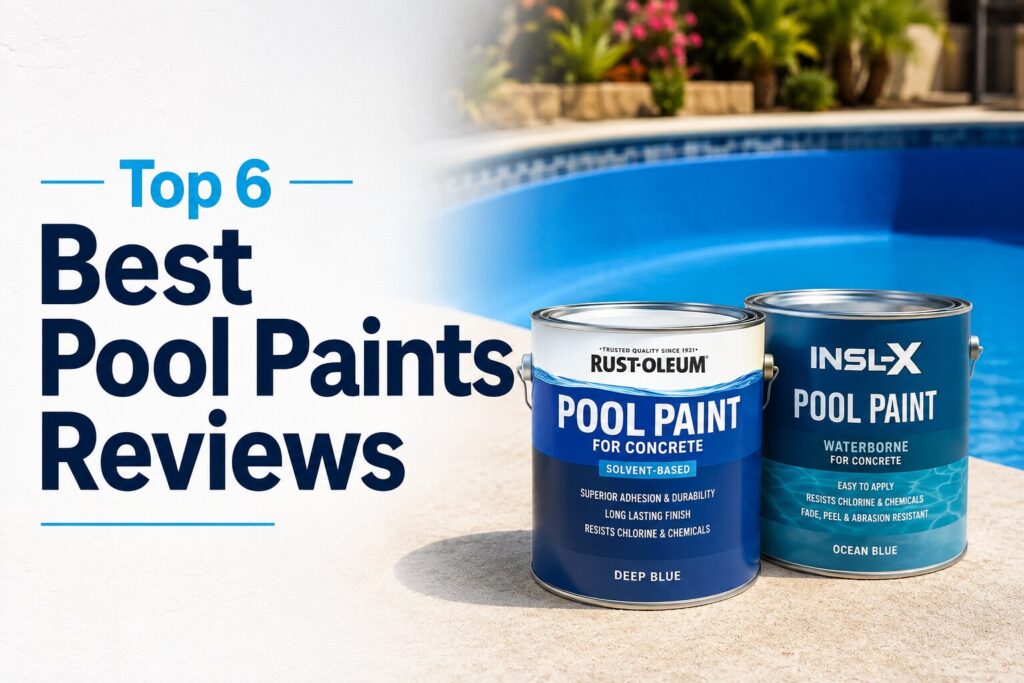
In this guide, we’ll compare six pool paints, including epoxy, water-based acrylic, and rubber-based options. We’ll also explain how pool paint cost varies, what to consider when painting concrete, and why ordinary concrete paint, chalk paint, and garage floor paint are not substitutes for products designed for continuous underwater use.
Top 6 Best Pool Paints at a Glance
| Product Name | Best For | Check Price |
|---|---|---|
| Ramuc Hi-Build Epoxy Pool Paint | Best Overall for Bare Concrete Pools | Check on Amazon |
| INSL-X Epoxy Pool Paint | Durable Epoxy Pool Finish | Check on Amazon |
| Olympic Zeron Pool Coating | High-Build Epoxy Protection | Check on Amazon |
| Ramuc DS Acrylic Pool Paint | Best Water-Based Acrylic Option | Check on Amazon |
| INSL-X Waterborne Pool Paint | Convenient Water-Based Recoating | Check on Amazon |
| Ramuc Type A-2 Pool Paint | Best Rubber-Based Option | Check on Amazon |
Affiliate disclosure: As an Amazon Associate I earn from qualifying purchases.
Top Picks: 6 Best Pool Paints Reviews
1. Ramuc Hi-Build Epoxy Pool Paint – Best Overall for Bare Concrete Pools
Check Ramuc Hi-Build Epoxy Pool Paint on Amazon
Ramuc Hi-Build Epoxy is a strong option to consider when you’re refinishing a concrete or plaster swimming pool and want a thick, durable epoxy coating. Unlike ordinary exterior paint, this product belongs to a category specifically developed for swimming pool surfaces.
Its high-build formulation is intended to create a substantial coating layer, making it worth considering for suitable pool surfaces that need a refreshed finish. Epoxy coatings are generally valued for their resistance to water exposure, pool chemicals, and everyday wear when properly applied and fully cured.
This product is particularly worth comparing for bare concrete, gunite, and compatible plaster surfaces. Before purchasing, confirm the exact substrate requirements and whether the pool needs a compatible primer. Rough or porous surfaces may require additional preparation to achieve an even result.
Another important consideration is the existing coating. You should never assume that a new epoxy product can be applied directly over an old acrylic or rubber-based pool finish. The existing coating must be identified, and incompatible layers may need to be removed.
Pros:
- High-build epoxy coating system.
- Designed for compatible swimming pool surfaces.
- Worth considering for concrete and plaster pools.
- Suitable for projects where a durable finish is important.
- Available in pool-specific color options.
- Useful for planned pool renovation projects.
Cons:
- Requires careful surface preparation.
- Application involves more steps than many water-based paints.
- Existing coatings must be compatible.
- Full curing can require several days before filling the pool.
Our Verdict: Ramuc Hi-Build Epoxy is our leading option for a suitable bare concrete or plaster pool renovation. Its high-build epoxy formulation makes it worth comparing when durability is a priority. Follow the current product data sheet for surface preparation, coverage, and filling instructions.
2. INSL-X Epoxy Pool Paint – Best for a Durable Epoxy Pool Finish
Check INSL-X Epoxy Pool Paint on Amazon
INSL-X Epoxy Pool Paint is another product worth considering when you want a dedicated epoxy coating for a swimming pool. Epoxy pool paints are designed to create a hard finish that can withstand the demanding conditions inside a properly maintained pool.
This type of coating is particularly relevant for pool owners renovating compatible concrete, plaster, or other manufacturer-approved surfaces. It can provide a smooth, attractive appearance while offering resistance to pool chemicals and regular cleaning when the complete coating system is applied correctly.
One important feature of two-part epoxy paint is that it generally requires mixing a resin and hardener. Once combined, the product has a limited working time, so you need to organize the application before mixing.
INSL-X also offers other pool coating products, including waterborne and rubber-based options. Make sure you select the actual epoxy version rather than confusing it with a different formulation from the same manufacturer.
Before application, inspect the pool for loose paint, cracks, surface contamination, and moisture problems. A coating cannot repair structural damage or stop water entering through the pool shell.
Pros:
- Dedicated epoxy pool coating.
- Hard, durable finish when properly applied.
- Useful for compatible pool renovation projects.
- Designed for demanding pool conditions.
- Worth considering for concrete and other approved substrates.
- Available from an established architectural coatings manufacturer.
Cons:
- Two-part mixing requires careful preparation.
- Limited working time after mixing.
- Existing coating compatibility must be checked.
- Requires complete curing before filling the pool.
Our Verdict: INSL-X Epoxy Pool Paint is worth comparing if you want an epoxy finish for a compatible swimming pool. It is especially relevant for renovation projects where a hard, chemical-resistant coating is preferred over a simpler acrylic finish.
3. Olympic Zeron Pool Coating – Best High-Build Epoxy Protection
Check Olympic Zeron Pool Coating on Amazon
Olympic Zeron is a high-build epoxy pool coating designed for specific swimming pool renovation applications. It is worth considering if you want a substantial coating system rather than an ordinary thin decorative paint.
The product is part of Olympic’s pool coating range, which includes different systems for concrete, plaster, fiberglass, and other approved pool surfaces. Zeron is particularly relevant when the manufacturer’s surface preparation and primer requirements match your project.
A high-build coating can be useful when renovating a compatible pool surface, but the quality of the finished result depends heavily on preparation. The surface must be properly cleaned and prepared, and any required primer must be applied according to the manufacturer’s instructions.
Olympic also offers other epoxy products, including Poxolon 2. These products should not be treated as identical simply because they belong to the same manufacturer’s range. Compare their application instructions, coverage, and compatibility before choosing.
Remember that epoxy pool paint is not the same as garage floor paint. Even though both may use epoxy chemistry, swimming pool coatings are formulated for immersion conditions. A garage floor coating should never be substituted unless its manufacturer specifically approves continuous underwater use.
Pros:
- High-build epoxy pool coating.
- Designed for specific pool renovation systems.
- Worth comparing for compatible pool surfaces.
- Suitable for projects requiring a substantial coating layer.
- Part of a dedicated swimming pool coating range.
- Offers an alternative to conventional thin-film finishes.
Cons:
- Requires careful preparation and application.
- May require a compatible primer.
- Not appropriate for every existing pool coating.
- Professional application may be preferable for complex renovations.
Our Verdict: Olympic Zeron is a strong product to investigate when you’re planning a more substantial epoxy pool renovation. Check the current technical instructions to confirm that your pool surface and existing coating are suitable.
4. Ramuc DS Acrylic Pool Paint – Best Water-Based Acrylic Option
Check Ramuc DS Acrylic Pool Paint on Amazon
Ramuc DS Acrylic Pool Paint is a useful option for pool owners who prefer a water-based acrylic coating. Compared with many two-part epoxy products, water-based acrylic pool paint can offer a more straightforward application and cleanup process.
This product is designed for compatible concrete and plaster pool surfaces. It can be particularly appealing when you’re refreshing an existing pool finish and want a water-based alternative to solvent-based coatings.
Acrylic pool paint is generally selected for convenience, easier cleanup, and a relatively simple application process. However, it typically does not provide the same expected service life as a properly installed high-quality epoxy system. You should consider the long-term maintenance schedule when comparing the options.
Before buying, check whether your existing pool coating is acrylic or another compatible finish. Although acrylic products can be suitable for certain recoating situations, compatibility still depends on the exact formulation and condition of the old coating.
For the best result, remove loose paint, clean away chalky residue, and prepare the surface according to the product instructions. Do not apply a new coating over peeling paint and expect it to remain attached.
Pros:
- Water-based acrylic formulation.
- Designed for compatible swimming pool surfaces.
- Convenient cleanup compared with solvent-based products.
- Useful for certain pool repainting projects.
- Suitable for owners who prefer a simpler application process.
- Worth considering for concrete and plaster pools.
Cons:
- Generally shorter service life than quality epoxy systems.
- Requires suitable surface preparation.
- Existing coating compatibility must be confirmed.
- May require more frequent repainting.
Our Verdict: Ramuc DS Acrylic is worth considering if you want a water-based pool coating for a compatible concrete or plaster surface. It is a practical alternative when easier application and cleanup matter more than achieving the longest possible coating life.
5. INSL-X Waterborne Pool Paint – Best for Convenient Water-Based Recoating
Check INSL-X Waterborne Pool Paint on Amazon
INSL-X Waterborne Pool Paint is another option for people who prefer a water-based swimming pool coating. Its formulation makes it worth comparing for compatible pool renovation projects where easier cleanup and application are priorities.
One advantage of a waterborne coating is that it can be more convenient to work with than certain solvent-based alternatives. Cleanup is generally simpler, and the product can be appealing to homeowners who want to avoid the handling requirements associated with some solvent-based pool paints.
The product is intended for specific pool surfaces and recoating situations. Its compatibility with an existing finish should be checked before application rather than assuming that every water-based pool paint can cover every previous coating.
A waterborne pool paint may also be considered when the surface is not perfectly dry, but this does not mean you can paint over standing water, wet contamination, or an active leak. Follow the manufacturer’s exact moisture and surface-preparation requirements.
If you are comparing concrete paint for a patio or basement with pool paint, remember that the two products have different purposes. Pool coatings must tolerate continuous immersion and swimming pool chemicals.
Pros:
- Waterborne formulation.
- Convenient cleanup.
- Designed specifically for pool coating applications.
- Worth considering for compatible repainting projects.
- Practical alternative to some solvent-based coatings.
- Available from an established coatings manufacturer.
Cons:
- Not suitable for every pool surface or existing coating.
- Requires careful cleaning and preparation.
- May have a shorter expected service life than epoxy.
- Full curing is necessary before filling the pool.
Our Verdict: INSL-X Waterborne Pool Paint is a practical option to compare when you want a water-based coating for a compatible pool. Check the product data sheet for the approved surfaces, moisture conditions, and required curing period.
6. Ramuc Type A-2 Pool Paint – Best Rubber-Based Option
Check Ramuc Type A-2 Pool Paint on Amazon
Ramuc Type A-2 is a rubber-based swimming pool coating worth considering for pool owners who already have a compatible rubber-based finish. It offers an alternative to epoxy and acrylic systems and is intended for specific pool surfaces and repainting situations.
Rubber-based pool paints are often selected for their compatibility with certain older rubber-based coatings. This makes them relevant when you’re maintaining a pool that was previously painted with chlorinated or synthetic rubber paint.
However, the existing coating must be identified before you purchase a replacement. Applying rubber-based paint over an incompatible epoxy or acrylic finish can lead to adhesion problems, peeling, or coating failure.
This product is also worth comparing for compatible concrete and plaster pool projects. Make sure the surface is clean, dry, and free from loose or chalky material before application.
Because rubber-based products can contain solvents, read the safety information carefully. Use the ventilation and protective equipment specified by the manufacturer, and keep the product away from ignition sources.
Pros:
- Rubber-based swimming pool coating.
- Useful for compatible existing rubber finishes.
- Worth considering for approved concrete and plaster surfaces.
- Offers an alternative to epoxy and acrylic systems.
- Designed for pool-specific applications.
- Available in pool coating color options.
Cons:
- Not compatible with every previous coating.
- Solvent-related handling precautions may apply.
- Usually has a shorter expected life than quality epoxy.
- Requires thorough surface preparation.
Our Verdict: Ramuc Type A-2 is a good product to compare when your pool already has a compatible rubber-based coating. It is not a universal replacement paint, so identify the existing finish before purchasing.
Buying Guide: How to Choose the Best Pool Paint
Choosing the right pool paint requires careful attention to the pool’s construction, previous coating, expected durability, and application conditions. Here are the most important factors to consider.
1. Identify Your Pool Surface
Start by determining what your pool is made from. Different materials require different coating systems.
- Concrete: Many concrete pools can use approved epoxy, acrylic, or rubber-based pool coatings.
- Gunite: Certain epoxy and other pool-specific systems are suitable when the manufacturer approves the application.
- Plaster: Pool paints are available for compatible plaster and marcite surfaces.
- Fiberglass: Use a pool coating specifically approved for fiberglass, commonly an appropriate epoxy system.
- Metal: Some specialized epoxy products are approved for steel pools, often with a required primer.
Do not assume that a paint labeled for concrete will automatically work on plaster, fiberglass, or metal. Check the manufacturer’s approved substrate list.
2. Choose Between Epoxy, Acrylic, and Rubber-Based Pool Paint
Pool paint generally falls into three main categories. Each has different application requirements and performance characteristics.
Epoxy pool paint
Epoxy is often selected when durability and resistance to pool chemicals are major priorities. Two-part epoxy products require mixing and careful application, and they usually need a longer curing period before the pool can be filled.
Water-based acrylic pool paint
Acrylic pool paint is generally easier to clean up and can be convenient for certain repainting projects. It may be a suitable option when the existing coating and pool surface are compatible, although its expected service life is usually shorter than that of a quality epoxy system.
Rubber-based pool paint
Rubber-based pool paint can be useful for compatible concrete and plaster surfaces, particularly when the previous coating is also rubber-based. Compatibility is essential because it should not be treated as a universal coating.
Choose the formulation according to the actual pool surface and previous paint rather than selecting only by price.
3. Check the Existing Pool Coating
This is one of the most important steps in any pool painting project.
A pool that has already been painted may have an epoxy, acrylic, chlorinated rubber, or synthetic rubber finish. These coating types are not automatically interchangeable.
As a general starting point:
- Epoxy is commonly applied over bare, properly prepared surfaces or compatible existing epoxy.
- Rubber-based coatings generally need a compatible rubber-based surface.
- Acrylic products may be suitable for certain existing coating types, depending on the specific product.
If you do not know what was previously used, consult the coating manufacturer or a qualified pool professional. Applying an incompatible coating can cause peeling and expensive repairs.
4. Consider Pool Paint Cost
Pool paint cost depends on the coating chemistry, container size, coverage, number of coats, surface condition, and preparation requirements.
A lower-priced acrylic product may be less expensive initially, while a two-part epoxy system can cost more upfront. However, comparing only the price per gallon does not show the full cost of a pool renovation.
Consider these expenses:
- Pool paint or coating kits.
- Primer, when required.
- Cleaning and preparation products.
- Crack and surface repair materials.
- Brushes, rollers, and other application equipment.
- Protective equipment.
- Professional labor, if needed.
- Water, refilling, and pool treatment costs.
You should also consider how often the pool may need repainting. A coating with a higher initial cost could offer better value if it lasts longer under the actual conditions.
To estimate the quantity of paint, calculate the pool’s interior surface area and compare it with the manufacturer’s coverage per gallon. Rough or porous surfaces may require more product than smooth surfaces.
5. Choose the Right Color
Pool paint colors affect the appearance of the water and the overall swimming area.
Popular choices include:
- Light blue: Creates a classic swimming pool appearance.
- White: Gives the pool a bright, clean look.
- Aqua: Produces a fresh, tropical appearance.
- Dark blue: Creates a deeper-looking water color.
- Gray: Offers a modern and understated finish.
Remember that the apparent water color also depends on pool depth, sunlight, surrounding surfaces, and water conditions. Always review the manufacturer’s available colors and samples before making a decision.
6. Check Coverage and Number of Coats
Coverage varies considerably between epoxy, acrylic, and rubber-based products. The surface condition also affects how much paint you need.
Bare concrete may absorb more coating than a previously painted, smooth surface. Rough plaster and porous areas can also increase consumption.
Before purchasing, check:
- Coverage per gallon or kit.
- Recommended number of coats.
- Whether primer is required.
- Recoat time.
- Whether the product needs a special application tool.
Buy enough product to complete the job using the same coating system. Running short halfway through can create problems if you cannot obtain the same formulation or color.
7. Consider Drying and Curing Time
A pool coating must be ready for immersion before the pool is filled. Touch-dry paint is not necessarily fully cured.
Check the product label for the complete curing schedule. The required time can vary according to the paint type, air temperature, humidity, surface conditions, and number of coats.
Do not rush this stage. Filling a pool too early can cause blistering, peeling, or other coating problems.
8. Inspect the Pool for Moisture Problems
Before painting, check the pool shell for cracks, leaks, groundwater pressure, and other moisture-related issues.
Paint is not a structural repair product. If water is entering through the pool shell or pressure is pushing against the coating from behind, even a high-quality epoxy may fail.
Repair underlying problems and allow the surface to meet the manufacturer’s moisture requirements before applying the coating.
9. Do Not Substitute Ordinary Concrete or Garage Floor Paint
Pool paint and concrete paint are not necessarily interchangeable. Ordinary concrete paint may be designed for patios, basement walls, or other surfaces that do not remain underwater.
The same distinction applies to garage floor paint. A two-part epoxy garage coating may be formulated to withstand vehicle tires, abrasion, and spills, but that does not mean it can tolerate continuous water immersion and swimming pool chemicals.
Chalk paint is even less suitable as a pool coating. It is primarily a decorative product for furniture and craft surfaces, not a swimming pool finish.
Always choose a coating whose manufacturer specifically approves it for your pool’s surface and continuous immersion conditions.
10. Decide Whether Professional Application Is Necessary
Painting a pool can be a demanding project because the preparation requirements are extensive. The pool must be drained safely, cleaned, repaired, and prepared according to the selected coating system.
A DIY application may be manageable for some straightforward projects, but professional assistance is worth considering when:
- The existing coating is unknown.
- The pool has widespread peeling.
- The concrete or plaster is damaged.
- The surface has moisture problems.
- A two-part epoxy system requires careful mixing.
- The pool has a complex shape or large surface area.
A professional can also help determine whether painting is appropriate or whether the pool needs resurfacing instead.
How to Paint a Concrete Swimming Pool
Proper preparation is essential for a successful pool painting project. The following steps provide a general overview. Always follow the specific instructions for your chosen pool coating because preparation requirements differ between products.
Step 1: Drain the Pool Safely
Drain the pool according to local requirements and the manufacturer’s guidance. Groundwater pressure can cause an empty in-ground pool to lift or shift, so consult a pool professional if there is any risk.
Do not assume that draining is safe simply because the pool is scheduled for repainting.
Step 2: Inspect the Pool Surface
Look for peeling paint, cracks, loose plaster, damaged concrete, and other defects.
Identify the existing coating type before selecting a replacement. If the pool has several layers of unknown paint, professional assessment may be necessary.
Step 3: Remove Loose Paint
Remove loose, flaking, and poorly bonded coatings using the preparation method recommended by the manufacturer.
Some pool coatings require mechanical abrasion or other specialized preparation. Use appropriate protective equipment and avoid creating unnecessary dust.
Step 4: Clean the Pool Thoroughly
Remove dirt, algae residue, oils, chalking, and other contaminants.
Use a pool-specific cleaning product or the cleaner approved for the selected coating. Rinse thoroughly when required and make sure cleaning residues do not remain.
Step 5: Repair Cracks and Damaged Areas
Repair suitable surface defects with materials approved for the pool structure and coating system.
Allow repairs to cure fully before continuing. Paint should not be used to cover structural cracks or active leaks.
Step 6: Prepare the Surface
The required preparation may include etching, sanding, abrasive blasting, or applying a compatible primer.
Not every pool paint uses the same preparation method. Follow the manufacturer’s instructions rather than applying an acid wash or primer automatically.
Step 7: Check Surface Moisture
Make sure the pool surface meets the coating manufacturer’s moisture requirements.
Some water-based coatings may tolerate certain slightly damp conditions, but that does not mean every pool paint can be applied to wet concrete. Avoid standing water and active moisture problems.
Step 8: Mix the Paint if Required
For a two-part epoxy system, combine the resin and hardener according to the specified mixing ratio.
Mix only the quantity that can be applied within the product’s working time. Incorrect mixing can prevent the coating from curing properly.
Step 9: Apply the First Coat
Use the recommended roller, brush, or other application equipment.
Apply the coating evenly and avoid leaving heavy buildup in corners, steps, and other detailed areas. Follow the recommended spreading rate to achieve the intended film thickness.
Step 10: Apply the Second Coat if Required
Some pool coatings require multiple coats, while certain high-build products have different application systems.
Follow the product’s recoat window. Applying the next coat too early or too late can affect the final result.
Step 11: Allow the Coating to Cure
Let the complete coating system cure for the specified period before refilling the pool.
Temperature and humidity can influence curing, so follow the manufacturer’s instructions rather than relying on a general number of days.
Step 12: Refill and Balance the Pool Water
Once the coating has fully cured, refill the pool according to the product instructions.
Balance the water chemistry and maintain the recommended sanitizer and pH levels. Proper water care can help protect the new finish and reduce unnecessary coating deterioration.
Common Pool Painting Mistakes to Avoid
- Using ordinary concrete paint: Standard concrete coatings may not be designed for continuous underwater exposure.
- Choosing paint without identifying the old coating: Incompatible layers can peel or fail.
- Skipping surface preparation: Dirt, chalking, and loose paint can prevent proper adhesion.
- Painting over structural damage: Cracks and leaks should be addressed before coating.
- Ignoring moisture: Excess moisture can interfere with bonding and curing.
- Applying the wrong primer: Use only a primer compatible with the selected pool paint.
- Mixing epoxy incorrectly: Incorrect resin-to-hardener ratios can prevent proper curing.
- Applying too much paint: Heavy coats can cause application defects and uneven curing.
- Filling the pool too early: The coating needs its full specified cure time.
- Ignoring water chemistry: Poorly maintained pool water can shorten the life of the finish.
Frequently Asked Questions
1. What is the best paint for a concrete swimming pool?
Ramuc Hi-Build Epoxy is our leading option to compare for suitable bare concrete and plaster pools. Other options include INSL-X Epoxy and Olympic Zeron. The best product depends on the existing coating, surface condition, and manufacturer compatibility requirements.
2. Is epoxy pool paint better than acrylic pool paint?
Epoxy generally offers a longer expected service life and strong resistance to pool chemicals when properly applied. Acrylic is often easier to apply and clean up but usually requires more frequent repainting. Your existing pool coating and surface condition should guide the decision.
3. How much does pool paint cost?
Pool paint cost varies by product type, brand, container size, and coverage. Acrylic products often have a lower initial purchase cost than specialized two-part epoxy systems. Remember to include primer, preparation materials, application equipment, and possible labor when estimating the total project expense.
4. How long does pool paint last?
The expected lifespan depends on the coating chemistry, preparation, application quality, water chemistry, sunlight, and pool use. Epoxy systems are often expected to last longer than acrylic coatings, while rubber-based products fall somewhere between depending on the formulation. Manufacturer estimates are not guarantees.
5. Can I use regular concrete paint in a swimming pool?
No, not unless the manufacturer specifically approves that product for continuous underwater use. Ordinary concrete paint is often designed for patios, walls, or other surfaces that are not permanently submerged.
6. Can I use garage floor paint in a swimming pool?
Generally, no. Garage floor paint is designed for floors exposed to vehicles, abrasion, and occasional spills. Swimming pool paint must tolerate continuous immersion and pool chemicals. Choose a dedicated pool coating instead.
7. Can chalk paint be used on a swimming pool?
No. Chalk paint is intended mainly for decorative furniture, crafts, and compatible household surfaces. It is not designed for continuous underwater exposure or swimming pool chemicals.
8. How many coats of pool paint do I need?
The required number depends on the coating system and pool surface. Many acrylic and rubber-based systems require two coats, while some high-build epoxy products have different application instructions. Follow the specific product data sheet.
9. Can I paint over old pool paint?
Sometimes, but only when the new coating is compatible with the existing finish and the old paint is sound. Identify whether the existing coating is epoxy, acrylic, or rubber-based before purchasing a replacement.
10. How long should pool paint dry before filling the pool?
The required time depends on the specific product and application conditions. Some coatings require several days before immersion, and cooler or humid conditions may extend the curing period. Follow the manufacturer’s exact filling instructions.
11. Can I paint a fiberglass swimming pool?
Some specialized epoxy pool coatings are approved for fiberglass. However, not every concrete or plaster pool paint is suitable for fiberglass. Choose a product that specifically lists fiberglass as an approved substrate and follow its primer and preparation requirements.
12. What is the best color for swimming pool paint?
Light blue, aqua, white, gray, and dark blue are popular choices. Light colors create a bright appearance, while darker colors can make the water look deeper. The final water color also depends on sunlight, pool depth, and surroundings.
13. Can I apply pool paint to a damp surface?
Only if the selected product specifically allows the moisture condition. Some waterborne pool coatings tolerate slightly damp surfaces, but others require a completely dry substrate. Standing water and active leaks are not acceptable substitutes for proper preparation.
14. Is painting a swimming pool cheaper than resurfacing?
Painting can cost less upfront than major resurfacing, particularly when the pool structure is sound and the existing surface is suitable for coating. However, paint may need more frequent maintenance or replacement. Compare the full cost over the expected service life before deciding.
Final Words
The best pool paints depend on your pool’s construction, previous coating, and preferred level of durability. Ramuc Hi-Build Epoxy is our leading option for suitable bare concrete and plaster pools, while INSL-X Epoxy and Olympic Zeron are worth comparing for epoxy renovation projects.
If you prefer a water-based option, Ramuc DS Acrylic and INSL-X Waterborne Pool Paint are alternatives for compatible surfaces. Ramuc Type A-2 is worth considering when your existing pool finish is rubber-based.
Before buying, identify the existing coating, check the manufacturer’s approved surfaces, and calculate the total pool paint cost, including preparation and application materials. Most importantly, use a dedicated swimming pool coating rather than ordinary concrete paint, chalk paint, or garage floor paint. Careful preparation and proper curing can make a significant difference in the appearance and performance of your finished pool.
Helpful Resources
- Olympic Paint – Pool Coating Selection Guide – Manufacturer guidance for choosing pool coatings according to concrete, plaster, fiberglass, and other pool surfaces.
- Ramuc – Pool Paint Compatibility and Preparation Guide – A useful compatibility chart for understanding which pool coating systems are appropriate for bare surfaces and previously painted pools.