
Choosing the best acrylic airbrush paints can make a noticeable difference in the smoothness, coverage, and detail of your artwork. The right paint should flow consistently through your airbrush, produce even color, and suit the surface you’re working on. Whether you’re painting scale models, canvas, sneakers, miniatures, or custom designs, using an acrylic formula made for airbrushing can help reduce clogging and uneven spray patterns.
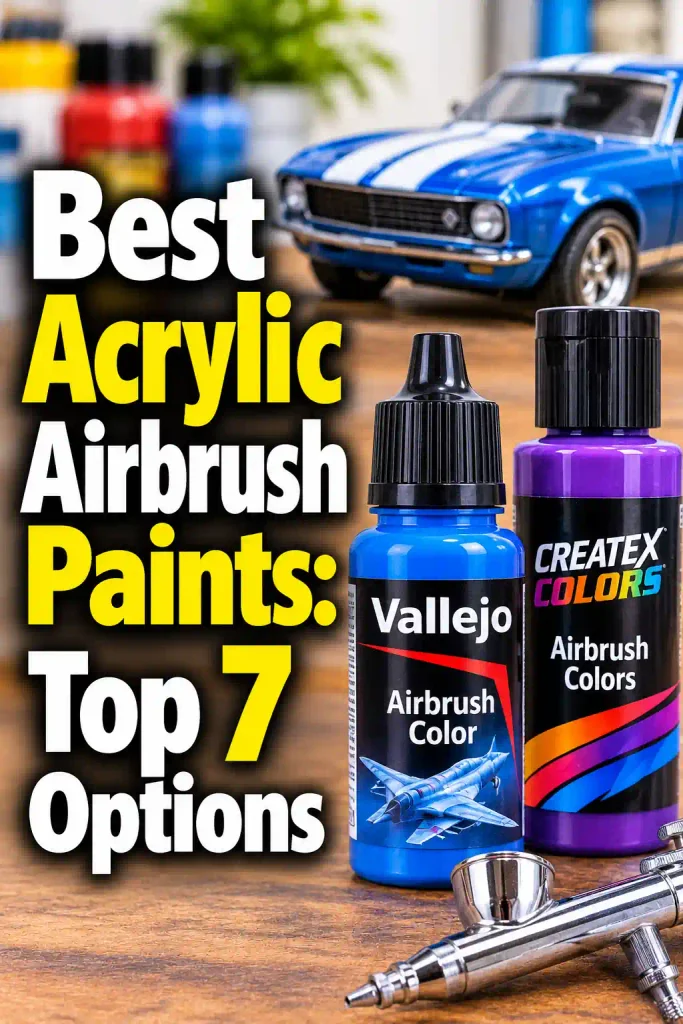
Not all acrylic paints work the same way. Some are ready to spray, while others need a compatible reducer or airbrush medium. In this guide, we’ll compare seven options from different brands, explain what each does best, and help you choose the right paint for your projects.
Top Picks: Best Acrylic Airbrush Paints
- Best Overall: Createx Wicked Colors – A versatile water-based acrylic range for illustration, crafts, automotive graphics, and multiple surfaces.
- Best for Scale Models: Vallejo Model Air – A convenient airbrush paint range with model-focused colors for aircraft, vehicles, figures, and miniature projects.
- Best for Fine Art: Golden High Flow Acrylics – An exceptionally fluid acrylic paint with an ink-like consistency for illustration, canvas, and detailed airbrush work.
- Best for Fabric and Sneakers: Jacquard Airbrush Color – A flexible, water-based acrylic paint designed for textiles and suitable compatible surfaces such as leather, vinyl, and canvas.
- Best for Illustration Details: Iwata Medea Com-Art Colors – A specialized acrylic color range with opaque and transparent choices for airbrush artwork.
- Best for Fine-Detail Artwork: Schmincke Aero Color Professional – A fluid acrylic ink range for detailed illustration, graphic work, and creative airbrush techniques.
- Best for Custom Color Mixing: Liquitex Soft Body Acrylic with Airbrush Medium – A flexible artist-paint system for turning compatible acrylic colors into sprayable mixtures.
Affiliate disclosure: As an Amazon Associate I earn from qualifying purchases.
Comparison Table: Best Acrylic Airbrush Paints
| Product Name | Best For | Check Price |
|---|---|---|
| Createx Wicked Colors | Versatile multi-surface airbrush projects | Check on Amazon |
| Vallejo Model Air | Scale models and miniatures | Check on Amazon |
| Golden High Flow Acrylics | Fine art and illustration | Check on Amazon |
| Jacquard Airbrush Color | Fabric, leather, and sneakers | Check on Amazon |
| Iwata Medea Com-Art Colors | Illustration and detailed artwork | Check on Amazon |
| Schmincke Aero Color Professional | Fine-detail acrylic illustration | Check on Amazon |
| Liquitex Soft Body Acrylic with Airbrush Medium | Custom color mixing | Check on Amazon |
Amazon links are tagged product-search links, not verified individual product listings. Check the exact range, color, bottle size, and seller before ordering. These products have different viscosities and application requirements, so they are not all interchangeable or ready to spray.
1. Createx Wicked Colors – Best Overall
Createx Wicked Colors is a versatile option for artists who want acrylic airbrush paint that can work across several types of projects. Its water-based acrylic formulation is designed for airbrush and spray-gun application, making it useful for artwork that involves more than one kind of surface.
One of its main advantages is versatility. The range is designed for compatible rigid and flexible substrates, including plastic, wood, automotive surfaces, and fabric. This makes it worth considering if you switch between illustration, hobby projects, custom graphics, and decorative painting.
Wicked Colors includes transparent, opaque, detail, pearl, and other specialty color options. You can choose an opaque shade when you need stronger coverage or a transparent color when you want to build layers and create visual depth.
The paint may require reduction depending on your airbrush nozzle, pressure, and technique. Createx provides its own reducer and mixing products, so using the manufacturer’s recommended materials is a sensible starting point.
For hard surfaces, adhesion and durability can depend on the preparation and coating system. Some projects may need an appropriate sealer or clear coat rather than relying on the color layer alone.
Pros
- Water-based acrylic formulation
- Designed for airbrush and spray-gun application
- Suitable for multiple compatible surfaces
- Offers opaque, transparent, and specialty colors
- Useful for both hobby and professional-style projects
Cons
- May require reduction for certain airbrush setups
- Some surfaces need additional preparation
- Different color types may spray differently
- A compatible clear coat may be needed for added protection
Best For: Artists who want one versatile acrylic airbrush paint range for illustration, crafts, custom graphics, and compatible hard surfaces.
2. Vallejo Model Air – Best for Scale Models
Vallejo Model Air is a popular choice for hobbyists who paint scale models, miniature vehicles, aircraft, military models, and other detailed projects. Its model-focused color range makes it especially useful when you want shades suited to specific subjects rather than building every color from a general artist palette.
The range is designed for airbrush use, so it is a convenient starting point for people who prefer not to thin ordinary heavy-bodied acrylic paint themselves. It can be useful for applying base colors, camouflage patterns, surface details, and layered finishes.
One advantage is the availability of model-oriented shades. When painting aircraft or military vehicles, for example, having colors selected for those subjects can save time when planning a project.
You should still test the paint with your particular airbrush. Even paints marketed for airbrushing can behave differently depending on nozzle size, air pressure, room conditions, and how thoroughly the bottle has been mixed.
For detailed work, apply several controlled passes rather than trying to cover the entire model in one heavy coat. This can help preserve small panel lines, raised details, and other features.
Pros
- Designed for airbrush use
- Extensive model-focused color selection
- Useful for aircraft, vehicles, and miniatures
- Convenient for base coats and layered effects
- Suitable for detailed hobby painting
Cons
- Primarily aimed at scale-model applications
- Some colors may need adjustment for particular setups
- Small bottles may not suit large projects
- Surface preparation still affects adhesion
Best For: Model builders who want convenient acrylic colors for aircraft, military vehicles, miniatures, and other scale-model projects.
3. Golden High Flow Acrylics – Best for Fine Art
Golden High Flow Acrylics are worth considering when you want a highly fluid acrylic paint for fine-art applications. Their ink-like consistency makes them different from traditional heavy-body acrylics, which are generally too thick to spray without modification.
The fluid consistency allows High Flow colors to be used in an airbrush, as well as in refillable markers, dip pens, and other creative tools. This versatility can be useful for artists who combine sprayed backgrounds with hand-drawn lines, brushwork, and other techniques.
Golden offers a broad selection of colors, including many single-pigment options. This is helpful when color mixing and pigment characteristics are important to your artwork.
For canvas and illustration, the paint can create smooth transitions, delicate layers, and fine details. You can also experiment with transparent effects and washes.
Although the paint is very fluid, you should not assume that every airbrush setup will spray every color identically. Test the flow with your nozzle and pressure before starting a finished piece. Clean the airbrush promptly after use to prevent dried acrylic from accumulating in the nozzle and internal passages.
Pros
- Very fluid, ink-like acrylic consistency
- Suitable for airbrush and other creative tools
- Broad color selection
- Useful for illustration and fine-art projects
- Works well for washes and layered effects
Cons
- Premium artist-paint option
- May be less economical for large coverage
- Color opacity varies by pigment
- Requires prompt cleaning after spraying
Best For: Fine artists who want fluid acrylic colors for illustration, canvas, washes, and detailed airbrush techniques.
4. Jacquard Airbrush Color – Best for Fabric and Sneakers
Jacquard Airbrush Color is a strong option for artists working on fabric, sneakers, leather, vinyl, and other compatible materials. It is a water-based fluid acrylic paint originally developed for textiles, but its versatility has made it useful for a variety of decorative and custom-painting projects.
One of its biggest advantages is that the formula is designed to spray directly from the bottle. This can reduce preparation time because you may not need to add a separate thinner for normal applications. Always check the instructions for the specific color and airbrush setup.
The range includes transparent, opaque, metallic, fluorescent, and other specialty colors. That gives you options for everything from subtle color layers to bright decorative finishes.
Flexibility is particularly important when painting sneakers and other items that bend during use. Jacquard’s formulation is designed for flexible applications, but surface preparation and the correct finishing system still matter. Clean and prepare the material according to the manufacturer’s instructions, and use a compatible finish when the project requires additional protection.
This paint is not limited to airbrush application. It can also be used with other techniques, making it a useful choice for artists who combine spraying with brushwork.
Pros
- Water-based fluid acrylic formulation
- Designed for easy airbrush application
- Suitable for compatible fabric and leather projects
- Offers opaque, transparent, metallic, and fluorescent choices
- Useful for custom sneakers and decorative work
Cons
- Surface preparation is important
- Not every material has the same adhesion requirements
- Color and finish selection can take planning
- Some projects need a compatible protective finish
Best For: Custom sneaker painters and artists working on compatible textiles, leather, vinyl, canvas, and other flexible surfaces.
5. Iwata Medea Com-Art Colors – Best for Illustration Details
Iwata Medea Com-Art Colors are designed for airbrush artists who want a wide range of colors for illustration and detailed creative work. The range includes opaque and transparent acrylic colors, giving you options for both strong coverage and subtle layered effects.
Opaque colors are useful when you want a more solid appearance, such as a defined shape or a brighter color over a prepared surface. Transparent colors are useful for glazing, shading, and building up depth gradually.
Com-Art is particularly worth considering for artists who work with portraits, graphic illustrations, decorative artwork, and other designs where controlled color application matters.
The range includes a variety of individual shades, which can be helpful if you prefer selecting specific colors rather than purchasing a large general-purpose kit. You can build a palette around the subjects and techniques you use most often.
As with any acrylic airbrush paint, the right consistency and cleaning routine are important. Test the paint with your nozzle, follow the product instructions for reduction, and clean the airbrush before acrylic residue dries inside it.
Pros
- Acrylic colors designed for airbrush artwork
- Opaque and transparent options
- Broad selection of individual shades
- Useful for illustration and detailed painting
- Suitable for layering and controlled color effects
Cons
- Some colors may require adjustment for your setup
- Individual bottles can add up when building a large palette
- Not every shade provides identical coverage
- Prompt cleaning is necessary
Best For: Airbrush artists who create detailed illustrations, portraits, graphic designs, and layered artwork.
6. Schmincke Aero Color Professional – Best for Fine-Detail Artwork
Schmincke Aero Color Professional is a fluid acrylic ink range designed for creative applications that benefit from precise color control. It is worth considering for illustration, graphic artwork, decorative designs, and fine-detail airbrush techniques.
Its fluid consistency makes it suitable for artists who want to create fine lines, transparent layers, and controlled color transitions. It can also be used with other compatible art tools, which is helpful if your work combines airbrushing with brush or pen techniques.
The range offers different colors and effects, allowing you to select shades based on the project. For detailed artwork, this can be more useful than relying on a small set of general-purpose colors.
Acrylic inks and fluid paints can dry quickly in exposed airbrush components. Avoid leaving paint sitting in the cup for long periods, and clean the nozzle and paint passages thoroughly after each session.
Before using it on an unfamiliar surface, check the manufacturer’s recommendations. An artist paint that works well on a prepared illustration surface may require additional preparation or a suitable primer on plastic, metal, or other materials.
Pros
- Fluid acrylic ink formulation
- Suitable for detailed airbrush artwork
- Useful for illustration and graphic techniques
- Can be combined with other compatible art methods
- Offers a range of creative color choices
Cons
- May dry in the airbrush if left unattended
- Surface compatibility varies
- Premium art materials can cost more
- Not specifically intended for every hobby or automotive application
Best For: Artists who prioritize fine lines, controlled layers, and detailed illustration work.
7. Liquitex Soft Body Acrylic with Airbrush Medium – Best for Custom Color Mixing
Liquitex Soft Body Acrylic combined with a compatible airbrush medium is a useful option for artists who want to create custom sprayable colors. Unlike the other choices in this list, it is a paint-and-medium system rather than a dedicated ready-to-spray airbrush paint.
Soft Body Acrylic has a smoother, more fluid consistency than heavy-body acrylic paint. When combined with the appropriate airbrush medium according to the manufacturer’s guidance, it can be prepared for airbrush application.
This approach gives you access to a broad artist-color range. It can be particularly useful when you need a specific shade that is not available in a dedicated airbrush paint line.
The important part is using the correct medium and mixing proportions. Simply adding large amounts of water to ordinary acrylic paint can weaken the binder and affect the final film. An airbrush medium is designed to help maintain the paint’s working properties while adjusting its consistency.
Strain the prepared mixture when appropriate and test it before spraying a finished project. The ideal mixture depends on your airbrush nozzle, pressure, and desired coverage.
Pros
- Broad artist-color selection
- Useful for custom color mixing
- More fluid than heavy-body acrylic paint
- Compatible airbrush medium helps adjust spray consistency
- Suitable for fine-art and creative projects
Cons
- Requires a separate airbrush medium
- Needs mixing and testing before spraying
- Not as convenient as ready-to-spray paint
- Incorrect proportions can affect performance
Best For: Artists who want to turn compatible artist acrylic colors into custom airbrush mixtures for canvas, illustration, and creative work.
Buying Guide: How to Choose the Best Acrylic Airbrush Paints
Choosing acrylic airbrush paint involves more than comparing colors and bottle sizes. You need to consider the surface, airbrush setup, paint consistency, coverage, and finish.
1. Match the Paint to Your Project
Start by identifying what you plan to paint.
- Scale models: Choose a model-focused range such as Vallejo Model Air.
- Fine-art illustration: Consider Golden High Flow, Com-Art, or Schmincke Aero Color.
- Sneakers and fabric: Look for a flexible product such as Jacquard Airbrush Color.
- Custom graphics and mixed surfaces: Createx Wicked Colors is a versatile option.
- Custom artist colors: Consider compatible acrylic paint and airbrush medium combinations.
A paint designed for fabric may not be the best choice for a plastic model, and an illustration ink may not provide the durability required for an item handled frequently.
2. Check Whether the Paint Is Ready to Spray
Some acrylic airbrush paints are formulated to spray directly from the bottle, while others need thinning or reduction.
Ready-to-spray products can save preparation time. However, even these may need adjustment for a very small nozzle or a particular spraying technique.
For thicker acrylic paints, use the manufacturer’s recommended airbrush medium or reducer. Avoid assuming that plain water is always an adequate substitute.
3. Consider Airbrush Nozzle Size
Your airbrush nozzle affects how easily paint flows.
- Small nozzles: Better suited to fine lines and detailed work, but they are more sensitive to thick paint and pigment particles.
- Medium nozzles: A practical choice for many hobby and illustration projects.
- Large nozzles: More suitable for broader coverage and some thicker paint formulations.
Always check the paint manufacturer’s recommendations. A product that works well through a 0.5 mm nozzle may need more careful preparation for a 0.2 mm setup.
4. Evaluate Pigmentation and Coverage
Pigmentation affects how strongly a color appears on the surface. Opaque paints generally provide more solid coverage, while transparent paints allow underlying layers to show through.
For a solid base coat, look for an opaque formulation. For shadows, gradients, and layered artwork, transparent colors can be more useful.
Remember that opacity varies by pigment. A single paint range may contain colors with noticeably different coverage.
5. Choose the Right Finish
Acrylic airbrush paints are available in different finishes.
- Matte: Useful for model painting and non-reflective artwork.
- Satin: Offers a subtle sheen.
- Gloss: Creates a more reflective surface.
- Metallic: Adds a metal-like visual effect.
- Pearlescent: Produces a soft iridescent appearance.
If you need a specific final sheen, check whether the paint provides it directly or whether a compatible clear coat is required.
6. Check Surface Compatibility
The surface determines which paint and preparation method you need.
- Canvas and paper: Use an artist paint suitable for the intended surface.
- Plastic models: Check whether the paint requires a primer or adhesion-promoting layer.
- Fabric: Choose a flexible textile-compatible formula.
- Leather and sneakers: Use a paint designed for compatible flexible materials.
- Wood: Prepare and seal the surface as recommended.
- Metal: Check the primer, adhesion, and corrosion-protection requirements.
Never assume that a water-based acrylic paint will automatically adhere to every material.
7. Consider Lightfastness and Durability
If your artwork will be displayed in a bright area, lightfastness matters. Look for pigment and permanence information from the manufacturer.
For frequently handled objects, also consider abrasion resistance, flexibility, and whether the project needs a protective clear coat.
The durability of the finished work depends on the complete coating system, not just the paint color.
8. Compare Bottle Size and Value
Small bottles can be convenient for miniature painting and detailed illustration. Larger bottles may offer better value when covering broad surfaces or completing repeated projects.
Compare the amount of usable paint, number of colors in a set, and whether you need additional reducer, medium, primer, or clear coat.
A cheaper bottle is not always the most economical choice if it requires more preparation or additional products.
9. Check Cleanup Requirements
Acrylic paint can dry inside an airbrush, so cleaning is essential.
Check the manufacturer’s recommended cleaner and cleaning procedure. Some products use water-based cleaning while others require a specific airbrush cleaner or solvent-based cleaning method after curing.
Do not assume that every acrylic formulation can be cleaned in exactly the same way.
How to Use Acrylic Airbrush Paint
Using acrylic paint in an airbrush is easier when you prepare the surface, check the paint consistency, and work in controlled layers.
Step 1: Prepare Your Work Surface
Clean the surface to remove dust, grease, fingerprints, and other contaminants. Use a suitable primer if the material or paint system requires one.
Allow the surface to dry before spraying.
Step 2: Prepare the Paint
Shake or stir the paint according to the manufacturer’s instructions. If reduction is required, use the recommended reducer or airbrush medium.
Add the reducer gradually rather than making the mixture excessively thin at the beginning.
Step 3: Test the Consistency
Place a small amount of paint in the airbrush cup and test it on scrap material.
Look for an even spray without spitting, excessive graininess, or repeated clogging. Adjust the mixture in small increments if necessary.
Step 4: Adjust Air Pressure
Set the air pressure according to the paint, nozzle, and airbrush manufacturer’s recommendations.
A very low pressure may produce inconsistent flow, while excessive pressure can create overspray or a rough finish. Test the settings before working on the final piece.
Step 5: Apply Light Coats
Hold the airbrush at a consistent distance and keep it moving while spraying. Apply thin, even passes instead of trying to cover the surface in one heavy coat.
Allow each layer to dry as directed before applying the next.
Step 6: Add Details and Color Layers
Once the base coat is ready, add shadows, highlights, gradients, and fine details.
Use a smaller nozzle or appropriate airbrush setup for delicate work. Keep the paint mixture consistent and clean the needle if dried paint begins to affect the spray.
Step 7: Apply a Compatible Protective Finish
Some projects need a clear coat or sealer to improve durability or change the sheen.
Choose a finish compatible with the paint and surface. Test the combination on a sample before applying it to your finished work.
Step 8: Clean the Airbrush
Empty leftover paint and clean the cup, needle, nozzle, and paint passages according to the manufacturer’s instructions.
Do not leave acrylic paint inside the airbrush after finishing. Dried residue can cause clogging and inconsistent spray performance during your next session.
Common Mistakes to Avoid When Using Acrylic Airbrush Paint
Using Thick Paint Without Proper Reduction
Paint that is too thick may clog the nozzle or produce an uneven spray. Use the recommended medium or reducer and test the consistency before starting.
Adding Too Much Water
Excessive water can change the paint’s working properties and weaken the binder. Use a compatible airbrush medium when the manufacturer recommends one.
Ignoring Nozzle Size
A paint that works with a large nozzle may not spray reliably through a very small one. Match the paint to your airbrush setup.
Spraying Heavy Coats
Heavy coats can cause runs, uneven drying, and loss of fine detail. Build coverage with controlled passes.
Skipping Surface Preparation
Dust, grease, and unsuitable old finishes can interfere with adhesion. Clean and prepare the surface before spraying.
Forgetting to Clean the Airbrush
Dried acrylic paint can block the nozzle and damage the consistency of future spraying sessions. Clean the airbrush promptly after use.
Mixing Incompatible Products
Not every reducer, medium, primer, or clear coat works with every acrylic paint. Check compatibility before combining products.
Spraying Without Suitable Protection
Airbrushing creates airborne paint particles that should not be inhaled. Use appropriate ventilation, respiratory protection, and eye protection according to the paint and equipment instructions.
Frequently Asked Questions
What are the best acrylic airbrush paints overall?
Createx Wicked Colors is a strong overall option because it is designed for airbrush application and works across several compatible surfaces. The best choice depends on your project: Vallejo Model Air is more specialized for scale models, while Golden High Flow is useful for fine art.
Can I use regular acrylic paint in an airbrush?
Yes, some regular acrylic paints can be adapted for airbrush use with a suitable airbrush medium. However, thick paints may need more preparation, and not every formulation is suitable for small nozzles. Dedicated airbrush paints are generally more convenient.
Do acrylic airbrush paints need thinning?
Some are ready to spray, while others need a compatible reducer or airbrush medium. Follow the manufacturer’s instructions and adjust the mixture to suit your nozzle and pressure.
What consistency should acrylic airbrush paint have?
There is no single consistency that works for every paint and airbrush. The mixture should flow smoothly through your particular setup without spitting, clogging, or producing an excessively wet spray. Test it on scrap material first.
Are acrylic airbrush paints water-based?
Many acrylic airbrush paints are water-based, including several options in this guide. However, their binders, additives, and cleaning requirements can differ. Check the product label and technical information.
What airbrush nozzle size is best for acrylic paint?
A medium nozzle is a versatile starting point for many acrylic airbrush projects. Smaller nozzles are useful for fine detail but require suitable paint consistency. Larger nozzles can be more convenient for broad coverage and some thicker formulations.
Can I use acrylic airbrush paint on plastic models?
Yes, if the paint is suitable for the plastic and model application. Clean the surface and use a compatible primer when recommended. Vallejo Model Air is one option specifically aimed at scale-model painting.
Can I use acrylic airbrush paint on fabric?
Yes, but choose a formula designed for textiles or flexible surfaces. Jacquard Airbrush Color and suitable Createx products are options to investigate. Follow the manufacturer’s fabric preparation and curing instructions.
Can acrylic airbrush paint be used on sneakers?
Some acrylic airbrush paints are designed for compatible sneaker materials, including leather and certain synthetic surfaces. Jacquard Airbrush Color is one option to consider. Prepare the material correctly and use a compatible finishing system when required.
How do I prevent acrylic paint from clogging my airbrush?
Use paint suitable for your nozzle, mix it properly, and avoid excessive thickness. Clean the airbrush promptly after use. If the paint repeatedly clogs, check the manufacturer’s reduction guidance and inspect the nozzle and needle for dried residue.
Do I need a primer before using acrylic airbrush paint?
It depends on the surface and paint. Plastic, metal, and some previously coated materials may need a compatible primer for better adhesion. Canvas and other artist surfaces may have different preparation requirements.
How long does acrylic airbrush paint take to dry?
Drying time varies by formula, layer thickness, airflow, humidity, and temperature. Thin coats often dry faster than heavy applications, but surface-dry paint may need additional time to cure fully. Follow the manufacturer’s instructions before handling or sealing the work.
Is acrylic airbrush paint waterproof?
Once properly dried or cured, some acrylic paints provide water resistance, but that does not mean every product is fully waterproof. The finished result depends on the formulation, surface, preparation, and protective finish.
Can I mix different acrylic airbrush paint brands?
Some water-based acrylic paints may be compatible, but mixing different brands is not guaranteed to work. Test a small amount first and check the manufacturer’s compatibility guidance before using the mixture on a finished project.
Final Words
The best acrylic airbrush paints depend on the surface and the kind of artwork you want to create. Createx Wicked Colors is a versatile overall option, Vallejo Model Air is useful for scale models, and Golden High Flow is a strong choice for fine-art applications. Jacquard Airbrush Color is worth considering for compatible fabric and sneaker projects, while Com-Art and Schmincke offer options for detailed illustration.
Before buying, check the paint’s surface compatibility, nozzle requirements, and reduction instructions. Use the correct medium when needed, test your spray pattern, and clean your airbrush after every session. Choosing a paint that matches your project and equipment will help you achieve smoother coverage and more consistent results.
Helpful Resources
- Createx Colors: Technical Data Sheets and Application Guides – Find manufacturer guidance on paint ranges, reducers, mixing products, and application.
- Golden Artist Colors: High Flow Acrylics – Review the properties, uses, and color information for Golden High Flow acrylics.