
Choosing the best exterior concrete paint can transform a plain patio, porch, walkway, or concrete step while helping the surface stand up to outdoor conditions. The right coating depends on where you plan to use it: concrete walls need a different product from a patio floor, and a driveway needs a coating specifically rated for vehicle traffic.
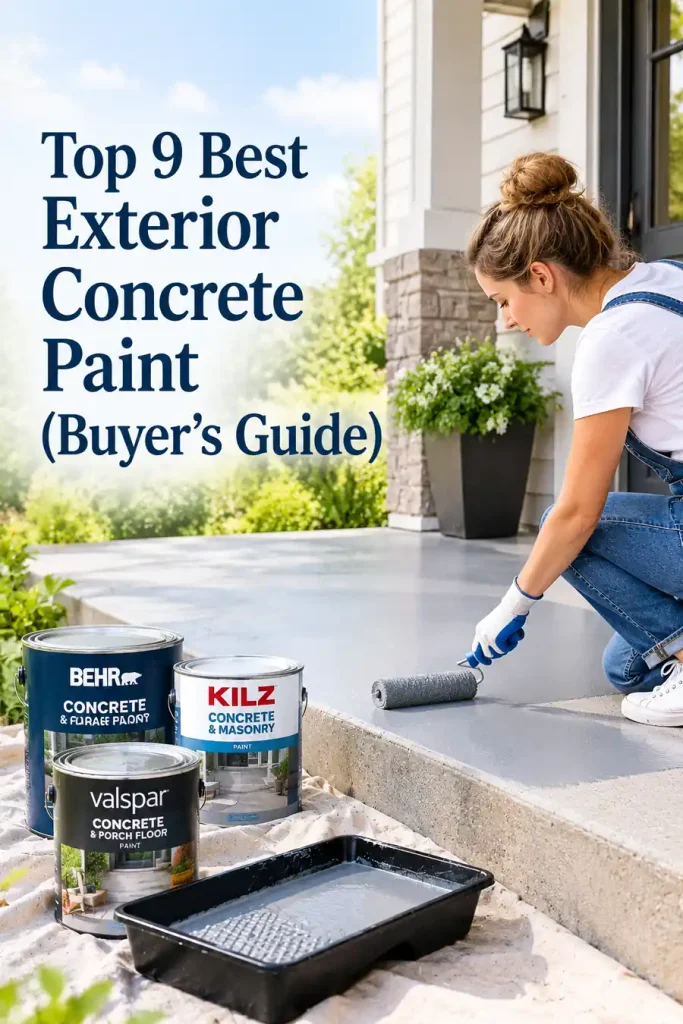
In this guide, we compare nine exterior concrete paint and coating options, explain what each is best suited for, and share practical preparation and application tips to help you achieve a durable finish.
Top 9 Best Exterior Concrete Paint: Comparison Table
| Product Name | Best For | Check Price |
|---|---|---|
| 1. BEHR PREMIUM Porch & Patio Floor Paint | Exterior concrete porches and patios | Check on Amazon |
| 2. BEHR PREMIUM Concrete & Garage 1-Part Epoxy | Outdoor concrete floors and suitable garage floors | Check on Amazon |
| 3. INSL-X Tough Shield Floor and Patio Paint | Concrete patios, walkways, and steps | Check on Amazon |
| 4. Valspar Porch, Floor & Patio Paint | General outdoor porch and patio projects | Check on Amazon |
| 5. KILZ 1-Part Epoxy Acrylic Concrete & Garage Floor Paint | Concrete floors needing a tougher coating | Check on Amazon |
| 6. BEHR Masonry, Stucco & Brick Paint | Vertical exterior concrete and masonry walls | Check on Amazon |
| 7. BEHR PREMIUM Elastomeric Masonry, Stucco & Brick Paint | Exterior masonry with suitable hairline cracks | Check on Amazon |
| 8. Sherwin-Williams Loxon XP Masonry Coating | Exterior concrete and masonry walls | Check on Amazon |
| 9. Rust-Oleum Concrete & Garage Floor Coating | Concrete floors where the exact coating is rated for the intended use | Check on Amazon |
Affiliate disclosure: As an Amazon Associate I earn from qualifying purchases.
These links search Amazon for the named products; they do not guarantee that every product or size is currently available. Check each manufacturer’s current label to confirm that the exact formulation is suitable for your outdoor surface. Concrete wall paint and floor coatings are not interchangeable.
1. BEHR PREMIUM Porch & Patio Floor Paint
Best for: Exterior concrete porches, patios, and steps
BEHR PREMIUM Porch & Patio Floor Paint is a practical option for homeowners who want to refresh a concrete porch or patio with a colored finish. Its 100% acrylic formula is designed for properly prepared horizontal wood and concrete surfaces, including approved interior and exterior applications. The low-lustre finish provides a more subdued appearance than a high-gloss coating.
This product is worth considering for outdoor areas that receive regular foot traffic but do not need a specialized vehicle-rated coating. It is designed to resist scuffing, fading, cracking, and peeling when applied according to the product instructions. The manufacturer’s published coverage is approximately 200–400 square feet per gallon, depending on application method and surface porosity.
Before purchasing, determine whether you need a smooth low-lustre finish or a textured anti-slip version. Textured products may be more suitable for certain walkways or steps, but the surface must still be kept clean and safe. Always follow the label’s instructions for preparation, required coats, and drying before foot traffic.
Pros
- Designed for approved concrete porch and patio surfaces.
- Acrylic formula.
- Low-lustre finish for a restrained appearance.
- Helps resist scuffing, fading, cracking, and peeling.
- Available in different finish options within the product range.
Cons
- Not automatically suitable for driveways or vehicle traffic.
- Requires proper concrete preparation.
- Coverage varies with porosity and application method.
Buying tip: For a typical concrete porch or patio, start by comparing the low-lustre finish with the textured anti-slip option. Confirm the exact product is rated for exterior concrete before ordering.
2. BEHR PREMIUM Concrete & Garage 1-Part Epoxy
Best for: Concrete floors that need a more robust coating
BEHR PREMIUM Concrete & Garage 1-Part Epoxy is designed for concrete floors and is worth comparing when durability is a priority. It is a different product category from ordinary exterior wall paint, with a formulation intended for floor applications. The manufacturer’s product range identifies it for appropriate concrete and garage-floor uses, but suitability depends on the exact surface and exposure.
For outdoor projects, check the label carefully before using it on a patio, walkway, or other surface exposed to sunlight and weather. A product designed for garage floors should not automatically be assumed to be the best choice for every outdoor slab. Consider water exposure, traction, sunlight, and the amount of traffic the surface receives.
Surface preparation is particularly important with floor coatings. Old paint, grease, dust, curing compounds, and weak concrete can interfere with adhesion. Follow the manufacturer’s cleaning and etching or preparation directions, and confirm the concrete is sufficiently dry before application.
Pros
- Designed for concrete-floor applications.
- Worth considering for suitable garage and utility floors.
- Different performance category from standard wall paint.
- Available in multiple color options, depending on the product.
- Useful when the project needs a floor-specific coating.
Cons
- Not every formulation is suitable for every exterior exposure.
- Concrete preparation can be more demanding.
- Not a replacement for repairing damaged or moisture-affected concrete.
Buying tip: Read the product label for outdoor suitability, UV exposure, hot-tire resistance, and required preparation. For a fully exposed patio, compare it with a coating explicitly recommended for exterior porch and patio use.
3. INSL-X Tough Shield Floor and Patio Paint
Best for: Concrete patios, walkways, and steps
INSL-X Tough Shield Floor and Patio Paint is a floor coating to consider for concrete areas that experience regular foot traffic. It is intended for floor and patio applications, so it may be a better starting point than ordinary wall paint when refreshing a suitable outdoor concrete surface.
A key consideration is the location of the concrete. An open patio exposed to direct sunlight and rain has different demands from a covered porch. Before purchasing, verify the current label for exterior use, approved concrete surfaces, surface preparation, and the time required before foot traffic. If the area becomes wet, consider whether a textured finish or compatible anti-slip additive is appropriate for that application.
The quality of the existing concrete also matters. Paint is unlikely to last well on a crumbling, dusty, contaminated, or persistently damp surface. Repair and prepare the slab first, then apply the coating according to the manufacturer’s directions.
Pros
- Designed for floor and patio applications.
- Suitable for evaluating when painting concrete walking areas.
- Can provide a refreshed, colored surface.
- Available in selected colors and finishes.
- Useful for projects where floor-specific paint is needed.
Cons
- Exact exterior suitability should be checked on the current label.
- Surface preparation is essential.
- Not necessarily suitable for driveways or heavy vehicle traffic.
Buying tip: Confirm the intended surface and outdoor exposure before ordering. For concrete steps or a frequently wet walkway, pay particular attention to slip resistance and any restrictions on adding anti-slip material.
4. Valspar Porch, Floor & Patio Paint
Best for: General porch and patio painting
Valspar Porch, Floor & Patio Paint is an option to compare when you want a durable-looking finish for concrete or wood porch and patio surfaces. The product range includes different finishes, including options intended to improve slip resistance. Choose the specific formulation based on the surface and conditions rather than assuming all versions are identical.
This type of coating can be useful for refreshing a covered porch, outdoor sitting area, or other approved concrete surface. The finish can make an old slab look cleaner and more coordinated with exterior trim, siding, or landscaping. For a fully exposed patio, make sure the exact product is rated for the weather conditions and use it only after the surface has been properly prepared.
If the concrete has previously been painted, check whether the old coating is firmly attached. Loose or peeling paint should be removed before recoating. Applying a new finish over failing paint can cause the new coating to peel with the old layer.
Pros
- Designed for porch, floor, and patio projects.
- Concrete and wood use may be supported by the specific formulation.
- Finish options can help match the design of the home.
- Textured options may be available for traction.
- Useful for refreshing suitable outdoor floors.
Cons
- Product variants have different characteristics.
- Not all versions are suitable for every exterior concrete condition.
- Loose existing paint must be addressed before repainting.
Buying tip: Check the current product label for exterior concrete approval, finish, and slip-resistance features. If traction is important, select a specifically textured product rather than relying on color or sheen alone.
5. KILZ 1-Part Epoxy Acrylic Concrete & Garage Floor Paint
Best for: Concrete floors where a floor-specific coating is preferred
KILZ 1-Part Epoxy Acrylic Concrete & Garage Floor Paint is designed for concrete-floor applications. It is worth comparing for appropriate garages, utility areas, and other surfaces identified on the current label. Its name refers to a one-part epoxy-acrylic coating, which is different from a two-part epoxy system that requires mixing separate components.
For outdoor use, verify that the specific product is rated for the location and exposure. A coating that works on a protected garage floor may have different limitations on a patio exposed to intense sunlight, standing water, or freeze-thaw conditions. The surface must be sound, clean, and prepared as directed.
A floor coating is only as dependable as the concrete underneath it. If the slab is damp, powdery, or affected by moisture coming through from below, investigate the problem before painting. Otherwise, the coating may blister or lose adhesion regardless of its advertised durability.
Pros
- Designed for concrete and garage-floor applications.
- One-part formula is simpler to handle than a multi-part coating.
- Useful for comparing floor-specific options.
- Can improve the appearance of suitable concrete.
- Available in selected colors.
Cons
- Outdoor exposure must be checked against the exact product instructions.
- Not designed to fix moisture problems in the slab.
- Requires careful surface preparation.
Buying tip: Before choosing this product for a patio or walkway, verify exterior-use approval, weather resistance, and any restrictions for exposed concrete. Compare it with a dedicated porch and patio paint if the area is frequently wet or receives direct sunlight.
6. BEHR Masonry, Stucco & Brick Paint
Best for: Vertical exterior concrete and masonry walls
BEHR Masonry, Stucco & Brick Paint is designed for masonry surfaces, making it a more appropriate category to investigate for exterior concrete walls than a floor paint. Depending on the specific formulation, the range includes flat and satin finishes for properly prepared masonry, stucco, and brick.
This type of product is useful for exposed foundation walls, concrete garden walls, and other vertical masonry surfaces that need a refreshed appearance. The manufacturer describes the satin formulation as providing adhesion and water repellency on properly prepared surfaces. Select the finish according to the texture of the concrete and the appearance you want.
A masonry wall must be sound and suitable for coating. Remove loose material and contamination, repair appropriate defects, and follow the product’s instructions for priming or self-priming. If moisture is moving through the wall, resolve the underlying cause rather than simply painting over it.
Pros
- Designed for masonry, stucco, and brick surfaces.
- More appropriate for exterior walls than floor-only paint.
- Finish options help match different exterior styles.
- Can provide water repellency on properly prepared surfaces, according to the specific formulation.
- Useful for foundations and vertical concrete features.
Cons
- Not intended as a substitute for a floor coating.
- Product preparation requirements depend on the exact formulation.
- Persistent moisture and structural problems must be resolved first.
Buying tip: For vertical concrete, compare this masonry paint with a dedicated masonry coating from a professional paint brand. Confirm the current label covers the concrete type and exposure you have.
7. BEHR PREMIUM Elastomeric Masonry, Stucco & Brick Paint
Best for: Suitable exterior masonry with minor hairline cracking
BEHR PREMIUM Elastomeric Masonry, Stucco & Brick Paint is a specialized exterior coating intended for masonry surfaces. Elastomeric coatings are designed to form a thicker, more flexible film than many conventional paints. The BEHR product information describes it as a high-build coating that can bridge hairline cracks on suitable vertical masonry surfaces.
This can be useful for certain exterior concrete walls and stucco surfaces where small, non-structural cracks are present. However, elastomeric paint is not a structural repair product. Wider cracks, movement, water intrusion, or crumbling concrete should be investigated and repaired before coating.
Because elastomeric coatings build a thicker film, application conditions and coverage can differ from standard masonry paint. Follow the label for surface preparation, application thickness, and drying. Do not use a vertical-wall coating on a patio or concrete floor unless the manufacturer specifically approves that application.
Pros
- Designed for exterior masonry, stucco, and brick.
- Flexible, high-build coating.
- Can bridge suitable hairline cracks.
- Useful for certain exposed vertical concrete surfaces.
- Provides a dedicated option for masonry rather than ordinary wall paint.
Cons
- Not intended for concrete floors unless explicitly approved.
- Does not repair structural cracks.
- Requires careful attention to preparation and application instructions.
Buying tip: Consider this product for an appropriate exterior wall, not automatically for a porch slab or driveway. If you see significant cracking or dampness, address the underlying issue before painting.
8. Sherwin-Williams Loxon XP Masonry Coating
Best for: Exterior concrete and masonry walls
Sherwin-Williams Loxon XP Masonry Coating is a professional-style coating to consider for exterior masonry. Sherwin-Williams identifies Loxon XP as suitable for masonry applications, including new concrete that has reached the minimum age specified by the manufacturer. It is designed for vertical masonry surfaces, so it belongs in a different category from porch and garage floor coatings.
This type of product is worth considering for exterior concrete walls, foundations, and similar masonry surfaces when its technical specifications match the project. Concrete age, moisture condition, surface texture, and existing coatings all affect preparation. Follow the product data sheet rather than assuming that every concrete wall can be coated immediately after installation.
Professional masonry coatings can be a good fit for larger exterior projects, but they may not be necessary for a small decorative slab. Compare the product’s requirements and coverage with simpler masonry paints before deciding.
Pros
- Designed for masonry coating applications.
- Suitable for evaluating on exterior concrete walls.
- Professional product line with technical documentation.
- Appropriate for projects where a masonry-specific coating is needed.
- Can be a useful choice for larger exterior wall surfaces.
Cons
- Not a general-purpose patio or driveway floor paint.
- Requires careful compliance with technical instructions.
- May be more specialized than necessary for a small DIY project.
Buying tip: Check the current Loxon XP technical data sheet for concrete age, surface preparation, moisture limits, and application conditions. Buy through an authorized paint retailer if the exact product is difficult to find on Amazon.
9. Rust-Oleum Concrete & Garage Floor Coating
Best for: Concrete floors when the exact product matches the intended use
Rust-Oleum offers several concrete and garage-floor coating products. These products are not all identical: some are intended for garage floors, some use epoxy-style formulations, and others have different preparation and application requirements. For that reason, check the exact product name and label before buying.
A Rust-Oleum floor coating may be worth considering for a suitable concrete surface that needs a more protective finish than ordinary wall paint. However, outdoor patios and driveways require extra attention to sunlight, weather exposure, moisture, and traffic. Do not assume that a coating marketed for a garage floor is automatically appropriate for a fully exposed outdoor slab.
Preparation can include removing contaminants, repairing defects, and following any required etching or profiling steps. The product’s instructions should also specify the appropriate temperature range, cure time, and when the surface can be used again.
Pros
- Offers multiple concrete and garage-floor coating options.
- Useful for comparing floor-specific coatings.
- Some formulations are designed for more demanding floor use.
- Can provide a refreshed appearance on suitable concrete.
- Available in selected colors and kits depending on the product.
Cons
- Product range includes different formulations with different uses.
- Not every version is suitable for exposed exterior concrete.
- Some coatings require more preparation and longer cure times than ordinary paint.
Buying tip: Select the exact Rust-Oleum product based on the surface: patio, garage, or driveway. Verify exterior suitability and traffic restrictions before ordering; do not rely on the brand name alone.
How to Choose the Best Exterior Concrete Paint
1. Identify the surface
The first step is deciding whether you are painting a vertical concrete wall or a horizontal concrete floor. Masonry paints are generally intended for walls, while porch and patio paints or floor coatings are designed for horizontal surfaces. Driveways need products explicitly rated for vehicle traffic.
2. Consider weather exposure
Outdoor concrete may experience direct sunlight, rain, temperature changes, and freeze-thaw cycles. Check the label for exterior approval and any climate or moisture restrictions. A covered porch may have different requirements from an uncovered patio.
3. Check the condition of the concrete
Concrete should be sound, clean, and appropriately dry. Remove dust, grease, efflorescence, loose coating, and other contaminants using the method recommended by the manufacturer. Repair cracks and damaged areas before applying paint.
4. Choose the right finish
Low-lustre finishes offer a softer look, while gloss finishes can look brighter and may be easier to clean. Textured coatings can improve traction in certain applications, but the specific product must be suitable for the surface and expected use.
5. Compare coating types
Acrylic porch and patio paint may be appropriate for foot-traffic areas. Masonry coatings are generally designed for vertical concrete and block walls. Epoxy-style floor coatings may be suitable for specific concrete floors but require checking their outdoor-use limitations.
6. Review coverage and cost
Compare the stated coverage per gallon, the number of coats required, and any separate primer or preparation products. Concrete is porous, so actual coverage may be lower than the estimate on a smooth or previously coated surface.
7. Read the drying and cure instructions
Drying to the touch does not necessarily mean a surface is ready for foot traffic, furniture, or vehicle use. Follow the product’s stated drying, recoat, and full-cure times.
8. Consider slip resistance
A smooth coating can become slippery when wet. For stairs, walkways, and frequently wet patios, consider a compatible textured finish or approved anti-slip additive. Follow the manufacturer’s directions to avoid compromising the coating.
How to Paint Exterior Concrete Step by Step
Step 1: Check the weather
Choose a period when the temperature, humidity, and forecast are within the coating manufacturer’s recommended limits. Avoid painting a surface that is wet or likely to get rained on before the coating has dried sufficiently.
Step 2: Clean the concrete
Remove dirt, leaves, grease, algae, and loose material. Use a cleaning method appropriate for the surface and coating. If you use water to clean the slab, allow it to dry as directed before applying primer or paint.
Step 3: Remove failing paint
Scrape away loose or peeling coating. Existing paint that remains should be firmly attached and compatible with the new system. Follow appropriate safety precautions when disturbing older coatings that may contain hazardous materials.
Step 4: Repair defects
Fill suitable cracks and repair damaged areas using products intended for the type of concrete and defect. Allow repairs to cure as required. Structural cracks or recurring water problems may need professional evaluation.
Step 5: Check for moisture and surface issues
Look for persistent dampness, powdery deposits, or signs of water entering through the concrete. Address the source before coating. Some coatings require particular moisture limits or surface profiles, so consult the technical instructions.
Step 6: Prime if required
Some products require a compatible concrete or masonry primer; others are self-priming on approved surfaces. Follow the instructions for the exact product instead of assuming a separate primer is always necessary.
Step 7: Apply the first coat
Use a brush for edges and a suitable roller or approved sprayer for larger areas. Spread the coating evenly and avoid heavy buildup. Keep a wet edge where practical to minimize lap marks.
Step 8: Allow the first coat to dry
Observe the stated recoat interval. Cool weather, humidity, and thick application can extend drying times. Do not apply the next coat simply because the surface feels dry in one spot.
Step 9: Apply additional coats as directed
Many concrete paint systems require two coats, but the correct number depends on the product and surface. Follow the manufacturer’s coverage and application instructions.
Step 10: Allow the coating to cure
Keep foot traffic, furniture, and vehicles off the surface for the required time. A coating that is dry to the touch may still be curing and vulnerable to damage.
Common Exterior Concrete Painting Mistakes to Avoid
Painting damp concrete
Moisture can interfere with adhesion and lead to blistering or peeling. Confirm that the concrete meets the product’s moisture requirements before painting.
Choosing wall paint for a floor
Exterior masonry wall paint is not automatically designed for foot traffic or abrasion. Use a coating rated for the specific horizontal surface.
Using a patio coating on a driveway
Driveways experience vehicle loads, hot tires, and abrasion. Choose a product specifically rated for driveway use rather than relying on a porch-paint label.
Ignoring surface preparation
Dust, grease, algae, loose paint, and efflorescence can prevent proper adhesion. Clean and prepare the concrete according to the product instructions.
Painting over active water problems
A coating cannot fix leaks, rising moisture, or drainage issues. Resolve the cause before applying a finish.
Applying paint in unsuitable weather
Extreme temperatures, high humidity, or approaching rain can interfere with drying and curing. Follow the recommended conditions on the label.
Skipping slip-resistance considerations
A smooth coating may be slippery when wet. Consider a compatible anti-slip solution for appropriate areas and follow the product instructions.
Rushing the cure time
Allow the coating to cure for the time specified before returning furniture, heavy foot traffic, or vehicles to the surface.
Frequently Asked Questions
What is the best exterior concrete paint?
The best choice depends on the surface. BEHR PREMIUM Porch & Patio Floor Paint is an option for suitable porches and patios, while BEHR Masonry, Stucco & Brick Paint and Sherwin-Williams Loxon XP are options to investigate for vertical masonry walls. Always confirm the exact product’s intended use.
Can I use regular exterior house paint on concrete?
Not every exterior house paint is suitable for concrete. Use a product specifically labeled for concrete or masonry and for the intended location. Floors need a coating rated for floor traffic, while vertical walls need a suitable masonry coating.
What is the best paint for an outdoor concrete patio?
A porch and patio floor paint explicitly rated for exterior concrete is a good starting point. Compare finish, slip resistance, weather suitability, and required preparation before buying.
Can I paint a concrete driveway?
Yes, but choose a product specifically rated for driveways and vehicle traffic. Ordinary porch paint may not withstand hot tires and repeated vehicle loads.
Does exterior concrete paint need a primer?
Some products require a compatible concrete primer, while others are self-priming on certain properly prepared surfaces. Follow the current product label and technical data sheet.
How many coats of concrete paint should I apply?
The required number varies by product and surface condition. Many systems call for two coats, but follow the manufacturer’s instructions for coverage and film thickness.
How long does exterior concrete paint last?
Longevity depends on surface preparation, product quality, weather exposure, traffic, moisture, and maintenance. A properly prepared surface and a coating suited to the application generally improve the chance of a durable result.
Can I paint concrete that has already been painted?
Yes, if the existing coating is sound and compatible with the new product. Remove loose or peeling paint, clean the surface, and follow the manufacturer’s instructions for preparing previously coated concrete.
Is epoxy better than acrylic concrete paint?
Neither is automatically better for every situation. Acrylic porch and patio paints may suit certain outdoor walking surfaces, while some epoxy-style coatings are designed for particular floor applications. Compare the exact product’s weather, UV, traffic, and moisture limitations.
What color is best for exterior concrete?
Gray, taupe, beige, and muted earth tones are popular choices because they work with many exterior styles. Lighter shades may show dirt differently from darker shades, so consider the surrounding landscaping, siding, and how often the surface will be cleaned.
How do I prevent exterior concrete paint from peeling?
Prepare the surface thoroughly, address moisture, use a coating suitable for the application, and follow the specified application and cure instructions. Painting over a damp, dusty, or failing surface is a common cause of coating failure.
Can exterior concrete paint be applied to a damp slab?
Only if the specific product explicitly permits the slab’s moisture condition. Many coatings require dry concrete within stated moisture limits. Check the label and resolve persistent moisture problems first.
Final Words
The best exterior concrete paint is the one designed for your particular surface and outdoor conditions. For porches and patios, compare dedicated floor paints such as BEHR PREMIUM Porch & Patio Floor Paint. For vertical concrete walls, look at masonry coatings such as BEHR Masonry, Stucco & Brick Paint or Sherwin-Williams Loxon XP.
Before buying, confirm exterior suitability, surface compatibility, slip resistance, and cure time. Clean and repair the concrete, address moisture problems, and allow the coating to cure fully. Proper preparation and choosing the right coating for the job are the most important steps toward a durable, attractive finish.