
Fresh drywall needs primer before paint because the paper surface and joint compound absorb paint differently. The best drywall primer for new drywall seals these porous areas, helps reduce visible seams and uneven sheen, and creates a more uniform base for your finish paint. Choosing a primer made specifically for new drywall can also help you avoid wasting expensive topcoat.
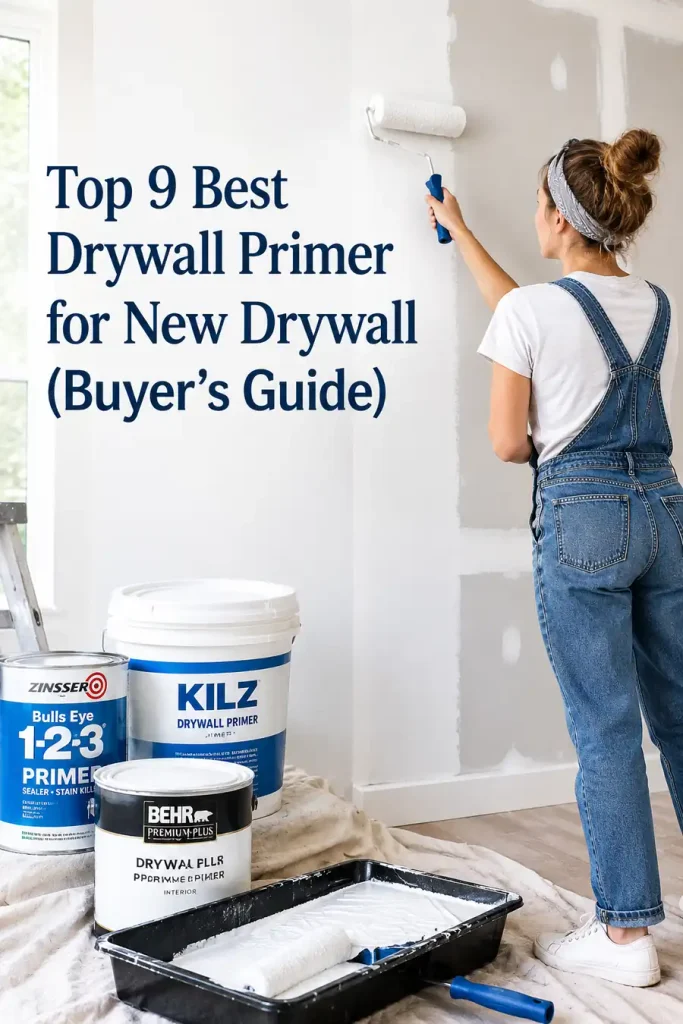
In this guide, we compare nine drywall primer options, explain which are best for new construction and DIY projects, and cover the steps that help you achieve a smooth, professional-looking finish.
Top 9 Best Drywall Primer for New Drywall: Quick Comparison
| Product Name | Best For | Check Price |
|---|---|---|
| 1. Zinsser Drywall Primer | Best overall for new drywall | Check on Amazon |
| 2. KILZ PVA Drywall Primer | Best dedicated PVA primer | Check on Amazon |
| 3. Zinsser PVA Professional Drywall Primer & Sealer | Best for large projects | Check on Amazon |
| 4. USG Sheetrock Brand First Coat Primer | Best for new gypsum board | Check on Amazon |
| 5. BEHR Drywall Plus Primer & Sealer | Best alternative for new drywall | Check on Amazon |
| 6. Glidden PVA Drywall Primer | Best budget-friendly option | Check on Amazon |
| 7. KILZ Drywall Primer & Sealer | Best straightforward drywall sealer | Check on Amazon |
| 8. KILZ PVA Zero VOC Interior Drywall Primer | Best zero-VOC option | Check on Amazon |
| 9. Zinsser Bulls Eye 1-2-3 Primer | Best versatile alternative | Check on Amazon |
Affiliate disclosure: As an Amazon Associate I earn from qualifying purchases.
Availability can vary by seller and location. The links above search Amazon for the named product; they do not guarantee that a particular listing or size is currently available.
1. Zinsser Drywall Primer
Best for: Sealing new drywall before painting
Zinsser Drywall Primer is a strong starting point for homeowners who want a product designed specifically for fresh, unpainted drywall. New drywall is porous, and the joint compound used to finish seams can absorb paint differently from the paper face. A dedicated drywall primer helps seal these areas and provides a more consistent base for the finish coat.
This water-based primer is designed to prepare new drywall for painting. The manufacturer highlights its ability to seal tape joints, dry quickly, and create a uniform base for topcoats. It is also designed to sand easily, which can help when a lightly textured or rough primer surface needs smoothing before painting.
For a standard bedroom, living room, hallway, or newly finished basement, this type of primer is often more appropriate than buying a specialty stain-blocking primer that your clean drywall does not need. It is still important to remove sanding dust and finish the joints properly before application.
Pros
- Designed specifically for new drywall.
- Helps seal porous paper and joint areas.
- Water-based formula with water cleanup.
- Sands easily when preparation requires it.
- Suitable for many standard interior painting projects.
Cons
- Does not replace proper joint finishing or sanding.
- May not be the right choice for serious stains or water damage.
- Coverage varies with drywall porosity and application method.
Buying tip: Choose the dedicated Zinsser Drywall Primer rather than assuming every Zinsser primer has the same purpose. If your walls are new and unpainted, a drywall-specific product is usually the most direct choice.
2. KILZ PVA Drywall Primer
Best for: New, uncoated drywall and large interior projects
KILZ PVA Drywall Primer is formulated specifically for new, uncoated drywall. PVA stands for polyvinyl acetate, a binder used in many drywall primers and sealers. The purpose is to seal the porous drywall surface and help the finish paint dry more evenly.
This is a practical option for new construction, additions, freshly finished bedrooms, and whole-house drywall projects. It is available in larger container sizes, which can be useful when priming multiple rooms. The manufacturer lists coverage of approximately 250–400 square feet per gallon, depending on surface texture, porosity, and application method.
One important detail is the recommended topcoat. The standard KILZ PVA Drywall Primer is designed for flat and low-sheen paints; the product information advises against using glossy finishes over it. If you plan to use a higher-sheen paint, check the exact primer’s label and choose a compatible system.
Pros
- Specifically designed for new, bare drywall.
- Helps create a uniform base for finish paint.
- Available in gallon and larger sizes.
- Water-based, with soap-and-water cleanup.
- Suitable for brush, roller, or approved spray application.
Cons
- Standard formulation is intended for flat and low-sheen topcoats.
- Thin primer can drip if applied too heavily.
- Not intended to solve active moisture or severe staining problems.
Buying tip: For a large project using flat or low-sheen wall paint, compare the cost of gallon and five-gallon containers. Estimate the wall area first, then account for waste and the product’s stated coverage range.
3. Zinsser PVA Professional Drywall Primer & Sealer
Best for: New drywall in large residential and commercial projects
Zinsser PVA Professional Drywall Primer & Sealer is another product made for sealing new drywall. It is aimed at residential and commercial applications, making it worth considering when several rooms need to be primed efficiently.
One of its main attractions is its quick turnaround. The manufacturer states that it can dry to the touch in about 15 minutes and be ready for recoating in approximately 45 minutes under the recommended conditions. Actual timing depends on temperature, humidity, ventilation, and how heavily the primer is applied.
Unlike some standard PVA primers, the product information states that this formulation can be topcoated with glossy finishes. That makes checking the exact product label especially important: do not assume that all PVA primers have identical topcoat restrictions.
Pros
- Designed for new drywall.
- Suitable for residential and commercial projects.
- Quick stated drying and recoat times.
- Can be used under glossy finishes according to the product information.
- Useful when project speed matters.
Cons
- Indoor use only.
- Fast drying still depends on environmental conditions.
- Does not replace a stain-blocking primer where stains are present.
Buying tip: If you are using satin, semi-gloss, or another higher-sheen finish, verify the current product label and topcoat compatibility before buying. For a multi-room project, compare larger containers and calculate the amount required.
4. USG Sheetrock Brand First Coat Primer
Best for: New interior gypsum board and uniform wall finishes
USG Sheetrock Brand First Coat Primer is designed to prepare new interior gypsum-panel walls and ceilings. Its purpose is to minimize differences in texture and porosity between drywall paper and joint compound, helping the finished wall look more uniform after painting or texturing.
This is a useful option when you want a product developed specifically for gypsum board rather than a general-purpose primer. It can be applied by brush, roller, or suitable spray equipment according to the manufacturer’s directions. USG lists approximate coverage of 180–200 square feet per gallon, so it is important to calculate the quantity needed rather than assuming it will cover as much area as a thinner PVA primer.
First Coat is particularly worth comparing for newly finished walls and ceilings where inconsistent absorption can make seams more visible under certain lighting. However, primer cannot fix poorly sanded joints, ridges, or other defects in the drywall finish itself.
Pros
- Designed for new interior gypsum panels.
- Helps equalize porosity and reduce visible joint banding.
- Can be applied by brush, roller, or sprayer.
- Useful for walls and ceilings.
- Developed by a manufacturer specializing in drywall systems.
Cons
- Stated coverage per gallon is lower than some other drywall primers.
- Intended for specific interior wall and ceiling applications.
- Does not eliminate the need for proper joint finishing.
Buying tip: Review the coverage information and application directions before estimating your purchase. For a large job, compare the total cost per square foot with other drywall-specific primers, not just the price of one container.
5. BEHR Drywall Plus Primer & Sealer
Best for: New drywall when you want to compare another dedicated primer
BEHR Drywall Plus Primer & Sealer is worth considering for freshly installed drywall. The purpose of a drywall primer is to reduce uneven absorption and create a more consistent surface for the finish paint. That is especially important where drywall paper meets joint compound, since these materials can otherwise produce visible differences in sheen.
For homeowners preparing several rooms, the most useful comparison points are coverage, price per gallon, drying time, and compatibility with the intended finish paint. Product names and formulations can vary across retail listings, so confirm that you are looking at the actual drywall primer rather than a different BEHR primer or a general-purpose paint-and-primer product.
Good surface preparation remains essential. Allow joint compound to dry fully, sand it smooth, and remove dust before priming. If the wall has water stains, smoke damage, or other discoloration, investigate the cause and choose a suitable stain-blocking product rather than relying on a standard drywall primer alone.
Pros
- An option to compare for new drywall preparation.
- Intended to help provide a more uniform base.
- Useful for comparing price and coverage with other drywall primers.
- Suitable for projects where its current label matches the surface and topcoat.
- Available through paint retailers, with online availability varying.
Cons
- Online listing names can be inconsistent.
- Availability and packaging can vary.
- A standard drywall primer is not a substitute for fixing moisture damage.
Buying tip: Verify the exact product name, intended surface, coverage, and topcoat instructions before purchasing. If you cannot confirm the listing is the drywall primer you need, choose a clearly identified drywall-specific product instead.
6. Glidden PVA Drywall Primer
Best for: Budget-conscious new drywall projects
Glidden PVA Drywall Primer is an option to investigate when you need to prime a large area without overspending. PVA drywall primers are generally designed to seal fresh, uncoated drywall and help the finish coat dry more evenly. This makes them useful for newly constructed rooms, rental renovations, and other projects where many walls need to be prepared.
When comparing budget primers, avoid looking only at the container price. Coverage, recommended application thickness, drying time, and topcoat compatibility all affect the final cost. A lower-priced primer may be a good value for a large project, but only if it is suitable for the surface and paint you plan to use.
Because product availability and names may differ by retailer, verify that the listing is actually a Glidden PVA drywall primer. Do not substitute ordinary wall paint or a different primer simply because it appears under the same brand.
Pros
- Worth comparing for larger budget-focused jobs.
- PVA drywall primers are intended to seal porous new drywall.
- Can be practical for standard interior painting when the label matches the job.
- May be available in larger containers, depending on the seller.
- Lets you compare total project cost with other dedicated primers.
Cons
- Availability may vary by market and retailer.
- Exact coverage and topcoat restrictions need to be checked.
- Standard PVA products may not be suitable for every glossy finish.
Buying tip: Before ordering, confirm the product label and compare the price per square foot of coverage. If you are planning to use semi-gloss or another higher-sheen finish, check the primer’s compatibility instructions first.
7. KILZ Drywall Primer & Sealer
Best for: Straightforward sealing of new, uncoated drywall
KILZ Drywall Primer & Sealer is another drywall-specific option for preparing new, uncoated walls before painting. It is intended to reduce excessive paint absorption and help prevent uneven sheen, often called flashing. This is the kind of primer to compare when the wall is newly installed, properly finished, and free from stains or moisture problems.
KILZ’s product range includes distinct drywall primer formulations, so make sure you are comparing the correct product. Some versions have specific limitations on the sheen of the topcoat. The standard product information recommends using it under low-sheen paints and advises against glossy finishes. Follow the instructions for the exact container you purchase.
For a typical new bedroom or living room, a drywall primer may be all you need before applying the finish paint. You do not usually need a stain-blocking primer unless the substrate has a stain or another condition that calls for one.
Pros
- Formulated for new, uncoated drywall.
- Helps seal the surface before finish painting.
- Designed to reduce uneven absorption.
- Water-based application and cleanup.
- Practical for routine interior wall preparation.
Cons
- The standard formulation has topcoat sheen restrictions.
- Not a solution for active leaks or severe stains.
- Coverage varies according to the wall’s condition and application method.
Buying tip: Read the product name carefully so you do not confuse KILZ Drywall Primer with KILZ PVA or KILZ 2 All-Purpose Primer. They are different products with different intended uses.
8. KILZ PVA Zero VOC Interior Drywall Primer
Best for: New drywall projects prioritizing a zero-VOC formulation
KILZ PVA Zero VOC Interior Drywall Primer is an alternative for buyers who want a drywall primer with a zero-VOC formulation. It is designed for new drywall and, according to its product information, can also be used on certain properly prepared plaster, wood, and previously coated interior surfaces.
That broader use can make it useful when the project includes a mix of new drywall and other approved interior surfaces. Still, read the product instructions closely rather than assuming it is suitable for every substrate or finish. Zero-VOC also does not mean that a product has no odor or that ordinary ventilation and safety precautions can be ignored.
For a newly finished room, its primary role remains sealing the porous drywall surface and helping the finish paint look more uniform. Make sure the joint compound is fully dry and the sanding dust has been removed before application.
Pros
- Zero-VOC formulation according to product information.
- Designed for new drywall.
- May be suitable for certain additional prepared interior surfaces.
- Helps create a more uniform base for topcoat.
- Useful for buyers comparing indoor-air-quality product specifications.
Cons
- Product availability may vary.
- You still need to verify topcoat and substrate compatibility.
- Zero-VOC does not eliminate the need to follow safety instructions.
Buying tip: Confirm that the listing explicitly says “Zero VOC” and matches the intended drywall primer. Compare the technical information with the standard KILZ PVA version before deciding which formulation fits your project.
9. Zinsser Bulls Eye 1-2-3 Primer
Best for: A versatile primer for projects involving more than new drywall
Zinsser Bulls Eye 1-2-3 is a general-purpose primer and sealer rather than a dedicated PVA drywall primer. It can be worth comparing if your project includes new drywall alongside properly prepared, previously painted, or other compatible surfaces. Its versatility is useful when one room contains several different materials that need priming.
For an entire house of fresh, uncoated drywall, a dedicated drywall primer may be the more economical and direct option. Bulls Eye 1-2-3 is better considered when you have a broader priming task or need a product with a wider range of approved applications. Always check the current label for the substrate, preparation requirements, and finish paint.
Remember that no general-purpose primer can make an unfinished or dusty drywall surface ready for paint without proper preparation. Remove dust, correct imperfections, and make sure the surface is sound before applying any primer.
Pros
- Versatile primer for many approved surfaces.
- Useful for mixed-material projects.
- Can be considered for selected drywall and repair situations.
- Practical when a project requires more than a basic drywall sealer.
- Available in a widely recognized primer range.
Cons
- May cost more than a dedicated PVA drywall primer.
- Not always the most economical choice for large areas of new drywall.
- Product suitability depends on the exact surface and conditions.
Buying tip: Choose Bulls Eye 1-2-3 when its broader uses are relevant to your project. For simple new drywall throughout a house, compare it against dedicated drywall primers before spending extra.
Why New Drywall Needs Primer
New drywall has a paper face and areas covered with joint compound. These materials absorb paint differently. If finish paint is applied directly, the wall can show uneven sheen, visible seams, or patches that look different depending on the lighting.
Drywall primer helps by:
- Sealing the porous surface.
- Reducing differences in absorption between paper and joint compound.
- Creating a more consistent base for finish paint.
- Helping the finish coat spread more evenly.
- Potentially reducing the number of finish coats needed.
Primer cannot hide every defect. Raised seams, deep sanding scratches, dents, and poorly finished joints should be corrected before priming. The smoother the drywall finish, the better the final paint is likely to look.
PVA Primer vs. General-Purpose Primer
| Feature | PVA Drywall Primer | General-Purpose Primer |
|---|---|---|
| Main purpose | Seal new, porous drywall | Serve a wider range of priming needs |
| Typical use | Fresh, uncoated drywall | Compatible drywall, repairs, and other approved surfaces |
| Large new-build projects | Often economical | May cost more per area |
| Stain blocking | Usually limited | Depends on the formulation |
| Topcoat compatibility | Check exact label; some restrict sheen | Check exact label and finish recommendations |
| Best reason to choose it | New drywall is the main surface | The project includes other surfaces or special needs |
For ordinary new drywall, a dedicated drywall primer is usually the most straightforward choice. A general-purpose primer can make sense when the project includes several materials or when its specific performance features are needed.
How to Choose the Best Drywall Primer for New Drywall
1. Check the drywall condition
If the drywall is new, unpainted, properly sanded, and free of stains, a dedicated drywall primer is a good starting point. If the surface has water marks, smoke damage, or other discoloration, first identify and resolve the cause, then select a primer designed for that condition.
2. Match the primer to your finish paint
Some drywall primers are intended for flat or low-sheen paints, while other formulations permit higher-sheen topcoats. Check the label before pairing a primer with satin, semi-gloss, or gloss paint.
3. Compare coverage
Coverage depends on porosity, surface texture, and application method. Use the manufacturer’s stated coverage as a planning estimate rather than a guarantee. Spraying can also result in more material loss than brushing or rolling.
4. Consider the size of the job
For one small room, a gallon may be enough depending on the surface area. For a whole house or several rooms, compare larger containers and calculate cost per square foot. Do not buy more than you can reasonably store and use according to the product instructions.
5. Think about drying and recoat times
Quick-drying products may help contractors and DIY painters move efficiently between stages. However, drying time depends on temperature, humidity, ventilation, and coat thickness. Follow the label instead of relying on a generic drying-time estimate.
6. Decide whether zero VOC matters to you
If indoor air quality is a priority, compare products that are explicitly labeled zero VOC or low VOC. These terms refer to different specifications, so read the current product information and follow ventilation directions even when using a low- or zero-VOC product.
7. Avoid paying for features you do not need
Fresh drywall generally needs sealing and uniform absorption, not necessarily a specialized stain blocker. Choose a more specialized primer only when the wall condition or project requirements justify it.
How to Prime New Drywall Step by Step
Step 1: Finish the joints
Make sure tape, joint compound, screw heads, and corners have been properly finished. Allow the compound to dry fully before sanding or priming.
Step 2: Sand the surface smooth
Sand ridges and rough areas carefully. Avoid damaging the drywall paper while sanding, since torn or fuzzy paper can create additional preparation problems.
Step 3: Remove dust
Vacuum the wall with a suitable brush attachment or use an appropriate dust-removal method. Fine sanding dust can interfere with the primer’s performance and create a rough finish.
Step 4: Protect the room
Cover floors and nearby surfaces. Mask trim, windows, and other areas that should not receive primer. If spraying, use appropriate masking and ventilation.
Step 5: Stir the primer
Mix the product thoroughly according to the label. Do not add water or other materials unless the manufacturer explicitly permits it.
Step 6: Cut in the edges
Use a suitable brush to apply primer around corners, ceilings, outlets, and other areas that are difficult to reach with a roller. Keep the coat even and avoid heavy buildup.
Step 7: Roll the main surfaces
Use a compatible roller cover and work in manageable sections. Apply an even coat without leaving heavy ridges, dry patches, or excess primer at the edges.
Step 8: Let the primer dry
Follow the product’s stated drying and recoat times. Temperature, humidity, and airflow can change how quickly the surface dries.
Step 9: Inspect the wall
Once dry, check for missed areas, rough spots, or defects that remain visible. Correct imperfections as needed and remove any dust before continuing.
Step 10: Apply the finish paint
Apply the finish paint according to its label. Many projects use one primer coat followed by two finish coats, but the exact number depends on the products, coverage, and desired appearance.
Common Mistakes to Avoid
Skipping primer
Directly painting new drywall can cause uneven absorption and visible patches. Use a suitable drywall primer unless the coating manufacturer’s instructions specify a different system.
Painting over sanding dust
Dust can compromise the finish and leave a rough surface. Remove it thoroughly before priming.
Using primer to hide poor drywall work
Primer will not repair raised joints, deep scratches, or poorly filled holes. Fix visible defects before painting.
Ignoring the topcoat restrictions
Some PVA primers are designed for flat or low-sheen paint only. Confirm compatibility if you plan to use satin, semi-gloss, or gloss.
Applying an excessively thick coat
Too much primer can drip, dry unevenly, or waste material. Follow the manufacturer’s coverage and application instructions.
Rushing the drying time
A primer that feels dry may not be ready for the next coat under all conditions. Follow the specified recoat interval.
Using a stain-blocking primer without a reason
Standard new drywall generally calls for a drywall sealer. If the wall has stains or water damage, choose a product suited to that specific problem after resolving its cause.
Assuming all primers are interchangeable
PVA drywall primer, general-purpose primer, bonding primer, and stain-blocking primer serve different purposes. Match the product to the actual surface and job.
Frequently Asked Questions
What is the best primer for new drywall?
A dedicated drywall primer is usually the best starting point for new, uncoated drywall. Zinsser Drywall Primer, KILZ PVA Drywall Primer, and Zinsser PVA Professional are options to compare. The best choice depends on the finish paint, project size, and product-label requirements.
Is PVA primer necessary on new drywall?
A drywall primer is strongly recommended because it helps seal the porous surface and reduce differences in absorption between drywall paper and joint compound. PVA primers are a common choice for this purpose.
Can I paint new drywall without primer?
You can apply paint directly, but the result may show uneven sheen, visible seams, and inconsistent coverage. Priming first usually provides a more uniform base and can reduce the amount of finish paint needed.
How many coats of primer does new drywall need?
One properly applied coat is commonly sufficient for ordinary new drywall. Very porous areas, missed spots, or product-specific instructions may require additional attention. Follow the primer manufacturer’s directions.
Should I use PVA primer or Bulls Eye 1-2-3?
For a large area of fresh, uncoated drywall, a dedicated PVA or drywall primer is often the direct and economical choice. Bulls Eye 1-2-3 is a versatile alternative when you also need to prime other compatible surfaces.
Can I use drywall primer under semi-gloss paint?
It depends on the exact primer. Some PVA primers restrict the topcoat to flat and low-sheen finishes, while certain other drywall primers allow glossy finishes. Check the product label before purchasing.
Does drywall primer hide seams?
Primer helps reduce the appearance of seams caused by uneven absorption, but it cannot conceal poorly finished joints or major surface defects. Sand and finish the drywall correctly before priming.
How long should drywall primer dry before painting?
Drying and recoat times vary by formulation and conditions. Follow the label for the exact product and allow additional time if the room is cool, humid, or poorly ventilated.
Do I need a stain-blocking primer on new drywall?
Not usually, if the drywall is clean, new, and uncoated. Stain-blocking products are intended for specific problems such as discoloration or stains. Resolve leaks or moisture issues before priming damaged surfaces.
Can I spray drywall primer?
Many drywall primers can be sprayed, but the product must permit that application method and the equipment must be appropriate. Follow the label for any thinning, tip, pressure, ventilation, and protective-equipment requirements.
Is zero-VOC drywall primer better?
A zero-VOC formulation may be attractive when indoor air quality is a priority. It does not automatically mean the product is best for every job, and you should still follow the label’s ventilation and safety instructions.
Should I sand after priming new drywall?
Inspect the dry primer first. If small rough spots or raised fibers remain, light sanding may help, provided the product allows it. Remove all sanding dust before applying the finish paint.
Final Words
The best drywall primer for new drywall is one that seals the surface, reduces uneven absorption, and works with your chosen finish paint. Zinsser Drywall Primer, KILZ PVA Drywall Primer, Zinsser PVA Professional, and USG Sheetrock Brand First Coat are dedicated options worth comparing for fresh drywall.
Before buying, verify the exact product name, coverage, topcoat compatibility, and drying instructions. Then take time to finish the joints, remove sanding dust, apply an even coat, and let the primer dry properly. Careful preparation is the key to a smoother and more consistent painted wall.