
Can you ceramic coat matte paint? Yes, you can. In fact, ceramic coatings specifically formulated for matte and satin finishes are designed to protect these surfaces while preserving their distinctive low-sheen appearance. The important part is choosing the right coating rather than automatically applying a conventional gloss-oriented ceramic coating. Current matte-specific products are formulated to provide hydrophobicity, UV and chemical resistance, and easier maintenance without intentionally adding gloss.
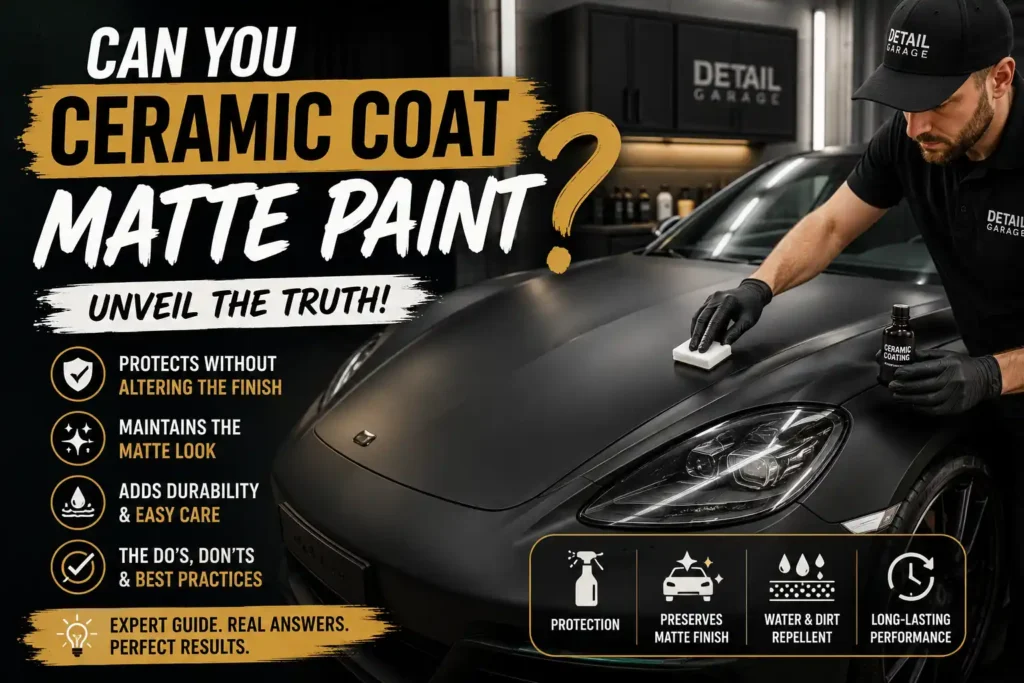
Matte paint does require more careful preparation and maintenance than traditional glossy paint. Its appearance depends on the surface texture that scatters light, so aggressive polishing or an incompatible product can create unwanted changes in sheen. With the correct coating and careful application, however, you can protect the finish while keeping the unique matte look intact.
What Is Matte Paint?
Matte automotive paint has a distinctive non-reflective or low-reflective appearance.
Unlike a traditional glossy finish, which reflects light strongly from a smooth surface, matte finishes scatter light across their microscopic surface texture. This creates the soft, muted appearance that makes matte vehicles stand out.
That texture is also why matte paint needs special treatment.
With conventional glossy paint, imperfections can often be corrected through polishing. Matte surfaces generally cannot be treated the same way because aggressive mechanical polishing can change the surface appearance.
Can You Ceramic Coat Matte Paint?
Yes. Matte paint can be ceramic coated, but choosing a coating specifically intended for matte or satin surfaces is the safest approach.
Several manufacturers now offer dedicated matte ceramic coatings. For example, GYEON’s Q² Matte EVO is specifically designed for matte and satin paint, PPF, and vinyl and is formulated not to add gloss. Dr. Beasley’s Matte Paint Coating similarly states that it preserves the muted appearance of matte and satin finishes.
The goal isn’t to make matte paint behave exactly like glossy paint. Instead, the coating adds a protective layer while maintaining the characteristics that make the finish matte.
Will Ceramic Coating Make Matte Paint Glossy?
This is one of the biggest concerns among matte-car owners.
A properly selected matte-specific ceramic coating should not turn the finish glossy.
Dedicated matte coatings are formulated specifically to preserve the original appearance. GYEON, for example, states that its matte coating does not add gloss or alter the original finish, while Dr. Beasley’s product is designed to retain the muted sheen of matte paint.
However, that doesn’t mean every coating on the market should automatically be considered safe for matte paint.
Always check the manufacturer’s compatibility information before application.
Why Ceramic Coat Matte Paint?
Ceramic coating can offer several valuable benefits for a matte vehicle.
1. Water Repellency
One of the most noticeable advantages is hydrophobic behavior.
Water tends to bead and move away from the surface instead of spreading across it.
This can make routine washing and drying easier.
2. Easier Cleaning
Matte paint can be difficult to clean because you don’t want to aggressively scrub the surface.
A suitable ceramic coating can reduce the tendency of dirt and contamination to remain attached, making gentle washing more effective.
Dedicated matte coatings are specifically marketed for self-cleaning and easier maintenance.
3. UV Protection
Sunlight can contribute to long-term fading and deterioration.
Many matte ceramic coatings are formulated with UV resistance to help protect the finish from prolonged environmental exposure.
4. Chemical Resistance
Road grime, environmental contaminants, bird droppings, and other substances can be troublesome for matte finishes.
Ceramic coatings can add a layer of chemical and contamination resistance, helping make the surface easier to maintain.
5. Better Stain Resistance
Matte surfaces can be particularly frustrating when stains become visible.
A suitable coating can reduce the tendency of contaminants to bond strongly to the surface.
Ceramic Coating Vs Wax for Matte Paint
Traditional waxes are often designed to enhance shine.
That’s not necessarily what you want on matte paint.
If you want to preserve the factory matte appearance, choose a product specifically labeled as compatible with matte or satin finishes.
A dedicated matte ceramic coating is designed to provide protection and water repellency without intentionally creating the glossy appearance associated with many traditional paint-protection products.
Ceramic Coating Vs Paint Protection Film
Ceramic coating and paint protection film perform different jobs.
| Feature | Ceramic Coating | Paint Protection Film |
|---|---|---|
| Preserves matte appearance | Yes, with compatible coating | Yes, with matte film |
| Water repellency | Excellent | Good, especially when coated |
| Easier cleaning | Yes | Yes |
| UV protection | Yes | Yes |
| Chemical resistance | Yes | Yes |
| Rock-chip protection | No | Yes |
| Impact protection | No | Yes |
| Light scratch protection | Limited | Better |
| Self-healing | Generally no | Available with some films |
If your primary concern is rock chips, PPF is the stronger choice.
If your priority is easier cleaning, hydrophobicity, and surface protection, ceramic coating is attractive.
For maximum protection, some owners use matte PPF with a compatible ceramic coating.
Can You Ceramic Coat Matte PPF?
Yes, but again, compatibility matters.
Some matte ceramic coatings are specifically designed for:
- Matte paint
- Satin paint
- Matte PPF
- Matte vinyl
- Satin vinyl
GYEON and FEYNLAB, for example, both describe their matte coating products as suitable for matte PPF and vinyl in addition to matte or satin paint.
Never assume that a coating designed for glossy paint or ordinary PPF is automatically suitable for matte film.
How to Ceramic Coat Matte Paint
Step 1: Choose a Matte-Specific Coating
Start by selecting a ceramic coating whose manufacturer explicitly states that it is compatible with matte or satin paint.
This is the most important decision in the entire project.
Step 2: Read the Instructions
Every coating has different requirements for:
- Surface preparation
- Temperature
- Humidity
- Application
- Flash time
- Removal
- Curing
Follow the specific product instructions.
Step 3: Wash the Vehicle
Thoroughly clean the vehicle using products appropriate for matte finishes.
Remove loose dirt, road grime, and other contaminants without aggressive scrubbing.
Step 4: Decontaminate Carefully
Matte paint needs a more cautious approach to decontamination.
Chemical decontamination may be preferable to aggressive mechanical methods because altering the surface texture can change the appearance.
Step 5: Dry the Vehicle
Dry the surface completely.
Pay attention to:
- Trim
- Seams
- Panel gaps
- Emblems
- Door handles
Water left behind can interfere with coating application.
Step 6: Inspect the Finish
Look closely for:
- Water spots
- Stains
- Contamination
- Scratches
- Existing coating
- Uneven areas
Don’t immediately reach for a polishing machine if you find imperfections.
Step 7: Avoid Conventional Paint Correction
This is one of the most important differences between matte and glossy paint.
Traditional polishing can change the surface texture and create shiny patches.
If the vehicle requires significant correction, consult a professional who specifically works with matte finishes.
Step 8: Use the Recommended Prep Product
Prepare the surface using the coating manufacturer’s recommended cleanser or panel-preparation product.
The surface should be clean and free from residues before coating.
Step 9: Apply the Coating
Work on a manageable section at a time.
Apply the product evenly according to the manufacturer’s instructions.
Don’t rush.
Step 10: Watch the Flash Time
The coating needs to be removed or leveled within the manufacturer’s recommended window.
Don’t guess based on how another coating behaves.
Step 11: Level the Coating
Use clean microfiber towels as directed.
Inspect the panel carefully for uneven residue.
Step 12: Check for High Spots
Look at the panel from different angles and under appropriate lighting.
High spots or uneven residue can be much more difficult to correct on matte paint than on glossy paint.
Step 13: Allow the Coating to Cure
Keep the vehicle in the recommended conditions during the initial curing period.
Follow the manufacturer’s instructions regarding water exposure and handling.
Why Matte Paint Requires Extra Care
Matte paint isn’t simply glossy paint with less shine.
Its appearance depends on the way light interacts with its surface.
That’s why conventional paint correction isn’t a simple option when something goes wrong.
If a glossy surface develops a polishing mark, a professional can often correct it with additional polishing.
With matte paint, aggressive polishing can itself alter the finish.
This makes prevention and careful application especially important.
Can You Polish Matte Paint Before Ceramic Coating?
Generally, conventional polishing should be avoided.
Traditional paint correction removes or changes a microscopic amount of the surface to reduce defects and create a more reflective finish.
That’s the opposite of what you want with matte paint.
If your matte vehicle has serious scratches, stains, or surface defects, professional evaluation is a better option than attempting ordinary machine polishing.
What Happens If You Use the Wrong Coating?
The result can range from an unwanted change in appearance to uneven sheen or difficult-to-remove coating residue.
A conventional gloss-enhancing coating may not be appropriate for a matte finish.
Dedicated matte products are specifically formulated to maintain the original appearance.
For an expensive factory-matte vehicle, it’s worth treating product compatibility as a requirement rather than an optional consideration.
Best Features to Look for in a Matte Ceramic Coating
When comparing products, look for:
Matte Compatibility
The manufacturer should specifically mention matte and/or satin finishes.
No-Gloss Appearance
Look for a formulation designed to preserve the existing appearance.
Hydrophobic Protection
Water repellency makes maintenance easier.
UV Resistance
Useful for vehicles regularly exposed to sunlight.
Chemical Resistance
Helpful against environmental contaminants.
Clear Application Instructions
A detailed application process is particularly valuable when working with a surface that is difficult to correct.
How to Maintain Ceramic-Coated Matte Paint
Ceramic coating doesn’t eliminate maintenance.
It makes maintenance easier when used correctly.
Wash Regularly
Don’t allow heavy contamination to remain on the vehicle for extended periods.
Use Matte-Safe Products
Choose cleaning products specifically approved for matte finishes.
Avoid Abrasive Products
Don’t use polishing compounds, aggressive cleaners, or abrasive pads unless a professional specifically recommends them.
Use Clean Microfiber Towels
Dirty towels can drag contaminants across the surface.
Remove Bird Droppings Promptly
Highly acidic or aggressive contaminants should not be allowed to remain on the finish unnecessarily.
Follow the Coating’s Maintenance Recommendations
Some coatings have specific maintenance products or washing recommendations.
Common Mistakes to Avoid
Using Any Ceramic Coating
Not every ceramic coating is formulated for matte surfaces.
Polishing the Finish
Conventional polishing can create shiny spots.
Using Gloss-Enhancing Products
These may interfere with the appearance you’re trying to preserve.
Scrubbing Too Hard
Use gentle washing techniques.
Ignoring Contamination
Matte surfaces should be maintained regularly.
Applying the Coating Without Testing
If you’re uncertain about compatibility, test the complete system in an inconspicuous location first.
Rushing the Curing Process
Give the coating adequate time to cure before exposing the vehicle to harsh conditions.
Is Ceramic Coating Worth It for Matte Paint?
For many matte vehicle owners, yes.
The biggest advantage isn’t simply visual enhancement. It’s the ability to make the finish easier to clean while adding protection against environmental contamination.
A suitable matte ceramic coating can provide:
- Hydrophobicity
- Easier maintenance
- UV resistance
- Chemical resistance
- Contamination resistance
- Protection from light wash marks
Dedicated matte coatings from current manufacturers are specifically designed around these goals.
Should You DIY or Hire a Professional?
DIY application is possible if you have experience with ceramic coatings and carefully follow the product instructions.
However, matte paint leaves less room for error.
A professional may be the better choice if:
- The vehicle is expensive
- The finish is factory matte
- You have never applied ceramic coating
- The vehicle has complex bodywork
- The surface already has stains or defects
- You aren’t comfortable managing flash times
The key isn’t simply getting the coating onto the paint. It’s getting an even, clean application without changing the appearance.
Matte Paint Ceramic Coating Pros and Cons
Pros
- Preserves the matte appearance when the correct product is used
- Provides water repellency
- Makes washing easier
- Helps resist environmental contamination
- Can provide UV protection
- Adds chemical resistance
- Helps reduce light wash marks
- Can extend the useful appearance of the finish
Cons
- Not every ceramic coating is suitable
- Application requires care
- Matte paint is difficult to correct after mistakes
- Ceramic coating doesn’t prevent rock chips
- It doesn’t make the surface scratch-proof
- Professional installation can be expensive
FAQs
Can you ceramic coat matte paint?
Yes. Choose a ceramic coating specifically designed or approved for matte and satin finishes.
Will ceramic coating make matte paint shiny?
A properly formulated matte ceramic coating is designed to preserve the original low-sheen appearance rather than add conventional gloss.
Can I use regular ceramic coating on matte paint?
Don’t assume it is safe. Check the manufacturer’s compatibility information. A dedicated matte coating is the safer choice when preserving the original appearance is important.
Does ceramic coating protect matte paint from scratches?
It can provide some resistance to light wash marks and surface contamination, but ceramic coating does not make matte paint scratch-proof.
Does ceramic coating prevent rock chips?
No. Ceramic coating is not a substitute for paint protection film.
Can you ceramic coat matte PPF?
Yes, when the ceramic coating is specifically approved for matte PPF. Several dedicated products are designed for matte paint, PPF, and vinyl.
Can you polish matte paint?
Conventional polishing is generally not recommended because it can alter the surface texture and create unwanted shiny areas.
How long does matte ceramic coating last?
Longevity varies by product, installation, climate, vehicle use, and maintenance. Current manufacturer claims range from around one to several years, so always check the specifications of the particular coating you choose.
Is ceramic coating better than wax for matte paint?
A matte-specific ceramic coating is generally a better option when you want durable hydrophobic protection without intentionally adding gloss. Avoid ordinary gloss-enhancing products unless they are specifically approved for matte finishes.
Should I ceramic coat a new matte car?
Yes, it can be a good way to protect a new finish from environmental contamination and make maintenance easier. Just ensure the coating is specifically compatible with the factory finish.
Final Verdict
So, can you ceramic coat matte paint? Absolutely—but choosing the right product is crucial.
Modern matte-specific ceramic coatings are designed to protect matte and satin finishes while preserving their characteristic appearance. They can add hydrophobicity, improve cleaning, and provide resistance against UV exposure, chemicals, and environmental contamination without intentionally turning the surface glossy.
The biggest rule is simple: don’t treat matte paint like ordinary glossy paint. Avoid conventional polishing, aggressive cleaning, and incompatible gloss-enhancing products. If the vehicle is valuable or you have little coating experience, professional installation can be worthwhile. With the right coating, careful preparation, and proper maintenance, you can enjoy the distinctive matte appearance while giving it an additional layer of long-term protection.