
Learning how to draw a kitten is a fun and rewarding project for beginners. Kittens have adorable round faces, oversized eyes, tiny paws, pointed ears, and soft fluffy bodies that can be simplified into basic shapes. You don’t need advanced drawing skills to create a charming kitten when you build the illustration gradually.
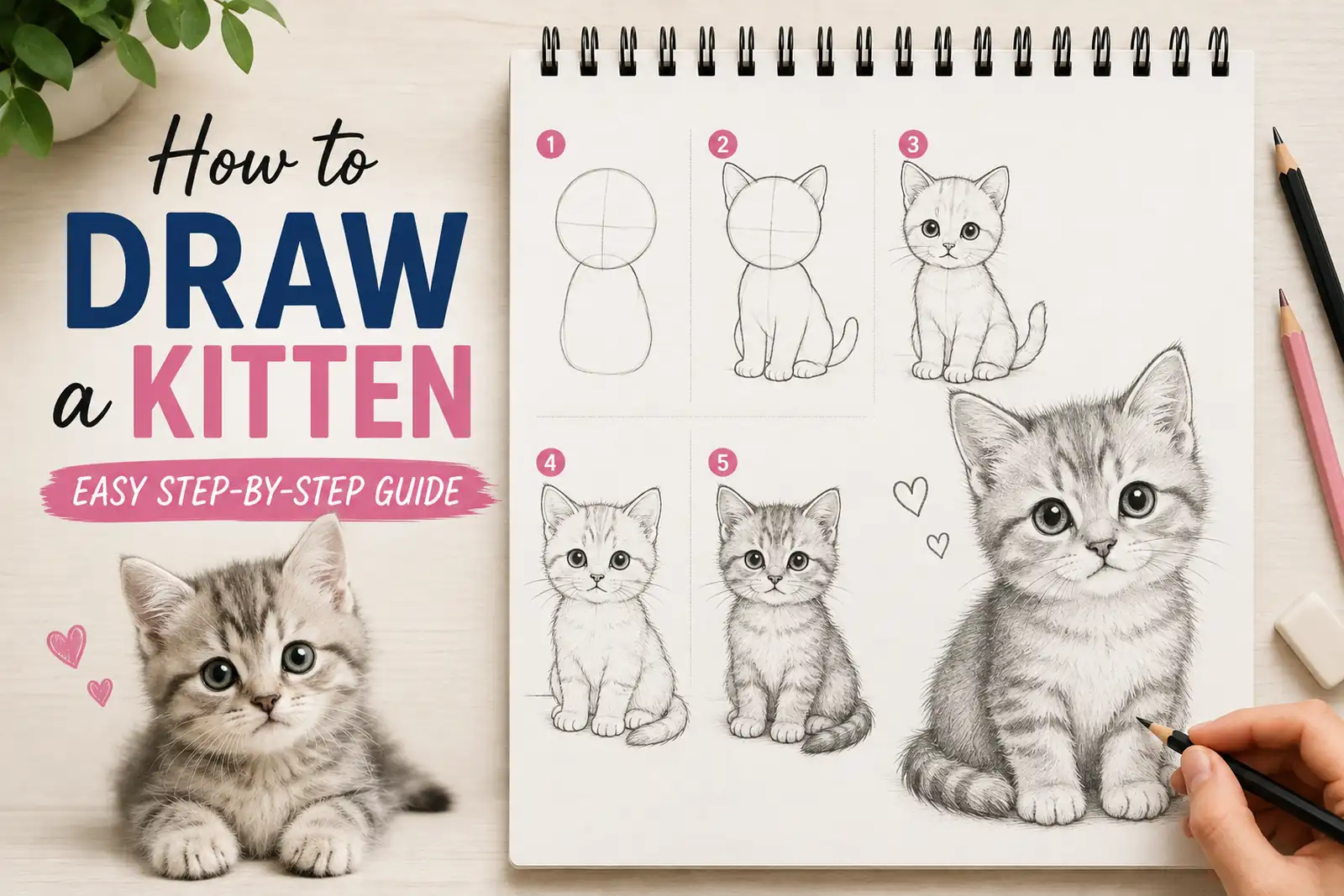
The easiest approach is to sketch the head and body first, then add the ears, eyes, nose, paws, tail, and fur. Once the basic proportions look right, you can add shading, texture, and color. Follow these simple steps to create a cute cartoon kitten or turn your sketch into a more realistic furry companion.
Items to Buy
- Drawing paper
- HB pencil
- 2B pencil
- 4B pencil
- Eraser
- Kneaded eraser
- Sharpener
- Fine-tip black pen
- Gray colored pencil
- Pink colored pencil
- Brown colored pencil
- Black colored pencil
- White colored pencil
- Blue colored pencil
- Green colored pencil
Why Draw a Kitten?
Kittens are excellent subjects for beginners because their bodies can be built from simple rounded shapes.
Drawing a kitten helps you practice:
- Circles and ovals
- Animal proportions
- Facial features
- Pointed ears
- Paws
- Fur texture
- Whiskers
- Curved tails
- Shading
- Expressions
You can draw a kitten sitting, sleeping, playing, stretching, or chasing a toy.
How to Draw a Kitten Step by Step
Step 1: Sketch the Head
Start with a large, slightly rounded circle for the kitten’s head.
Don’t make it perfectly geometric. A soft, slightly irregular shape will look more natural.
Use very light pencil strokes because you’ll add the ears and facial features around this basic shape.
Step 2: Add the Body
Draw a smaller oval beneath the head for the kitten’s body.
Keep the body rounded and slightly fluffy.
For a sitting kitten, make the torso upright and compact. If you’re drawing a standing kitten, extend the body horizontally.
Step 3: Draw the Ears
Add two triangular ears at the top of the head.
Round the corners slightly rather than making them perfectly sharp.
Then draw smaller shapes inside each ear to represent the inner ear.
For a cute kitten, slightly enlarge the ears to emphasize its youthful appearance.
Step 4: Add the Eyes and Face
Place two large eyes in the upper-middle portion of the face.
Kittens often have proportionally large eyes, so don’t make them too small.
Add a tiny triangular nose between the eyes, followed by a small curved mouth underneath.
You can add highlights inside the eyes to make them look bright and expressive.
Step 5: Draw the Muzzle and Whiskers
Create two soft rounded muzzle shapes around the nose.
Then draw several thin whiskers extending outward from both sides of the face.
Keep the whiskers light and curved.
Avoid making them too thick because delicate lines look more natural.
Step 6: Add the Legs and Paws
Sketch the kitten’s legs beneath the body.
For a sitting kitten, the front legs can extend straight downward while the rear legs remain tucked beside the body.
Add small rounded paws at the bottom.
Use a few short lines to indicate individual toes.
Step 7: Draw the Tail
Extend a curved tail from the side or back of the body.
You can make the tail curl around the kitten’s feet for a cute sitting pose.
For a fluffy kitten, use a slightly wider tail with small uneven strokes along the edge.
Step 8: Add Fur Texture
Now begin adding short fur strokes.
Follow the natural direction of the fur around the:
- Face
- Cheeks
- Ears
- Chest
- Back
- Legs
- Tail
Don’t draw every individual hair. Concentrate on small groups of strokes around the edges and important areas.
Step 9: Add Shading and Color
Choose your kitten’s coat color.
You can create a:
- Gray kitten
- White kitten
- Black kitten
- Orange kitten
- Brown kitten
- Cream kitten
- Tabby kitten
Use darker shading beneath the chin, around the legs, inside the ears, and underneath the body.
Leave lighter areas on the forehead, cheeks, and chest to create dimension.
Step 10: Finish the Drawing
Clean up the construction lines and strengthen the important contours.
Add small details such as:
- Eyebrow markings
- Stripes
- Spots
- Paw pads
- Fur tufts
- Collar
- Tiny bell
Then add a simple background such as a blanket, floor, garden, or cozy basket.
How to Draw a Cute Kitten
To make your kitten extra adorable, exaggerate its youthful proportions.
Make the:
- Head large
- Eyes big
- Nose small
- Ears slightly oversized
- Body round
- Paws tiny
Give it a gentle smile or curious expression.
A curled tail and slightly tilted head can make the pose even more charming.
How to Draw a Realistic Kitten
For a realistic kitten, focus on anatomy and fur direction.
Keep the head rounded but proportionate to the body.
Use layered pencil strokes to create soft fur rather than drawing individual hairs everywhere.
Pay special attention to the eyes because realistic eyes can make the entire drawing feel more lifelike.
How to Draw a Sitting Kitten
Start with the head and upright body.
Draw the front legs vertically beneath the chest.
Then sketch the hind legs folded beside the body.
Place the tail around the paws or along the ground.
This is one of the easiest kitten poses for beginners.
How to Draw a Sleeping Kitten
Create a rounded body curled into a compact shape.
Draw the head resting against the front paws.
Close the eyes with simple curved lines.
Wrap the tail around the body and add soft fur strokes to emphasize the cozy pose.
How to Draw a Kitten With Colored Pencils
Begin with a light base color.
Build darker layers around the ears, cheeks, back, legs, and tail.
For a tabby kitten, add darker stripes across the forehead, cheeks, body, and tail.
Use pink inside the ears and around the nose.
Leave small white highlights inside the eyes.
How to Draw a Kitten With Watercolors
Start with a light pencil outline.
Apply a pale base wash over the body.
Allow it to dry before adding darker areas.
Use a fine brush for the eyes, nose, whiskers, and fur markings.
For a fluffy appearance, leave small areas of paper visible between some brushstrokes.
How to Make Kitten Fur Look Realistic
The secret to realistic fur is following its natural direction.
Use shorter strokes around the face and longer strokes around the body and tail.
Keep the fur darker in shadowed areas.
Don’t make every stroke equally dark or the kitten may look flat and overly outlined.
Vary the length, pressure, and direction of your pencil strokes.
Common Mistakes to Avoid
Making the Eyes Too Small
Large eyes help create the youthful appearance of a kitten.
Making the Ears Too Sharp
Use gently rounded triangular shapes.
Drawing Fur With Long Lines
Short layered strokes generally look more natural.
Forgetting the Whiskers
A few delicate whiskers add personality and realism.
Making the Body Too Thin
Kittens generally have soft, rounded proportions.
Overworking the Face
Keep the facial features clean and avoid adding too many unnecessary lines.
Easy Kitten Drawing Ideas
Cute Cartoon Kitten
Use oversized eyes, large ears, and a round body.
Fluffy Kitten
Emphasize the fur around the cheeks, chest, and tail.
Sleeping Kitten
Draw the kitten curled up with its eyes closed.
Tabby Kitten
Add stripes across the forehead, cheeks, body, and tail.
Kitten With a Ball
Place a small toy near its front paws for a playful scene.
Kitten in a Basket
Draw the kitten curled inside a cozy basket with a soft blanket.
FAQs
Is a kitten easy to draw?
Yes. A kitten can be created using simple circles, ovals, triangles, and curved lines, making it suitable for beginners.
What should I draw first?
Start with the head and body, then add the ears, facial features, legs, paws, and tail.
How do I draw kitten eyes?
Use two large rounded shapes with dark pupils and small highlights. Large expressive eyes work especially well for cute kittens.
How do I draw fluffy kitten fur?
Use short, layered pencil strokes that follow the natural direction of the fur.
How do I make a kitten look cute?
Give it a large head, big eyes, small nose, rounded body, and slightly oversized ears.
What colors can I use?
Gray, orange, black, white, cream, brown, and mixed tabby patterns all work beautifully.
How do I draw a sleeping kitten?
Curl the body into a compact shape, place the head against the paws, close the eyes, and wrap the tail around the body.
Can beginners draw realistic kittens?
Absolutely. Start with basic proportions and gradually add fur texture, shading, whiskers, and detailed eyes.
What pencil should I use?
Use an HB pencil for the initial sketch and 2B or 4B pencils for darker details and shadows.
Final Words
Learning how to draw a kitten becomes much easier when you break the animal into simple shapes. Begin with the rounded head and body, then add the pointed ears, large eyes, tiny nose, paws, and curved tail. Once your basic proportions are correct, short fur strokes and gentle shading can give your kitten a soft, realistic appearance.
After mastering the basic pose, try different styles and personalities. Draw a playful kitten chasing a toy, a fluffy kitten sleeping in a basket, or a striped kitten sitting curiously. With regular practice, you’ll become more confident drawing animal proportions, expressive faces, soft fur, paws, whiskers, and adorable poses.