
Learning how to paint flowers on the wall is a creative way to transform an ordinary room into a personalized space filled with color and character. You don’t need to be a professional artist to create beautiful floral wall art. With a few basic supplies, a simple sketch, and the right painting technique, you can create everything from delicate botanical branches to oversized statement blooms.
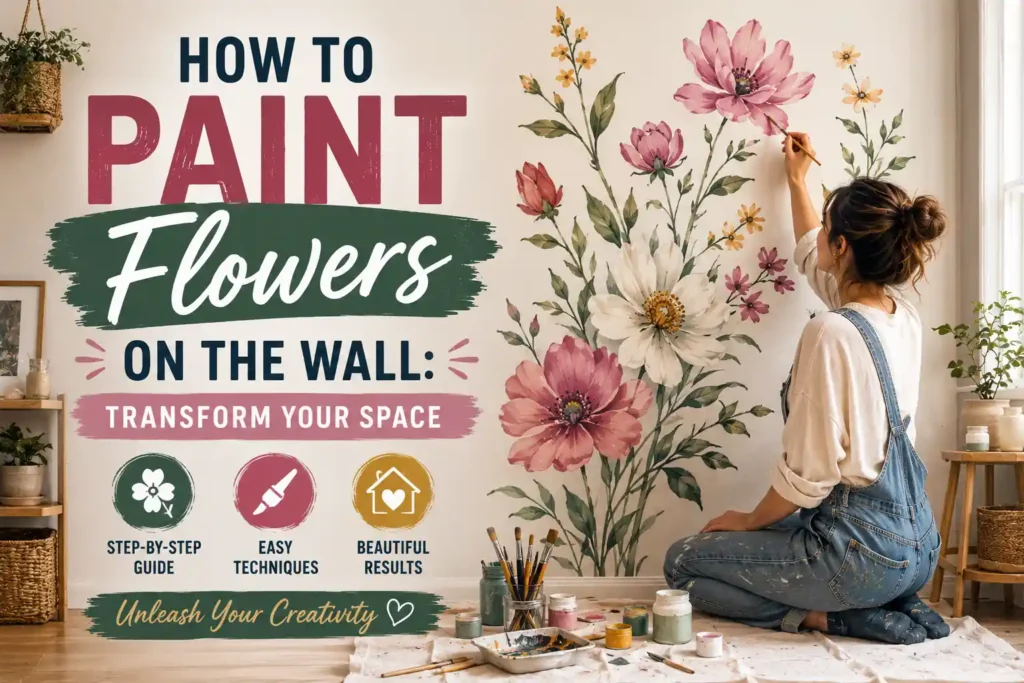
Whether you’re decorating a bedroom, nursery, living room, hallway, or creative workspace, wall flowers can suit almost any interior style. You can keep the design minimal with a few small blossoms or create a dramatic mural covering an entire feature wall. The key is choosing the right colors, planning your layout, and working from large shapes toward smaller details.
Items to Buy
- Interior wall paint
- Acrylic or wall-compatible craft paint
- Small paintbrushes
- Medium paintbrushes
- Detail brushes
- Foam brushes
- Paint palette
- Pencil
- Measuring tape
- Level
- Painter’s tape
- Drop cloth
- Sponge
- Clean cloth
- Small container for water
- Stencils, if desired
- Clear protective finish, if appropriate
Why Paint Flowers on a Wall?
Floral wall painting can completely change the personality of a room without requiring expensive wallpaper or artwork.
A hand-painted floral design can:
- Add color
- Create a focal point
- Make a plain wall more interesting
- Bring nature indoors
- Personalize a bedroom
- Decorate a nursery
- Create an accent wall
- Complement existing furniture
- Add artistic character
- Make a room feel more inviting
You can also customize the flowers to match your existing décor instead of trying to find artwork that fits perfectly.
Choose Your Floral Style
Before picking up a paintbrush, decide what kind of floral artwork you want.
Realistic Flowers
Realistic flowers use shading, highlights, layered petals, and detailed centers.
This style works well if you want an artistic mural with a sophisticated appearance.
Simple Floral Shapes
Simple flowers are easier for beginners.
Use basic petals, circles, leaves, and curved stems to create an attractive design without complicated shading.
Botanical Line Art
Paint thin stems and outlines with minimal color.
This creates a clean, modern appearance.
Oversized Flowers
Large flowers can make a dramatic statement on an accent wall.
You can paint one enormous bloom or several oversized flowers overlapping across the wall.
Wildflower Design
A mixture of different flower shapes can create a relaxed, natural look.
This style works particularly well in bedrooms, reading spaces, and cottage-inspired interiors.
How to Paint Flowers on the Wall Step by Step
Step 1: Choose the Wall
Select the wall where you want your floral artwork.
Consider how the design will interact with:
- Furniture
- Windows
- Doors
- Shelves
- Lighting
- Wall decorations
A large blank wall usually gives you the most freedom.
Step 2: Pick Your Color Palette
Choose a small group of colors before you begin.
For example, you could use:
- Soft pink
- Cream
- Sage green
- Terracotta
- Deep green
A limited palette helps the mural feel intentional rather than chaotic.
Step 3: Prepare the Wall
Clean the wall to remove dust, dirt, and grease.
If the wall has holes or cracks, repair them before painting.
Allow any repairs to dry completely and smooth them as needed.
Step 4: Protect the Room
Place a drop cloth along the floor.
Move furniture away from the wall or cover it carefully.
Use painter’s tape around trim and other areas that should remain unpainted.
Step 5: Create a Rough Sketch
Don’t begin with detailed petals.
Start by sketching the overall composition.
Mark:
- Flower locations
- Stem directions
- Leaf positions
- Major gaps
- Large and small blooms
Keep the pencil lines light.
Step 6: Start With the Largest Flowers
Paint the largest flowers first.
These will establish the main visual structure.
Don’t worry about perfect details at this stage.
Focus on getting the shape and placement right.
Step 7: Paint the Petals
Work around each flower center.
For simple flowers, paint individual rounded or pointed petals.
For more natural-looking flowers, vary the size and direction of the petals.
Avoid making every petal identical.
Step 8: Add the Flower Centers
Once the petals have dried sufficiently, add the centers.
You can use:
- Yellow
- Brown
- Orange
- Black
- Contrasting colors
Tiny dots can create the appearance of pollen or texture.
Step 9: Paint the Stems
Use a thinner brush for stems.
Create slightly curved lines rather than perfectly straight ones.
Natural variation makes the flowers feel more organic.
Step 10: Add Leaves
Paint leaves along the stems.
Try different sizes and angles.
A simple almond-shaped leaf can work beautifully for beginner murals.
Step 11: Add Secondary Flowers
Fill some of the empty areas with smaller flowers.
These should support the major blooms rather than compete with them.
Step 12: Add Shadows
Once your base colors are dry, introduce darker shades.
Add subtle shading where petals overlap.
This gives the flowers more depth.
Step 13: Add Highlights
Use a lighter version of the petal color to create highlights.
A few carefully placed strokes can make flat flowers appear more dimensional.
Step 14: Add Fine Details
Use a small detail brush for:
- Petal veins
- Tiny dots
- Fine stems
- Leaf veins
- Flower-center details
Don’t overwork the design.
Sometimes a few details look better than dozens.
Step 15: Step Back and Inspect
Move several feet away from the wall.
Look at the entire composition rather than focusing only on individual flowers.
Check whether the design feels balanced.
Step 16: Make Final Touch-Ups
Correct uneven edges, missing color, or areas that feel too empty.
You can also add a few small leaves or buds to connect disconnected areas.
How to Paint Simple Flowers on a Wall
If you’re a beginner, start with basic flower shapes.
One of the easiest designs is a five-petal flower.
Simple Five-Petal Method
- Paint a small circle.
- Add five rounded petals.
- Fill the petals with your chosen color.
- Add a contrasting center.
- Paint a curved stem.
- Add two or three leaves.
Repeat the design at different sizes.
Varying the size and angle prevents the wall from looking repetitive.
How to Paint Large Flowers on a Wall
Large flowers are excellent for accent walls.
Begin by lightly sketching the flower’s overall circular shape.
Then divide it into individual petals.
Don’t try to make every petal identical.
Instead:
- Vary petal widths
- Change petal angles
- Add overlapping shapes
- Use multiple shades
- Keep the center prominent
Large flowers can be especially effective behind a bed, sofa, or dining table.
How to Paint a Floral Accent Wall
A floral accent wall doesn’t need to cover every square inch.
Start by choosing the dominant flower.
Then place smaller flowers and leaves around it.
Leave intentional negative space between some elements.
This helps the design breathe and prevents the wall from feeling overcrowded.
A good arrangement might include:
- Two large flowers
- Three medium flowers
- Several small buds
- Curved stems
- Scattered leaves
How to Paint Flowers With a Stencil
Stencils are useful if you want consistent shapes.
Tape the stencil firmly against the wall.
Use a small amount of paint on your brush or sponge.
Apply the paint using light tapping motions instead of pushing paint underneath the stencil.
Remove the stencil carefully.
Allow the shape to dry before repositioning it.
For a more natural look, rotate the stencil or use several related flower shapes rather than repeating exactly the same pattern.
How to Paint Flowers With a Sponge
A sponge can create soft, textured petals.
Dip the sponge lightly into the paint.
Remove excess paint before touching the wall.
Press gently to create individual petals.
Layer a second color over parts of the first layer after it dries.
This technique works particularly well for:
- Abstract flowers
- Cherry blossoms
- Hydrangeas
- Wildflowers
- Soft botanical murals
How to Paint Realistic Flowers on a Wall
Realistic floral artwork requires more layering.
Start with the basic silhouette.
Then build the flower gradually.
Layer 1: Base Color
Paint the main petal color.
Layer 2: Midtone
Add a slightly darker shade toward the petal base.
Layer 3: Shadows
Add deeper tones where petals overlap.
Layer 4: Highlights
Use a lighter color along selected petal edges.
Layer 5: Fine Details
Add veins, texture, and tiny accents.
The secret is restraint.
Too much contrast can make the flowers look harsh.
How to Paint a Rose on the Wall
Roses can look complicated, but you can simplify them.
Start with a rounded flower shape.
Paint a series of curved, overlapping lines moving inward toward the center.
Use a darker shade in the deepest folds.
Then add lighter highlights along selected petal edges.
Finish with green leaves and a curved stem.
For a beginner mural, an impressionistic rose is often easier and more forgiving than trying to reproduce every natural detail.
How to Paint Sunflowers on a Wall
Sunflowers are excellent for bold wall designs.
Start with a large brown center.
Then paint yellow petals around it.
Use slightly different shades of yellow to prevent the petals from appearing flat.
Add green leaves and stems.
For an extra-dimensional appearance, place darker yellow or orange near the base of some petals and lighter yellow toward the tips.
How to Paint Wildflowers on a Wall
Wildflowers are among the easiest floral designs for beginners.
Instead of focusing on botanical accuracy, create a mixture of simple shapes.
Try:
- Small five-petal flowers
- Tiny dots
- Bell-shaped flowers
- Simple daisies
- Small leaves
- Curved stems
Vary the heights and spacing.
The resulting design can look naturally scattered without requiring advanced painting skills.
How to Paint Flowers in a Bedroom
A bedroom usually benefits from softer floral colors.
Consider:
- Dusty pink
- Cream
- Lavender
- Soft peach
- Sage
- Pale blue
A floral mural behind the bed can serve as a natural focal point.
For a calmer atmosphere, avoid using too many highly saturated colors.
How to Paint Flowers in a Nursery
For a nursery, consider gentle colors and simple floral shapes.
A small arrangement of flowers and leaves can create a whimsical accent without overwhelming the room.
You could also combine flowers with:
- Butterflies
- Bees
- Clouds
- Small birds
- Stars
- Vines
Keep the design balanced and choose paints appropriate for the room’s intended use.
How to Paint Flowers in a Living Room
A living room gives you more freedom to experiment.
For a modern space, try large abstract flowers.
For a traditional room, consider botanical branches.
For a bohemian interior, use colorful wildflowers and organic shapes.
For a minimalist room, use a monochromatic floral design.
Flower Color Combinations for Wall Art
Pink and Green
Soft pink flowers with leafy green stems create a classic botanical appearance.
Blue and White
This combination feels fresh and calm.
Terracotta and Cream
Warm and earthy, this palette works well with neutral interiors.
Lavender and Sage
A soft combination for bedrooms and relaxing spaces.
Yellow and Green
Bright and cheerful, especially for sunflowers and wildflowers.
Burgundy and Blush
A richer palette that can create an elegant accent wall.
How to Make Painted Flowers Look More Professional
Vary the Sizes
Don’t make every flower the same size.
Vary the Angles
Rotate flowers and leaves in different directions.
Use Multiple Shades
Even two or three shades can add considerable depth.
Leave Negative Space
Not every part of the wall needs to be painted.
Avoid Perfect Symmetry
Natural flowers aren’t perfectly identical.
Build Layers
Let the artwork develop gradually instead of trying to complete everything in one coat.
Use Quality Brushes
Good brushes make detailed work easier and can help create cleaner edges.
Common Mistakes to Avoid
Starting Without a Plan
A rough layout can prevent awkward empty spaces.
Using Too Many Colors
A controlled palette usually creates a more cohesive mural.
Making Every Flower Identical
Variation makes floral artwork look more natural.
Painting on a Dirty Wall
Dust and grease can affect paint adhesion.
Making the Design Too Dense
Negative space helps individual flowers stand out.
Using Too Much Paint
Heavy layers can drip and take longer to dry.
Forgetting the Furniture
Consider how sofas, beds, shelves, and other objects will interact with the design.
Skipping Practice
If you’re nervous about freehand painting, practice the flowers on cardboard or paper first.
Easy Floral Wall Ideas for Beginners
If you’re new to painting, try one of these simple designs:
- Five-petal flowers with curved stems
- Minimalist botanical branches
- Small daisies
- Simple wildflowers
- Large abstract blooms
- Flower-and-leaf border
- Floral corner arrangement
- Scattered tiny blossoms
- Monochrome flower silhouettes
- Oversized single flower
These designs don’t require advanced artistic skills and can still create a dramatic result.
How to Fix Mistakes
Don’t panic if you make a mistake.
For a small error, allow the paint to dry and carefully paint over it with the background wall color.
For a larger mistake, repaint the area and allow it to dry before recreating the design.
Keeping some leftover wall paint available is extremely useful for touch-ups.
How to Make Painted Flowers Last
Once the artwork is complete, let the paint cure according to the paint manufacturer’s instructions.
For walls that experience frequent contact, such as hallways or children’s rooms, you may consider a compatible protective finish if appropriate for the paint system.
Avoid scrubbing the mural aggressively.
Gentle cleaning will help preserve the colors and details.
FAQs
Can I paint flowers directly on my wall?
Yes. Clean and prepare the wall first, then use wall-compatible paint or a suitable decorative paint system.
What kind of paint is best for painting flowers on walls?
Interior acrylic or latex wall paint works well for large areas. Acrylic craft paints can also be useful for decorative details when compatible with the wall surface.
Do I need to sketch the flowers first?
Not necessarily. Beginners often find that lightly sketching the composition first makes the process much easier.
Can I paint flowers without artistic experience?
Absolutely. Start with simple shapes such as circles, petals, leaves, and curved stems. You can create attractive floral artwork without realistic painting skills.
Should I use a stencil?
A stencil is useful if you want consistent flower shapes. For a more natural appearance, combine stenciled flowers with some hand-painted details.
How do I paint realistic flowers on a wall?
Build the flowers in layers. Start with a base color, then add shadows, midtones, highlights, and small details.
What colors look best for floral wall art?
Pink, green, cream, blue, lavender, yellow, terracotta, and burgundy are all versatile choices. Your existing room colors should guide the final palette.
Can I paint flowers over an existing painted wall?
Yes, as long as the existing wall paint is sound, clean, and suitable for the new paint. Repair damaged areas first.
How do I keep the floral design balanced?
Mix large, medium, and small flowers and leave some negative space between groups. Step back frequently to evaluate the overall composition.
Can I paint flowers on a textured wall?
Yes, although detailed artwork can be more challenging on heavily textured surfaces. Simple flowers and larger shapes are generally easier to paint than fine botanical details.
Final Words
Learning how to paint flowers on the wall is an enjoyable way to bring personality and creativity into your home. You can keep the design simple with small daisies and leafy stems or create an impressive mural filled with oversized roses, wildflowers, vines, and colorful botanical details.
The most important thing is to plan your composition, choose a manageable color palette, and build your flowers gradually. Start with the largest shapes, add smaller details, and don’t worry about making every petal perfect. A little variation can make your artwork feel more natural and handmade. With patience and practice, even a plain wall can become a beautiful floral feature that completely transforms your space.