
Drawing a mustache is a fun way to practice curves, textures, and facial details. Despite seeming simple, a well-drawn mustache can add personality and realism to any portrait.
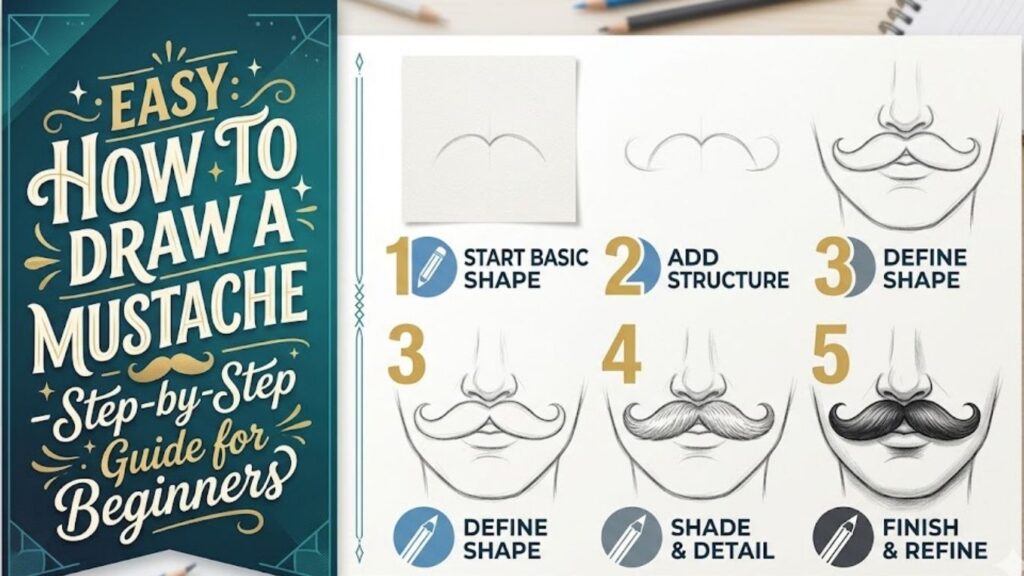
This guide will take you through a step-by-step process to draw different styles of mustaches. With practice, even beginners can create clean, detailed, and expressive mustache drawings.
Essential Drawing Supplies You Should Have
Sketchbook
HB and 2B pencils
Eraser
Black fineliner pen
Colored pencils or markers
Simple Tips Before You Start Drawing
Before starting, observe real mustaches or reference images to understand shape, thickness, and flow. Mustaches grow in specific directions, which affects how you draw each hair.
Keep your strokes light in the beginning. Starting lightly allows you to refine shapes and adjust proportions before committing to darker lines or shading.
How to Draw a Mustache Step by Step Guide for Beginners
1. Understanding the Structure of a Mustache
Learn the Basic Shape
A mustache typically covers the area above the upper lip, spanning from one side of the mouth to the other.
Most mustaches can be broken down into a basic outline shape, like a horizontal oval, soft triangle, or swooping curves depending on the style.
The hair follows natural growth patterns: some parts curve downward, others outward, and the density varies.
Understanding this structure helps you decide how to shape the mustache and where to add details. Breaking it into basic forms first makes the drawing process easier for beginners.
2. Sketching the Outline
Start with Light Guidelines
Draw a light line above the upper lip to indicate the mustache placement.
Then sketch the general shape of the mustache based on the style you want—whether a simple rectangle, soft triangle, or curved flair.
Keep the outline light and simple. Avoid drawing individual hairs at this stage; focus on proportion and placement.
A clear outline serves as the foundation for refining shape, texture, and flow later.
3. Dividing the Mustache into Sections
Organize for Hair Flow
Divide the mustache into sections to follow natural hair direction: left, center, and right.
The center typically points slightly downward, while the outer sections curve or flare based on style.
Segmenting the mustache makes it easier to draw consistent, flowing strokes and ensures symmetry.
Breaking complex hair patterns into manageable parts allows beginners to maintain control while adding texture and volume gradually.
4. Drawing Individual Hairs
Create Natural Texture
Using short, light strokes, start drawing hairs along the guidelines.
Follow the direction of hair growth: downwards in the middle, slightly outward on the sides.
Vary the length and thickness of hairs to make the mustache look natural.
Avoid drawing perfectly straight lines—slightly curved strokes create a realistic effect.
This technique ensures that your mustache has texture and depth without looking flat or uniform.
5. Refining the Shape
Smooth and Balance
After sketching hairs, refine the edges to create a clean and well-shaped outline.
Adjust thickness or shape to ensure balance between left and right sides.
Some guides suggest using an eraser to soften any rough edges or overly sharp lines.
Refining helps your mustache look polished and realistic while maintaining the natural irregularity of hair.
6. Adding Shading
Enhance Depth and Volume
Add shading under the hairs, near the lip line, and at denser areas to create depth.
Use soft strokes and gradually build darker areas for realistic effect.
Shading gives the mustache a three-dimensional look and separates individual hairs from the base.
Even subtle shading dramatically improves realism and adds character to the drawing.
7. Highlighting Hairs
Suggest Shine and Dimension
Add very light strokes or leave small gaps to represent highlights.
This mimics the way light naturally hits hair and prevents the mustache from appearing flat.
Highlights work best when applied sparingly, focusing on the top of the hairs or outer edges.
Adding subtle shine enhances texture and makes the mustache appear more lifelike.
8. Drawing Different Mustache Styles
Experiment with Variations
Practice drawing styles like the handlebar, chevron, pencil, or walrus mustache.
Each style has unique shapes and hair directions.
Understanding the style allows you to adjust your strokes and outline accordingly.
Experimenting helps improve versatility and understanding of mustache anatomy.
Drawing multiple styles also builds confidence and creativity in your sketches.
9. Common Mistakes to Avoid
Learn and Improve
Drawing all hairs the same length or direction can make the mustache look unnatural.
Over-darkening early can result in a flat, rigid appearance.
Skipping light guidelines often causes asymmetry.
Neglecting shading reduces depth and realism.
Being aware of these mistakes helps beginners improve quickly and create more polished drawings.
10. Practice Tips for Beginners
Build Your Skills
Practice drawing quick mustache sketches from reference images or imagination.
Start with simple styles before attempting more complex or thick mustaches.
Observe real facial hair to understand growth patterns and flow.
Use different pencils or pens to experiment with texture.
Consistent practice helps build control, precision, and confidence.
Frequently Asked Questions
Is drawing a mustache easy for beginners?
Yes, starting with light guidelines and simple shapes makes it manageable for anyone.
How do I make the mustache look realistic?
Use varied strokes, follow hair direction, and apply subtle shading and highlights.
Should I draw every hair individually?
Not necessarily; suggest hairs with layered strokes for a natural effect.
What styles can I draw first?
Start with simple styles like chevron or pencil, then try handlebar or walrus.
How long does it take to improve?
With regular practice, beginners can see significant improvement within a few days.
Final Words
Drawing a mustache is a simple yet effective way to practice hair texture, shading, and facial detail. Following step-by-step techniques ensures realistic and expressive results.
Keep practicing, explore different styles, and enjoy the process. Every drawing adds skill and confidence to your art journey.