
Learning how to draw a dandelion is a simple and enjoyable project for beginners. Dandelions have delicate petals, thin stems, soft seed heads, and interesting natural textures that can be created with basic lines and shapes.
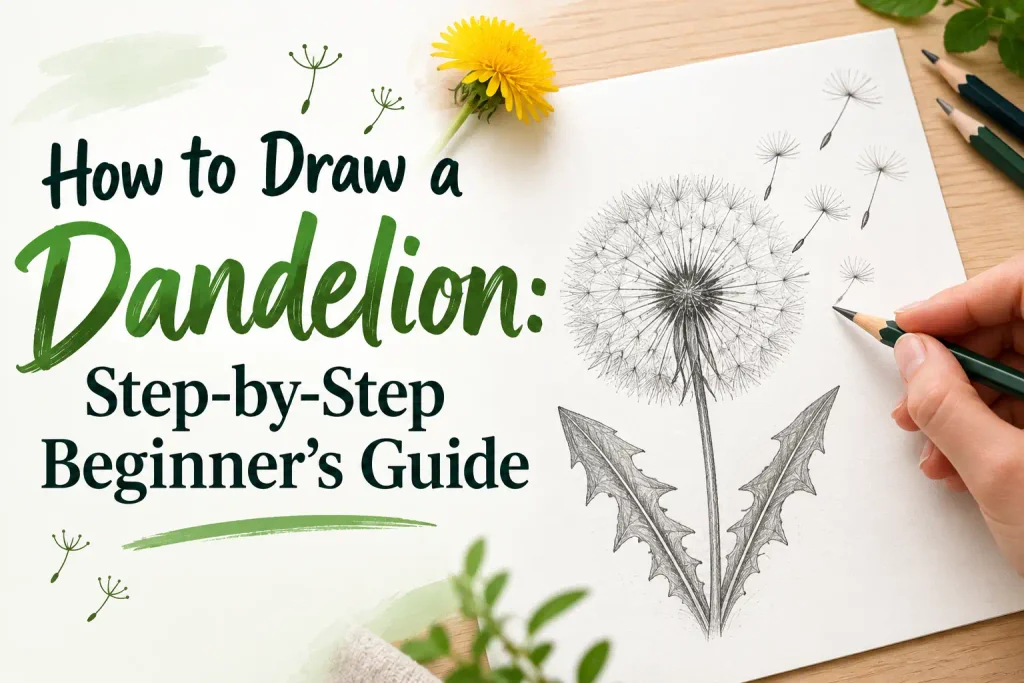
Whether you want to draw a bright yellow dandelion flower, a fluffy white seed head, or a dandelion blowing in the wind, this guide will help you build the drawing step by step. Begin with the basic shape and stem, then gradually add petals, seeds, details, and shading.
Items to Buy
- Drawing Pencil
- Eraser
- Sketchbook
- Fine-Line Pen
- Yellow Colored Pencil
- Green Colored Pencil
- White Gel Pen
- Colored Pencils
- Markers
- Watercolor Paints
- Pencil Sharpener
Why Learn How to Draw a Dandelion?
Dandelions are wonderful subjects for beginner artists because they are made from simple natural forms. A flower head can be built from many small petals, while a seed head can be created with thin lines and repeated shapes.
Drawing a dandelion also gives you a chance to practice fine lines, texture, symmetry, and movement. You can create a realistic botanical illustration or simplify the flower into a cute and decorative drawing.
How to Draw a Dandelion Step by Step
Step 1: Draw the Main Flower Shape
Start by lightly drawing a small circle near the top of your page. This circle will act as a guide for the dandelion flower head.
Keep the circle light and loose. You will eventually cover most of the guideline with petals, so there is no need to make it dark or perfectly round.
Step 2: Draw the Stem
From the bottom of the flower shape, draw two long, slightly curved lines downward to create the stem. Keep the lines close together.
Make the stem slightly uneven or curved for a more natural appearance. Avoid drawing it perfectly straight unless you want a more stylized illustration.
Step 3: Add the First Layer of Petals
Begin drawing thin pointed petals around the outer edge of the circle. Use short, narrow strokes that extend outward.
The petals should overlap and point in slightly different directions. Varying their length will make the flower look fuller and more natural.
Step 4: Fill the Flower with Petals
Continue adding more petals toward the center of the flower. Make the petals dense and layered so the flower head looks full.
Use shorter petals near the center and longer petals around the outside. You can leave a few small gaps between groups of petals to create texture.
Step 5: Add the Base of the Flower
Draw the small green structure where the flower connects to the stem. Add several pointed leaf-like shapes beneath the flower head.
These shapes help define the transition between the bright petals and the stem. Keep them slightly curved and natural-looking.
Step 6: Add the Leaves
Draw long, narrow dandelion leaves near the bottom of the stem. Dandelion leaves often have deep jagged edges.
Sketch a central line through each leaf, then add pointed sections along both sides. Vary the size and direction of the leaves to create a more natural arrangement.
Step 7: Refine the Petal Details
Go back to the flower head and add extra thin lines between some petals. These small details can make the petals appear more layered.
Avoid outlining every petal heavily. A mixture of lighter and darker lines will give the flower more depth and keep the drawing from looking flat.
Step 8: Add Texture and Shading
Add gentle shading near the center of the flower and around the base of the petals. Use light strokes so the yellow petals can remain bright.
Shade one side of the stem and leaves slightly darker to create dimension. Keep your imaginary light source consistent throughout the drawing.
Step 9: Add Color
Color the flower using bright yellow shades. Add deeper golden yellow near the center and lighter yellow toward the outer petals.
Color the stem and leaves with different shades of green. Add darker green along one side and lighter green where the light hits the plant.
Step 10: Add Final Details
Erase any remaining construction lines that are still visible. Strengthen selected outlines and add final small details to the petals and leaves.
You can also add a simple background, grass, or a few additional dandelion flowers. Keep the background light enough so the main flower remains the focus.
How to Draw a Dandelion Seed Head
A dandelion seed head begins with a lightly drawn circle. From the center, draw many thin lines extending outward like spokes.
Add tiny feathery marks at the ends of each line. Keep the lines soft and delicate so the seed head appears fluffy and lightweight.
How to Draw a Dandelion Blowing in the Wind
Start by drawing a fluffy seed head with a few missing sections. Add individual seeds drifting away from the main flower.
Draw the seeds at different distances and angles. Curved lines can suggest the direction of the wind and create a sense of movement.
How to Draw a Yellow Dandelion
For a yellow dandelion, focus on creating many thin pointed petals. Begin with darker yellow or golden tones near the center.
Gradually use lighter yellow toward the outer petals. Add small areas of orange or brown near the base to create more depth.
How to Draw a Cute Dandelion
A cute dandelion can use simplified shapes and bright colors. Make the flower head rounder and the petals softer.
You can add a smiling face, rosy cheeks, or tiny decorative details. A cartoon-style dandelion works well in greeting cards, notebooks, and simple illustrations.
How to Draw a Realistic Dandelion
A realistic dandelion requires careful observation of the petals, leaves, and stem. Use different petal lengths and avoid repeating identical shapes.
Add subtle shading and color variations throughout the flower. Keep the stem slightly textured and use jagged edges on the leaves for a more natural botanical appearance.
How to Draw Dandelion Seeds
Each dandelion seed can be simplified into a thin stem with a tiny seed at the bottom and a feathery parachute at the top.
Draw several seeds moving in different directions. Make some larger and darker in the foreground while keeping distant seeds smaller and lighter.
Easy Dandelion Drawing Ideas
Once you understand the basic structure, try these variations:
- Yellow dandelion flower
- Dandelion seed head
- Dandelion blowing in the wind
- Dandelion seeds
- Cute dandelion
- Realistic dandelion
- Dandelion field
- Dandelion with a butterfly
- Dandelion silhouette
- Dandelion with a bee
- Dandelion bouquet
- Magical glowing dandelion
How to Make Your Dandelion Drawing Look Better
Use a variety of line thicknesses when drawing the petals and seeds. Thicker lines can define important areas, while thin lines work well for delicate details.
Keep your flower from looking too symmetrical. Natural plants have irregular petals and leaves, so small variations in length and direction can make the drawing appear more realistic.
Common Mistakes to Avoid
One common mistake is making every petal exactly the same size. Dandelion petals overlap and vary naturally, so use different lengths and angles.
Another mistake is drawing the seed head too heavily. Use light, delicate lines so the fluffy structure looks soft. Also avoid making the stem perfectly straight unless you want a simplified cartoon style.
Tips for Better Flower Drawings
Study the basic structure before adding tiny details. Begin with the flower shape, stem, and leaves, then build the petals gradually.
Practice drawing different types of flowers to improve your understanding of natural forms. Roses, daisies, sunflowers, and tulips can all help you develop petal and leaf drawing skills.
FAQs
Is drawing a dandelion easy for beginners?
Yes. A basic dandelion can be created using a simple circle, a stem, and many short petals. Seed heads can also be drawn with thin lines and feathery details.
What colors should I use for a dandelion?
Bright yellow and golden shades work well for the flower, while different shades of green can be used for the stem and leaves.
How do I draw a fluffy dandelion?
Draw a light circular guide and add many thin lines extending outward. Add tiny feathery marks at the ends of the lines to create a soft seed head.
How do I draw dandelion seeds blowing away?
Draw several small seeds with thin stems and feathery tops. Place them at different distances and angles to create movement.
How can I make my dandelion look realistic?
Use irregular petals, varied line thicknesses, subtle shading, and natural leaf shapes. Avoid making every part perfectly symmetrical.
Can I draw a dandelion with colored pencils?
Yes. Colored pencils are great for layering yellow shades on the petals and green shades on the leaves and stem.
What should I draw after learning how to draw a dandelion?
Try drawing other flowers, plants, butterflies, bees, or a complete garden scene. These subjects will help you practice natural textures and botanical details.
Final Words
Learning how to draw a dandelion is a relaxing way to practice petals, fine lines, leaves, texture, and natural movement. By starting with a simple shape and gradually adding details, you can create everything from a bright yellow flower to a delicate seed head blowing in the wind.
Keep experimenting with different styles, colors, and compositions. With regular practice, you can use your dandelion drawing skills to create beautiful botanical illustrations, decorative artwork, and imaginative nature scenes.