
Learning how to draw a lamb is a lovely beginner-friendly art project that helps you practice rounded shapes, fluffy textures, facial features, and simple animal proportions. Lambs have soft wool, small legs, rounded bodies, and gentle expressions, making them especially fun to illustrate. Instead of trying to draw every strand of wool, you can build the lamb from simple shapes and gradually add fluffy details.
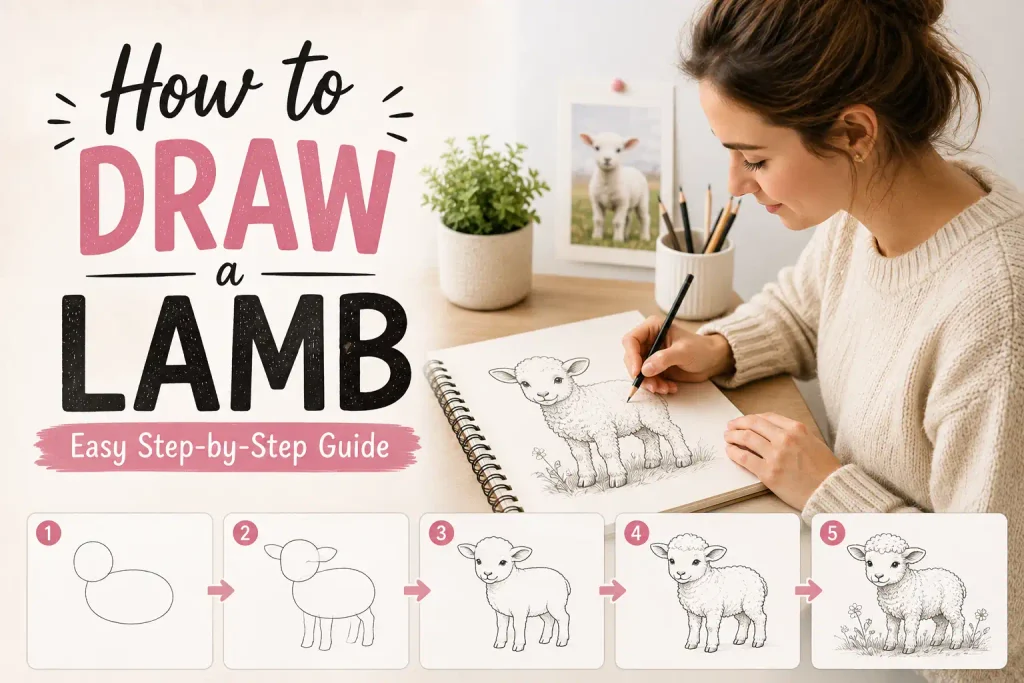
The easiest approach is to sketch the body and head first, then add the ears, legs, tail, and wool. Once the basic silhouette is finished, use curved strokes and small cloud-like shapes to create the fluffy coat. A little shading around the legs, face, and wool will give your lamb more depth and personality.
Items to Buy
- Drawing paper
- HB pencil
- 2B pencil
- 4B pencil
- Eraser
- Kneaded eraser
- Sharpener
- Fine-tip black pen
- Ruler, optional
- Colored pencils
- White colored pencil
- Light gray colored pencil
- Beige colored pencil
- Brown colored pencil
- Black colored pencil
- Blending stump
Why Draw a Lamb?
A lamb is an excellent subject for beginners because its body can be constructed from simple rounded forms.
Drawing one can help you practice:
- Animal proportions
- Basic shapes
- Curved lines
- Fluffy textures
- Facial features
- Small legs
- Shading
- Highlights
- Simple poses
- Cute character design
You can draw a lamb standing in a field, sitting, walking, jumping, or resting beside flowers.
How to Draw a Lamb Step by Step
Step 1: Choose Your Lamb’s Pose
First, decide how you want your lamb to appear.
A standing side view is one of the easiest poses for beginners.
You can also draw a lamb:
- Sitting
- Walking
- Jumping
- Lying down
- Looking forward
- Grazing
- Standing in a field
Choose a simple pose for your first attempt.
Step 2: Draw the Main Body
Start with a large horizontal oval for the body.
Keep the pencil pressure light.
The body should look rounded rather than angular.
This oval will eventually be covered with fluffy wool.
Don’t add texture yet.
Step 3: Add the Chest
Draw a rounded shape near the front of the body.
The chest should connect smoothly to the neck.
Lambs have compact, rounded bodies, so avoid making the torso too narrow.
Step 4: Draw the Head
Add a smaller rounded shape near the front of the body.
The head should be noticeably smaller than the torso.
For a side view, extend the front slightly to create the muzzle.
Step 5: Shape the Muzzle
Add a small rounded or slightly elongated shape at the front of the head.
Keep it soft and compact.
Don’t make the muzzle too long.
A young lamb’s face generally has a gentle, rounded appearance.
Step 6: Add the Nose
Place a small dark shape near the end of the muzzle.
You can make it oval or slightly rounded.
Leave a tiny highlight if you’re creating a realistic illustration.
Step 7: Draw the Eye
Add one small eye above the muzzle.
For a side view, only one eye may be visible.
Keep it relatively small.
A tiny highlight inside the eye can give the lamb a sweet, lively expression.
Step 8: Add the Ears
Draw one ear near the top side of the head.
For a front-facing lamb, add both ears.
Lamb ears can be slightly pointed or rounded depending on your style.
Add a smaller curved line inside each ear.
Step 9: Sketch the Neck
Connect the head to the body with a short, rounded neck.
Don’t make the neck too long.
The wool can eventually overlap the neck and make the transition look softer.
Step 10: Add the Fluffy Wool Outline
Now begin shaping the lamb’s wool.
Instead of drawing a smooth body outline, add small rounded bumps around the body.
Think of the wool as a series of soft, overlapping cloud shapes.
Keep the bumps varied.
Don’t make them perfectly identical.
Step 11: Add Wool Around the Head
Add fluffy sections around the top and sides of the head.
Keep the face itself relatively smooth.
This creates a nice contrast between the soft wool and facial features.
Step 12: Draw the Front Legs
Sketch two short legs underneath the front of the body.
Start with slightly wider upper sections.
Gradually narrow them toward the hooves.
Keep the legs relatively straight for a standing pose.
Step 13: Add the Hind Legs
Draw the rear legs beneath the back half of the body.
Depending on the pose, one leg may be partly hidden.
Make the hind legs slightly stronger and thicker than the front legs.
Step 14: Draw the Hooves
Add small dark shapes at the bottom of each leg.
Keep the hooves simple.
A slight separation line can suggest the two sections of a cloven hoof.
Step 15: Add the Tail
Draw a small tail at the rear of the lamb.
For a young lamb, the tail can be short and fluffy.
Use a few rounded curves rather than a long, thin tail.
Step 16: Refine the Silhouette
Look at your entire lamb.
Check:
- Body size
- Head position
- Leg length
- Ear placement
- Tail position
- Wool outline
Erase the construction lines that aren’t needed.
Make sure the lamb’s body looks balanced.
Step 17: Add Individual Wool Details
Now begin adding smaller fluffy shapes inside the main body.
Use curved, overlapping strokes.
Concentrate more texture around:
- Back
- Chest
- Neck
- Belly
- Head
You don’t need to fill every area.
Leave some smooth sections so the drawing doesn’t become cluttered.
Step 18: Add Facial Details
Refine the:
- Eyes
- Nose
- Mouth
- Cheeks
- Ear interiors
Keep the facial features clean.
The face should remain easier to read than the wool texture.
Step 19: Add Shadows
Choose a light source.
Then add soft shadows underneath the wool.
Good areas for shading include:
- Under the belly
- Beneath the neck
- Behind the legs
- Under the chin
- Around the hooves
- Between wool clusters
Use soft pencil strokes.
Step 20: Add Highlights
For a white lamb, highlights are especially important.
Use a kneaded eraser to lift graphite from the wool.
Leave the upper areas brighter.
This creates the appearance of soft, fluffy wool.
You can also add a tiny highlight to the eye and nose.
Step 21: Strengthen the Outline
Once the drawing is finished, selectively darken the outer silhouette.
Use stronger lines around:
- Face
- Ears
- Legs
- Hooves
- Tail
Keep the wool details lighter.
This makes the lamb look soft rather than heavily outlined.
How to Draw a Cute Lamb
For a cartoon lamb, exaggerate the soft features.
Make the:
- Head slightly larger
- Eyes bigger
- Body rounder
- Legs shorter
- Wool puffier
Use rounded shapes instead of sharp edges.
A small smile can make the lamb look especially friendly.
How to Draw a Realistic Lamb
Start with accurate proportions before adding wool.
Study the basic body structure.
Then use overlapping curls and short strokes to represent wool.
Keep the face smoother.
Use subtle shadows beneath the wool to create volume.
Avoid drawing every strand individually.
How to Draw a Lamb From the Front
Start with a large rounded body behind the head.
Place the head in the center.
Add two symmetrical ears.
Position the eyes evenly.
Add the muzzle and nose below them.
Then draw the front legs beneath the body.
Use fluffy wool around the head and shoulders.
How to Draw a Lamb From the Side
Begin with the large oval body.
Add the head at one end.
Extend the muzzle slightly forward.
Draw one visible ear and one or two legs prominently.
Add the rear legs and short tail.
This view makes the lamb’s body proportions especially easy to understand.
How to Draw a Lamb Lying Down
Start with a large rounded body shape resting horizontally.
Place the head toward the front.
Fold the legs underneath the body.
Add the small tail behind it.
Use shadows underneath the body to show that it is resting on the ground.
How to Draw a Lamb in a Field
Once your lamb is finished, create a simple outdoor background.
Add:
- Grass
- Flowers
- Small rocks
- Clouds
- Hills
- Fence posts
Keep the background relatively simple.
This allows the fluffy lamb to remain the main focus.
How to Draw a Lamb With Colored Pencils
For a white lamb, start with very light gray or cream.
Use beige and light brown around the shadows.
Add darker gray beneath the belly and between wool clusters.
Keep the upper wool lighter.
For a cartoon lamb, you can experiment with pastel colors and a colorful background.
How to Draw a Lamb With Watercolors
Begin with a light pencil outline.
Apply a very pale cream or gray wash to the wool.
Allow it to dry.
Add slightly darker gray or beige around the underside and wool folds.
Use a small brush to create a few fluffy texture marks.
Leave plenty of white paper visible for highlights.
How to Make Lamb Wool Look Realistic
The key is layering.
Don’t draw hundreds of individual hairs.
Instead, create:
- Large fluffy masses
- Medium wool clusters
- Small curved texture marks
- Soft shadows between the clusters
This gives the wool volume without making the drawing look overly busy.
Common Mistakes to Avoid
Making the Body Too Thin
Lambs have rounded, compact bodies.
Making the Legs Too Long
Keep them short and proportional.
Drawing Every Wool Strand
Use groups of curls and fluffy shapes instead.
Making the Face Too Fluffy
Keep the muzzle and key facial features relatively clear.
Forgetting the Hooves
Small dark hooves help define the legs.
Making Both Ears Identical in Perspective
In an angled pose, the farther ear may appear smaller.
Using Heavy Lines Everywhere
Use lighter marks around the wool to preserve its softness.
Easy Lamb Drawing Ideas
Cute Baby Lamb
Use oversized eyes, rounded wool, and tiny legs.
Lamb in a Meadow
Add grass, flowers, and a sunny background.
Sleeping Lamb
Draw the lamb curled up with its eyes closed.
Lamb With a Flower
Place a small flower near its mouth or beside its feet.
Cartoon Lamb
Use simple shapes and bold outlines.
Realistic Lamb Portrait
Focus on the face, wool texture, eyes, and subtle shading.
FAQs
Is a lamb easy to draw?
Yes. Its rounded body, short legs, and simple facial features make it a good subject for beginners.
What should I draw first?
Start with the body and head using simple oval and rounded shapes. Add the legs and wool after the main proportions are established.
How do I draw fluffy wool?
Use overlapping cloud-like shapes, curved strokes, and small clusters instead of drawing every individual hair.
How do I make a lamb look realistic?
Focus on body proportions, soft wool texture, subtle shadows, and clear facial features.
How do I draw a cute lamb?
Make the head and eyes slightly larger, shorten the legs, round the body, and exaggerate the fluffy wool.
What colors should I use?
White, cream, light gray, beige, and soft brown work well for a traditional lamb.
How do I draw a lamb from the side?
Start with a horizontal oval for the body, add a smaller head and muzzle at the front, then add the legs, tail, ears, and wool.
Can I draw a lamb with colored pencils?
Yes. Layer light gray, cream, beige, and brown tones gradually to create soft wool and gentle shadows.
What pencil should I use?
Use an HB pencil for construction and 2B or 4B pencils for darker areas and shadows.
How do I make white wool visible?
Use light gray or cream shading around the edges and between wool clusters. Leaving some areas completely white creates natural highlights.
Final Words
Learning how to draw a lamb is a simple and rewarding project when you begin with basic rounded shapes. Start with the body, head, muzzle, ears, short legs, and tail before adding the fluffy wool. Once the main silhouette is correct, use overlapping curls, soft shadows, and highlights to give the lamb its characteristic texture.
After mastering the basic drawing, try different poses and styles. Draw a cute cartoon lamb, a realistic baby lamb, or a fluffy lamb standing in a peaceful meadow. With regular practice, you’ll become more comfortable creating soft textures, expressive faces, and charming animal illustrations.