
Learning how to draw a panda is a fun and beginner-friendly art project. Pandas have a rounded body, large head, small ears, short limbs, and their instantly recognizable black-and-white markings. Because their basic anatomy can be simplified into circles and ovals, they are a great animal to practice if you’re still developing your drawing skills.
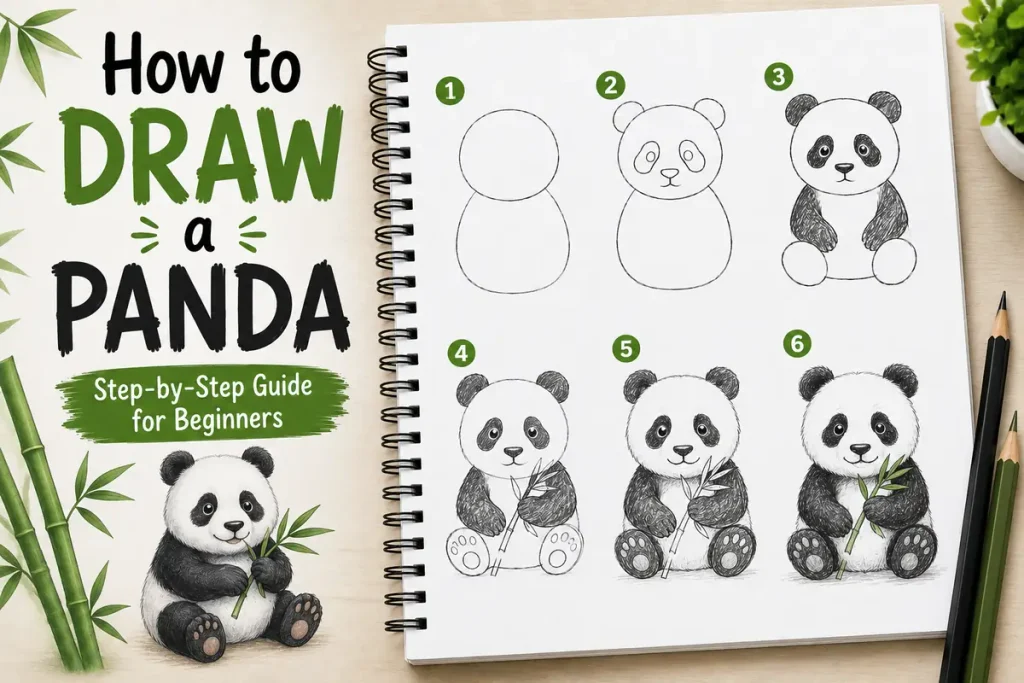
The easiest way to draw a panda is to build it from simple shapes first, then add the ears, eyes, paws, legs, and characteristic dark patches. Once the outline is complete, you can add fur texture, gentle shading, bamboo, or a forest background. Whether you want a cute cartoon panda or a more realistic illustration, these steps make the process easy to follow.
Items to Buy
- Drawing paper
- HB pencil
- 2B pencil
- 4B pencil
- Eraser
- Kneaded eraser
- Sharpener
- Fine-tip black pen
- Colored pencils
- Black colored pencil
- White colored pencil
- Gray colored pencil
- Green colored pencil
- Brown colored pencil
- Blending stump
Why Draw a Panda?
Pandas are excellent subjects for beginners because their bodies are made from simple rounded forms.
Drawing a panda can help you practice:
- Basic shapes
- Animal proportions
- Facial symmetry
- Fur texture
- Eyes and facial features
- Rounded bodies
- Paws and claws
- Shading
- Black-and-white contrast
- Simple backgrounds
You can draw a panda sitting, standing, climbing, eating bamboo, or relaxing on the ground.
How to Draw a Panda Step by Step
Step 1: Choose Your Panda’s Pose
First, decide what pose you want.
A sitting panda facing forward is one of the easiest options for beginners.
You can also draw a panda:
- Sitting with bamboo
- Lying down
- Walking
- Climbing a tree
- Eating
- Waving
- Sleeping
- Looking sideways
Start with a simple pose before attempting an action scene.
Step 2: Draw the Main Body
Begin with a large oval or rounded shape for the body.
Pandas have stocky, rounded bodies, so don’t make the torso too narrow.
Keep your pencil strokes light.
This shape will provide the foundation for the rest of the drawing.
Step 3: Add the Head
Draw a large rounded shape above the body.
The panda’s head should be broad and slightly rounded.
For a cute cartoon panda, you can make the head slightly larger compared with the body.
Step 4: Add the Ears
Draw two small rounded ears at the top of the head.
Make them roughly symmetrical.
Panda ears are dark, so you’ll eventually fill them in with black.
Keep the ears rounded rather than pointed.
Step 5: Draw the Face Guidelines
Lightly draw a vertical line through the center of the head.
Then add a horizontal guideline across the face.
These lines will help you position the eyes, nose, and mouth evenly.
You can erase them later.
Step 6: Add the Eye Patches
Pandas are famous for their dark eye patches.
Draw two angled oval or rounded patches around the eyes.
They should follow the shape of the face.
Don’t make them perfectly identical if you’re aiming for a natural appearance.
Step 7: Draw the Eyes
Place small eyes inside the dark patches.
Keep the pupils dark.
Add tiny white highlights if you want a cute or expressive look.
The contrast between the black patches and white face makes the eyes especially noticeable.
Step 8: Add the Nose
Draw a small rounded or triangular nose beneath the eyes.
Darken it gently.
For a cartoon panda, you can make the nose slightly larger.
Step 9: Draw the Mouth
Add a short curved line beneath the nose.
For a cute panda, create a small smiling expression.
For a realistic panda, keep the mouth subtle.
Step 10: Add the Front Legs
Draw two short, rounded arms on either side of the body.
Pandas have relatively short limbs compared with their stocky torso.
For a sitting pose, let the arms rest near the belly.
Step 11: Draw the Hind Legs
Add the large hind legs underneath the body.
Keep them rounded.
For a sitting panda, the hind legs can extend slightly outward.
Step 12: Add the Paws
Draw rounded paws at the ends of the limbs.
Add a few small lines to suggest toes.
For a cartoon panda, simple rounded paws are enough.
Step 13: Add the Feet
Create slightly larger rounded shapes at the ends of the hind legs.
Keep the feet proportional to the body.
Add subtle toe marks if desired.
Step 14: Refine the Body Shape
Look at your panda from head to toe.
Check that:
- The head is rounded
- The ears are balanced
- The body is stocky
- The limbs are proportional
- The paws connect naturally
- The face is centered
Erase unnecessary construction lines.
Step 15: Add the Black Fur Areas
Now establish the panda’s main dark markings.
Fill in:
- Ears
- Eye patches
- Arms
- Legs
- Feet, depending on your pose
Keep the central face and much of the torso white.
Use smooth, even shading for a clean cartoon style.
Step 16: Add Fur Texture
If you’re creating a realistic panda, add short strokes around the body.
Follow the direction of the fur.
Use slightly longer strokes around the torso.
Use shorter strokes around the face.
Avoid outlining every hair.
Instead, build the impression of fur using groups of strokes.
Step 17: Add Shading to the White Fur
White fur still needs shadows.
Use very light gray shading around:
- Cheeks
- Neck
- Belly
- Legs
- Under the chin
- Around the arms
Keep the highlights mostly white.
This helps the panda look three-dimensional.
Step 18: Add Highlights
Use a kneaded eraser or white colored pencil to add highlights.
Focus on:
- Eyes
- Nose
- Cheeks
- White fur
- Top of the head
Small highlights can make the panda’s face look much more expressive.
Step 19: Strengthen the Outline
Once you’re satisfied with your drawing, selectively strengthen the main outline.
Darken important areas around:
- Ears
- Head
- Arms
- Legs
- Feet
Keep the white fur edges softer.
How to Draw a Cute Panda
For a cute cartoon panda, exaggerate the rounded features.
Make the:
- Head larger
- Eyes bigger
- Ears rounder
- Body plumper
- Paws smaller
Give the panda a friendly smile.
You can also add a small bamboo shoot or flower.
How to Draw a Realistic Panda
Begin with accurate proportions.
Pay attention to the large head, short neck, stocky torso, and powerful limbs.
Build the fur with short layered strokes.
Use different levels of black and gray rather than filling every dark section with completely solid black.
Add subtle shadows to the white fur.
How to Draw a Panda From the Front
Start with a large rounded head.
Add two ears.
Use light guidelines to position the eyes.
Draw the dark eye patches.
Add the nose and mouth beneath them.
Then create the rounded body underneath.
Place the arms symmetrically on both sides.
How to Draw a Panda From the Side
Begin with a rounded body.
Add the head at one end.
Draw one visible ear and one eye patch.
Add the front and hind legs.
The panda’s rounded back and stocky body should form the main silhouette.
How to Draw a Panda Eating Bamboo
Start with a sitting panda.
Draw the arms toward the center of the body.
Place a bamboo stalk between the paws.
Add a few leaves at the top.
You can position the mouth slightly open to make the panda look like it’s eating.
How to Draw a Panda Lying Down
Start with a long rounded body.
Place the head at one end.
Let the legs rest beside or underneath the body.
Add the ears and eye patches.
For a sleeping panda, close the eyes and add a few small curved lines to suggest a peaceful expression.
How to Draw a Panda in a Bamboo Forest
After drawing your panda, create a simple forest background.
Add:
- Bamboo stalks
- Bamboo leaves
- Rocks
- Grass
- Tree branches
- Small plants
Keep background lines lighter than the panda.
This helps your main subject stand out.
How to Draw a Panda With Colored Pencils
Pandas may appear to require only black and white, but subtle colors can make the drawing more interesting.
Use:
- Black for dark markings
- Gray for shadows
- White for highlights
- Green for bamboo
- Brown for branches
Layer gray lightly into the white fur instead of using pure black for every shadow.
How to Draw a Panda With Watercolors
Begin with a light pencil sketch.
Use very pale gray washes for the white fur.
Apply darker gray or black gradually to the ears, eye patches, arms, and legs.
Keep the white areas relatively clean.
For the background, use soft greens and muted browns.
How to Make Panda Fur Look Realistic
The secret is direction and layering.
Start with the basic light and dark areas.
Then add short fur strokes.
Follow the natural direction of the fur around the face and body.
Use different values of gray and black.
Keep the edges slightly irregular rather than perfectly smooth.
This creates a softer and more natural appearance.
Common Mistakes to Avoid
Making the Head Too Small
A panda’s head is relatively large compared with its body.
Making the Body Too Thin
Keep the torso rounded and stocky.
Making the Eye Patches Perfectly Circular
Natural eye patches have irregular, angled shapes.
Using Pure Black Everywhere
Use gray and softer values for realistic shading.
Forgetting the Ears
The rounded black ears are an important part of the panda’s silhouette.
Making the Legs Too Long
Keep the limbs relatively short and sturdy.
Overdrawing the Fur
Use grouped strokes instead of drawing every hair individually.
Easy Panda Drawing Ideas
Cute Baby Panda
Create a large head, tiny body, oversized eyes, and rounded paws.
Panda Eating Bamboo
Show the panda sitting while holding a bamboo stalk.
Sleeping Panda
Draw a curled-up panda resting peacefully.
Panda on a Tree
Place the panda climbing or sitting on a thick branch.
Cartoon Panda
Use simplified shapes and bold black-and-white patterns.
Realistic Panda Portrait
Focus on facial proportions, eye patches, fur texture, and subtle shading.
FAQs
Is a panda easy to draw?
Yes. A panda can be constructed using simple circles, ovals, and rounded shapes, making it suitable for beginners.
What should I draw first?
Start with the main body and head. Then add the ears, facial features, limbs, and distinctive dark markings.
How do I draw panda eye patches?
Use two rounded, slightly angled shapes around the eyes. Their positioning is important for creating a recognizable panda face.
How do I draw panda ears?
Draw two small rounded shapes at the top of the head. Fill them with dark shading.
How do I make a panda look realistic?
Focus on its stocky body, large head, small ears, accurate eye patches, layered fur, and subtle shadows.
How do I draw a cute panda?
Make the head larger, eyes bigger, body rounder, and paws smaller. Add a friendly expression.
What colors should I use?
Black, white, gray, green, and brown are useful for a traditional panda illustration and its surroundings.
How do I draw a panda eating bamboo?
Draw the panda sitting upright, position both paws near its belly, and place a bamboo stalk between them.
Can beginners draw a realistic panda?
Absolutely. Start with simple shapes and gradually build the anatomy, black markings, fur, and shading.
What pencil should I use?
Use an HB pencil for construction and 2B or 4B pencils for darker markings, shadows, and fur details.
Final Words
Learning how to draw a panda becomes much easier when you begin with simple rounded shapes. Start with the large head and stocky body, then add the rounded ears, eye patches, facial features, short limbs, and paws. Once your basic silhouette is correct, use black, gray, and white values to create the panda’s distinctive appearance.
After mastering the basic drawing, experiment with different poses and scenes. Try a cute baby panda, a panda eating bamboo, a sleeping panda, or a realistic panda in a bamboo forest. With regular practice, you’ll become more confident drawing animal proportions, fur texture, facial expressions, and natural backgrounds.