
Learning how to draw a snail is a simple and enjoyable art project for beginners. Snails have a distinctive spiral shell, soft body, long feelers, and tiny eyes, making them easy to recognize even when drawn with basic shapes. By starting with an oval body and a large spiral shell, you can create a charming snail without needing advanced drawing skills.
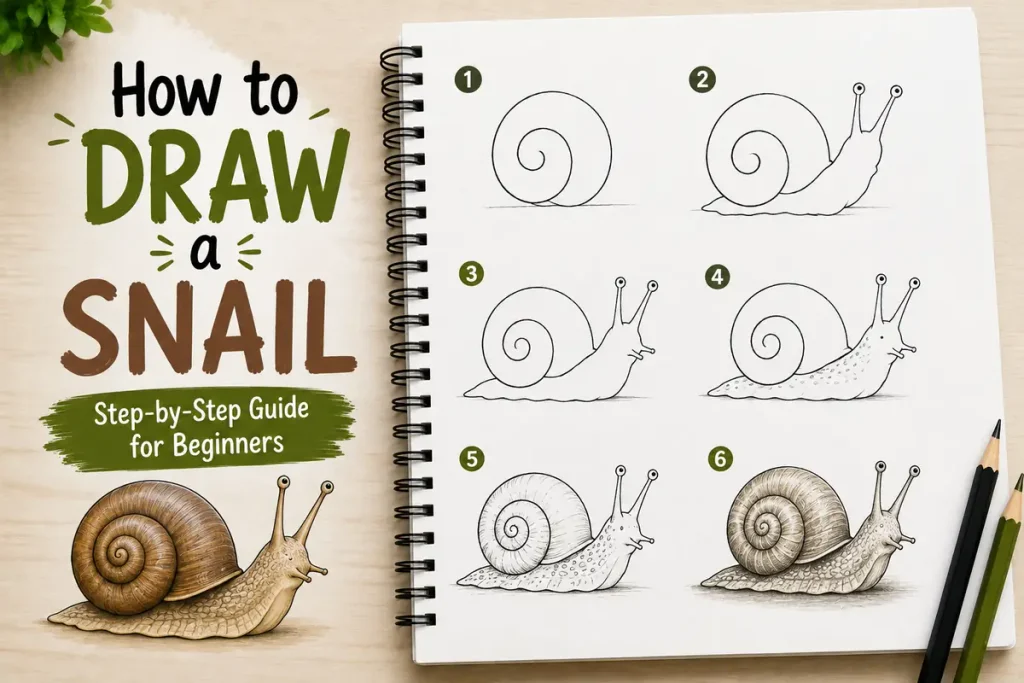
The easiest method is to sketch the shell and body first, then add the head, feelers, eyes, foot, and small details. After the basic outline is complete, you can add shell patterns, gentle shading, and a few environmental details. Whether you want to create a cute cartoon snail or a more realistic garden snail, these steps will help you build your drawing confidently.
Items to Buy
- Drawing paper
- HB pencil
- 2B pencil
- 4B pencil
- Eraser
- Kneaded eraser
- Sharpener
- Fine-tip black pen
- Colored pencils
- Green colored pencil
- Brown colored pencil
- Tan colored pencil
- Yellow colored pencil
- Black colored pencil
- White colored pencil
- Blending stump
Why Draw a Snail?
Snails are excellent subjects for beginner artists because their bodies can be created from a few simple shapes.
Drawing a snail can help you practice:
- Circles and ovals
- Spiral shapes
- Curved lines
- Animal proportions
- Small details
- Texture
- Shading
- Symmetry
- Organic shapes
- Simple backgrounds
The shell is particularly useful for practicing circular forms and creating the illusion of depth.
How to Draw a Snail Step by Step
Step 1: Choose Your Snail’s Pose
Decide how you want your snail to appear.
A side-view snail crawling along the ground is one of the easiest poses for beginners.
You can also draw a snail:
- Crawling upward
- Resting on a leaf
- Crossing a garden path
- Looking toward the viewer
- Sitting beside a flower
- Moving across a wet surface
Start with a simple side view before trying more complicated perspectives.
Step 2: Draw the Main Shell
Begin with a large circle or slightly oval shape.
This will become the snail’s shell.
Don’t worry if your circle isn’t perfect.
A slightly irregular shape can actually make the drawing feel more natural.
Step 3: Add the Shell Spiral
Inside the shell, draw a large curved spiral.
Start near the outside and gradually curl inward.
Keep the spiral smooth.
Avoid making the center too tight.
The spiral is the most recognizable feature of the shell, so take your time with it.
Step 4: Shape the Shell
Refine the outer shell.
You can add a few curved lines following the shell’s rounded surface.
These lines can later be used to create texture and shading.
Keep them light during the sketching stage.
Step 5: Draw the Body
Underneath the shell, sketch a long, soft shape for the snail’s body.
The body should extend forward beyond the shell.
Keep the lower edge relatively flat because this area represents the snail’s broad foot.
Step 6: Add the Head
At the front of the body, create a slightly rounded head.
The head should flow naturally from the body rather than looking like a separate circle.
Keep it relatively small compared with the shell.
Step 7: Draw the Upper Feelers
Snails have two long upper tentacles.
Draw two thin, curved stalks extending upward from the head.
Make them slightly different in direction for a natural appearance.
Step 8: Add the Eyes
For a simple cartoon snail, place small dots at the ends of the feelers.
For a more realistic snail, create tiny rounded eye structures.
Keep the eyes small.
Step 9: Add the Lower Feelers
Depending on the style you’re drawing, add two shorter feelers below the upper pair.
These can be subtle.
They help give a more detailed and natural appearance.
Step 10: Draw the Snail’s Mouth
Add a tiny curved line or small shape near the front of the head.
Keep it subtle.
For a cartoon snail, you can make a small smile.
Step 11: Refine the Foot
The snail’s foot is the long, flat portion underneath its body.
Draw a gently curved lower edge.
Keep it slightly wider around the middle and narrower toward the tail.
Step 12: Add the Tail
At the back of the body, gradually taper the foot into a small tail.
The tail should remain underneath the shell.
Don’t make it too pointed.
Step 13: Refine the Shell-to-Body Connection
Look at where the shell meets the body.
The body should appear to emerge naturally from beneath the shell.
Add a few curved lines around the shell’s lower edge to suggest overlap.
This will make the snail look more three-dimensional.
Step 14: Add Shell Texture
Now add subtle texture to the shell.
You can use:
- Curved bands
- Small irregular lines
- Dots
- Rings
- Speckles
Follow the rounded shape of the shell.
Avoid covering the entire surface with heavy marks.
Step 15: Add Body Texture
Use short, gentle strokes along the snail’s body.
Keep the texture softer than the shell.
You can add a few horizontal or diagonal lines along the foot to suggest movement.
Step 16: Add Shading
Choose a light source.
Darken the area beneath the shell.
Add shadows around:
- The underside of the head
- The body beneath the shell
- The foot
- The shell’s lower edge
- The spiral
Build the shadows slowly.
Step 17: Add Highlights
Use a kneaded eraser or white colored pencil to create highlights.
Good areas include:
- Upper shell
- Spiral
- Head
- Feelers
- Body
Small highlights can make the shell look smooth and slightly glossy.
Step 18: Strengthen the Main Outline
Once the drawing is finished, selectively darken the main silhouette.
Focus on:
- Shell
- Spiral
- Head
- Feelers
- Foot
- Tail
Keep the interior texture lighter.
How to Draw a Cute Snail
For a cartoon snail, simplify the anatomy and exaggerate the friendly features.
Make the:
- Shell larger
- Eyes bigger
- Body rounder
- Feelers longer
- Smile wider
You can decorate the shell with hearts, flowers, stars, dots, or colorful spiral patterns.
How to Draw a Realistic Snail
For a realistic snail, focus on proportions and surface texture.
Start with the shell’s overall shape.
Then carefully construct the soft body underneath.
Add subtle skin texture.
Use darker shading beneath the shell.
Keep the feelers thin and delicate.
Avoid using heavy outlines around every feature.
How to Draw a Snail From the Front
A front-facing snail can be simplified into a symmetrical head and body.
Start with the head.
Add two long feelers on either side.
Place the eyes near the tips.
Draw the lower feelers.
Then add the body underneath.
The shell can appear behind the head as a large rounded shape.
How to Draw a Snail on a Leaf
Start by drawing the snail using the basic steps.
Then add a large curved leaf underneath the body.
Create a central vein through the leaf.
Add smaller veins branching outward.
You can also include tiny water droplets for a fresh garden appearance.
How to Draw a Snail in a Garden
Create a simple garden scene around your snail.
Add:
- Grass
- Leaves
- Flowers
- Small rocks
- Twigs
- Soil
- Water droplets
Keep background details lighter than the snail.
This makes the shell and body stand out.
How to Draw a Snail Shell
The shell is usually the most important part of the drawing.
Start with a circle.
Then create a spiral beginning near the outer edge.
Gradually curve the line inward.
Use progressively smaller curves as you approach the center.
For depth, add darker shading along one side of the spiral.
How to Draw a Snail With Colored Pencils
Start with a light brown or tan base for the shell.
Layer darker brown around the spiral.
Use yellow, orange, or reddish-brown tones for shell patterns.
For the body, use pale beige, gray, or soft green depending on your desired style.
Blend colors gradually.
Leave small highlights on the shell to create a glossy appearance.
How to Draw a Snail With Watercolors
Begin with a light pencil outline.
Apply a pale brown wash to the shell.
Add darker brown around the spiral and lower shell.
Use a lighter beige or gray wash for the body.
Add a few delicate darker strokes for texture.
Leave some areas unpainted to create natural highlights.
How to Make a Snail Shell Look Three-Dimensional
The shell should not look like a flat circle.
Use shading to create volume.
Darken one side of the shell.
Add lighter tones toward the opposite side.
Follow the shell’s curved surface with your texture lines.
Make the spiral slightly darker in selected areas.
This creates the impression of a rounded shell.
Common Mistakes to Avoid
Making the Shell Too Small
The shell is a major part of the snail’s body and should be prominent.
Making the Spiral Too Tight
Leave enough space between the spiral curves.
Making the Feelers Too Thick
Keep them thin and delicate.
Forgetting the Flat Foot
The lower body should extend along the ground.
Using Heavy Lines Everywhere
Soft shading works better for a natural snail.
Making the Body Completely Straight
Use gentle curves to create a more organic shape.
Overloading the Shell With Patterns
Keep decorative marks balanced so the spiral remains visible.
Easy Snail Drawing Ideas
Cute Cartoon Snail
Draw a large colorful shell, oversized eyes, and a friendly smile.
Garden Snail
Place the snail among leaves, flowers, and grass.
Snail on a Leaf
Create a simple leaf beneath the body and add water droplets.
Realistic Snail
Focus on shell texture, body folds, shading, and delicate feelers.
Rainbow Shell Snail
Use multiple colors to create a bright decorative shell.
Sleeping Snail
Draw the snail resting beneath a leaf with its feelers relaxed.
FAQs
Is a snail easy to draw?
Yes. A snail can be constructed from a large oval shell, a simple spiral, and a long curved body.
What should I draw first?
Start with the shell because it establishes the size and position of the rest of the snail.
How do I draw a snail shell?
Begin with a circle or oval and add a smooth spiral inside it. Use curved shading to make the shell look rounded.
How do I draw snail feelers?
Draw two long, thin curved stalks from the head. Add small eyes near their tips.
How do I make a snail look realistic?
Focus on the shell’s three-dimensional shape, subtle body texture, natural proportions, and soft shading.
How do I draw a cute snail?
Make the shell large, enlarge the eyes, give the snail a rounded body, and add a friendly expression.
What colors should I use?
Brown, tan, cream, yellow, orange, gray, and green are excellent choices for snail illustrations.
How do I draw a snail on a leaf?
Draw the snail first, then place a large curved leaf beneath its body. Add veins and a few water droplets for detail.
Can beginners draw a realistic snail?
Absolutely. Start with simple shapes and gradually add the shell texture, body details, feelers, and shading.
What pencil should I use?
Use an HB pencil for the initial sketch and 2B or 4B pencils for shadows, outlines, and darker shell details.
Final Words
Learning how to draw a snail is easier when you break the animal into a few recognizable shapes. Start with the large rounded shell, add the spiral, and then build the soft body, head, feelers, eyes, foot, and tail underneath it. Once your basic silhouette is correct, use shell patterns, subtle texture, shading, and highlights to give the drawing more depth.
After mastering the basic side-view snail, experiment with different creative scenes. Try a colorful cartoon snail, a realistic garden snail, or one crawling across a leafy plant after the rain. With regular practice, you’ll become more comfortable drawing spirals, organic shapes, textures, and small animal details.