
Learning how to draw Indominus Rex is an exciting project for dinosaur and Jurassic-themed art fans. This fictional hybrid dinosaur has a distinctive combination of massive proportions, sharp teeth, powerful limbs, claws, and a long tail, making it a great subject for practicing dynamic creature drawing. Although the finished dinosaur can look complicated, you can build it from simple shapes before adding the intimidating details.
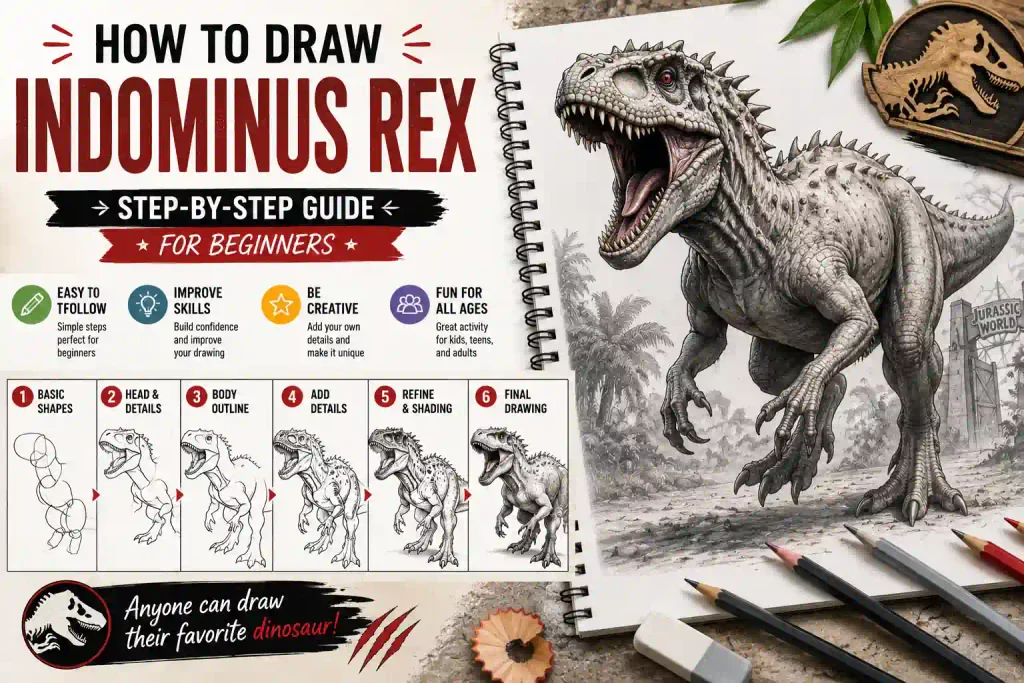
The easiest approach is to work from the body outward. Begin with basic shapes for the torso, head, and hips, then add the neck, jaws, arms, legs, tail, and characteristic spikes. Once the silhouette looks right, strengthen the outline and add scales, claws, teeth, shadows, and texture. This method makes the drawing much more manageable for beginners.
Items to Buy
- Drawing paper
- HB pencil
- 2B pencil
- 4B pencil
- Eraser
- Kneaded eraser
- Sharpener
- Fine-tip black pen
- Ruler, optional
- Colored pencils
- Gray colored pencil
- Black colored pencil
- Green colored pencils
- Dark brown colored pencil
Why Draw Indominus Rex?
Indominus Rex is an excellent subject for practicing creature illustration because its design includes many dramatic features.
Drawing it can help you practice:
- Dinosaur anatomy
- Creature proportions
- Perspective
- Jaw construction
- Claws and teeth
- Muscular forms
- Scales and texture
- Dynamic poses
- Light and shadow
You can create a simple cartoon version or develop the drawing into a detailed, intimidating dinosaur illustration.
How to Draw Indominus Rex Step by Step
Step 1: Choose Your Pose
Before drawing anything, decide how you want your Indominus Rex to stand.
A simple side-view pose is easiest for beginners.
You could draw it:
- Standing still
- Walking
- Roaring
- Running
- Turning its head
- Preparing to attack
For your first attempt, choose a side or three-quarter pose so the body proportions are easier to manage.
Step 2: Sketch the Main Body
Start with a large horizontal oval for the torso.
Don’t make it perfectly round.
Indominus Rex has a powerful, muscular body, so make the torso broad and substantial.
Use very light pencil pressure.
This shape establishes the main mass of the dinosaur.
Step 3: Add the Hips
Sketch another large shape toward the rear of the body.
The hips should connect naturally to the torso.
This area will eventually support the powerful hind legs.
Make the hips slightly larger than you might initially expect.
A strong hip structure helps create the heavy dinosaur silhouette.
Step 4: Draw the Neck
Indominus Rex has a large, muscular neck.
Sketch two curved lines extending upward and forward from the torso.
Don’t make the neck too thin.
Keep it substantial enough to support the large head.
Step 5: Add the Head
Sketch a large, elongated shape at the end of the neck.
The head should be relatively long and powerful.
Indominus Rex has a distinctive predatory appearance, so make the snout substantial rather than short and rounded.
Step 6: Shape the Snout
Extend the front of the head into a long, slightly tapered snout.
Keep the upper jaw broad near the skull and narrower toward the nose.
The exact proportions can vary depending on the pose you’re drawing.
Don’t worry about teeth yet.
Concentrate on the overall head shape first.
Step 7: Draw the Lower Jaw
Add a separate curved shape underneath the upper jaw.
If you’re drawing a roaring dinosaur, open the lower jaw widely.
If you’re drawing a closed-mouth pose, keep the two jaw shapes closer together.
For a dramatic illustration, an open mouth provides an opportunity to add large teeth and a strong facial expression.
Step 8: Add the Eye
Place a small eye on the side of the head.
The eye should be relatively small compared with the skull.
Position it carefully because even a slight change can alter the dinosaur’s expression.
You can make the brow area heavier to create a more intimidating appearance.
Step 9: Add the Facial Structure
Build up the areas around the eye and jaw.
Use curved shapes to suggest:
- Brow ridges
- Cheek muscles
- Jaw muscles
- Nose area
- Skull contours
Don’t immediately cover the head with scales.
First establish the underlying structure.
Step 10: Draw the Teeth
If the mouth is open, add rows of sharp teeth.
Start with the larger teeth around the front and sides.
Then add smaller teeth toward the back.
Don’t make every tooth identical.
Vary their length and spacing slightly.
Keep the teeth following the curve of the jaws.
Step 11: Add the Arms
Sketch the small but powerful forelimbs beneath the upper body.
Indominus Rex has noticeable claws.
Start with the upper arm.
Then add the forearm and hands.
Keep the arms relatively small compared with the massive torso and hind legs.
Step 12: Draw the Claws
Add sharp claws to the hands.
Keep them curved and pointed.
Don’t make them excessively long.
Use darker lines to emphasize the tips.
The claws are important details, but they should remain proportional to the hands.
Step 13: Draw the First Hind Leg
The hind legs should be much larger and stronger than the arms.
Start at the hip.
Draw a thick upper leg that narrows toward the knee.
Then create the lower leg extending downward and slightly backward.
Finally, add the foot.
Step 14: Add the Foot and Toes
Draw several strong toes extending from the foot.
Add curved claws at the ends.
Keep the toes spread enough to support the dinosaur’s weight.
The foot should look sturdy rather than delicate.
Step 15: Draw the Second Hind Leg
Add the far leg behind the first.
Because of perspective, it may appear slightly smaller or partially hidden.
Don’t make both legs perfectly identical.
This difference creates depth.
Step 16: Add the Tail
The tail should extend from the rear of the body and gradually taper.
Start thick at the base.
Then gradually narrow it as it extends away from the body.
A long curved tail can make your drawing feel much more dynamic.
Try slightly bending it rather than drawing it as a perfectly straight line.
Step 17: Refine the Dinosaur Silhouette
Now look at the entire dinosaur.
Check:
- Head size
- Neck thickness
- Body width
- Hip size
- Leg proportions
- Arm placement
- Tail length
Erase unnecessary construction lines.
Don’t add detailed scales yet.
Make sure the overall silhouette looks strong first.
Step 18: Add the Characteristic Spikes
One of the recognizable features of Indominus Rex is its prominent irregular dorsal structures and spikes.
Add them gradually along the:
- Back
- Neck
- Head
- Tail
Vary their size.
The larger structures can appear around the neck and upper back, while smaller ones can taper toward the tail.
Keep them integrated into the body rather than floating above it.
Step 19: Add Skin Folds
Use curved lines around the:
- Neck
- Shoulders
- Elbows
- Hips
- Knees
- Jaw
These lines help suggest thick, flexible skin.
Avoid making the folds completely straight.
Follow the direction of the muscles and body forms.
Step 20: Add Scales and Skin Texture
Now you can begin adding texture.
You don’t need to draw every scale individually.
Instead, use groups of small irregular shapes.
Concentrate texture around:
- Face
- Neck
- Arms
- Legs
- Tail
- Back
Leave some areas simpler.
Too much texture can make the drawing visually cluttered.
Step 21: Strengthen the Outline
Once you’re satisfied with the anatomy, reinforce the important exterior lines.
Use darker lines around:
- Jaw
- Head
- Neck
- Back
- Tail
- Legs
- Claws
Use lighter internal lines for scales and skin folds.
This creates depth and keeps the drawing readable.
Step 22: Add Shadows
Choose a light source.
For example, imagine the light coming from above.
Darken areas underneath:
- Jaw
- Neck
- Torso
- Arms
- Belly
- Tail
- Legs
Add darker shadows between overlapping limbs.
Don’t make the entire dinosaur equally dark.
Step 23: Add Highlights
Use a kneaded eraser to gently lift graphite from selected areas.
Highlights can emphasize:
- Brow
- Snout
- Shoulder
- Back
- Tail
- Upper legs
This can make the creature appear more three-dimensional.
How to Draw Indominus Rex From the Side
A side view is one of the easiest approaches for beginners.
Start with:
- Large torso
- Powerful hips
- Thick neck
- Large head
- Small arms
- Large hind legs
- Long tail
Then add the spikes and facial details.
A side profile also makes the distinctive dinosaur silhouette easier to recognize.
How to Draw Indominus Rex Roaring
For a roaring pose, open the mouth wide.
Tilt the head slightly upward.
Then:
- Separate the upper and lower jaws
- Add rows of teeth
- Stretch the neck
- Open the throat area
- Add facial folds
- Position the arms forward
- Extend the tail
You can add curved lines around the mouth to suggest tension in the skin.
How to Draw Indominus Rex Running
A running pose requires more attention to movement.
Tilt the body slightly.
Extend one hind leg forward and the other backward.
Move the arms in different positions.
Curve the tail in the opposite direction of the body movement.
Keep the head slightly forward.
This creates a stronger sense of speed.
How to Draw a Cute Indominus Rex
For a cartoon version, simplify the intimidating features.
Make the:
- Head slightly larger
- Eyes bigger
- Body rounder
- Arms shorter
- Feet larger
Keep the characteristic spikes and long tail so the dinosaur remains recognizable.
You can also add a friendly smile instead of a threatening expression.
How to Draw a Realistic Indominus Rex
For a more realistic interpretation, focus on anatomy and texture.
Use large muscle groups beneath the skin.
Add irregular scales rather than repeating identical patterns.
Use darker shading around folds and overlaps.
Keep the head detailed while allowing some parts of the body to remain less defined.
Realism often comes from controlled variation, not simply adding more lines.
How to Draw Indominus Rex With Colored Pencils
Begin with a light base color.
Then layer darker colors around the shadows.
You can experiment with:
- Gray
- Dark gray
- Olive green
- Brown
- Black
- Cream
Keep the belly and underside lighter if you want stronger contrast.
Use short directional strokes to suggest scales.
Build the colors gradually rather than pressing hard from the beginning.
How to Draw Indominus Rex With a Pencil
A pencil drawing can look dramatic without any color.
Use HB for construction.
Use 2B for medium shadows.
Use 4B for the darkest areas.
Keep the teeth and highlights relatively light.
For a cinematic appearance, increase contrast around the head and mouth.
How to Make Indominus Rex Look Three-Dimensional
Think of the dinosaur as a collection of large forms.
The torso is a large volume.
The hips are another.
The neck connects the torso to the head.
The limbs overlap the body.
Then add shadows between these forms.
For example, the far leg should generally be less prominent than the near leg.
This simple difference can make your creature appear much more three-dimensional.
Common Mistakes to Avoid
Making the Head Too Small
The head is an important part of the dinosaur’s silhouette.
Making the Arms Too Large
Keep them noticeably smaller than the powerful hind legs.
Drawing a Thin Neck
The neck should look strong and muscular.
Forgetting the Tail
A long tail balances the large body.
Making the Spikes Identical
Vary their size and spacing.
Adding Scales Too Early
Get the anatomy right before adding surface details.
Making Every Line Dark
Use varied line weight to create depth.
Overloading the Drawing With Texture
Strategic details are more effective than covering every area with scales.
Easy Indominus Rex Drawing Ideas
Indominus Rex Roaring
Create a dramatic open-mouth pose with visible teeth.
Indominus Rex in the Jungle
Add tropical plants and shadows around the dinosaur.
Indominus Rex Walking
Use a simple side profile to practice proportions.
Indominus Rex Running
Create a dynamic pose with the tail extended behind it.
Indominus Rex Head Drawing
Focus entirely on the skull, jaws, teeth, eye, and facial texture.
Cute Indominus Rex
Use simplified proportions and oversized eyes.
FAQs
Is Indominus Rex difficult to draw?
It can look complicated because of its size, teeth, claws, and spikes, but beginners can simplify it into basic shapes before adding details.
What should I draw first?
Start with the torso, hips, head, and neck. Add the limbs and tail after the major body proportions are established.
How do I draw the Indominus Rex head?
Begin with an elongated skull shape, add the long snout and lower jaw, then refine the eye, brow, teeth, and facial structure.
How do I make the dinosaur look powerful?
Use a broad torso, strong hips, thick neck, muscular hind legs, and a long balancing tail.
How do I draw the teeth?
Follow the curve of the upper and lower jaws and vary the size of the individual teeth slightly.
How do I draw the spikes?
Place irregular spikes along the back, neck, and other characteristic areas, gradually varying their size.
What pencil should I use?
HB works well for construction, while 2B and 4B are useful for darker shadows and dramatic details.
Can I draw Indominus Rex with colored pencils?
Yes. Layering gray, green, brown, and darker tones can create a dramatic dinosaur appearance.
How do I make my Indominus Rex look realistic?
Focus on proportion, muscle structure, overlapping forms, irregular skin texture, and controlled shading.
How do I draw a cute Indominus Rex?
Simplify the body, enlarge the eyes, make the proportions rounder, and soften the facial expression while retaining the distinctive spikes and tail.
Final Words
Learning how to draw Indominus Rex is much easier when you build the creature from large shapes before adding its intimidating details. Start with the torso, hips, neck, and head, then add the powerful hind legs, smaller arms, claws, long tail, and distinctive spikes. Once the silhouette works, refine the jaws, teeth, eye, skin folds, and texture.
Don’t worry about making every detail perfect on your first attempt. Practice the overall proportions first, then experiment with roaring, running, standing, and three-quarter poses. With repeated practice, you can turn a simple construction sketch into a dramatic Indominus Rex illustration with convincing anatomy, texture, and depth.