
Finding the best air compressor for paint gun use starts with matching the compressor’s airflow to your spray gun. A compressor may have a large tank and impressive maximum PSI, but that does not guarantee it can supply enough air for consistent spraying. If airflow drops while you are painting, the spray pattern can become uneven and leave a rough or inconsistent finish.
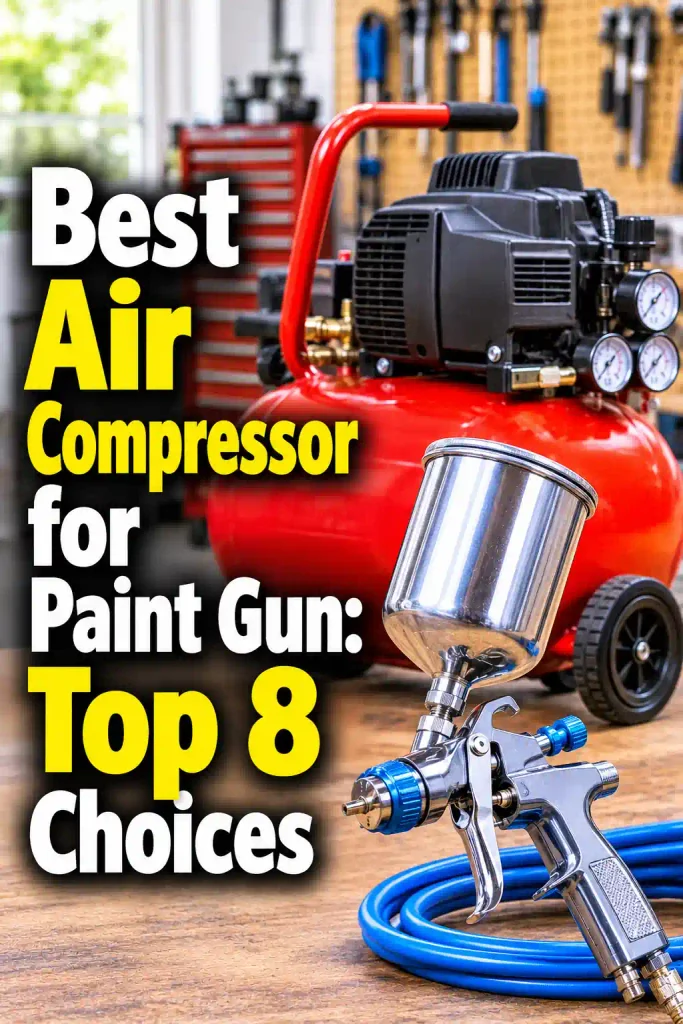
The right compressor depends on whether you are spraying furniture, cabinets, fences, vehicle panels, or an entire car. Smaller LVLP guns can work with more modest compressors, while full-size HVLP guns generally need much higher continuous airflow. Below, we compare eight air compressors for different painting needs and explain what to check before buying.
Top Picks: Best Air Compressor for Paint Gun
- Best Overall for Serious Spray Painting: California Air Tools 20040DCAD – A 20-gallon oil-free compressor with published output of up to 10.6 CFM at 90 PSI, suitable for more demanding residential HVLP applications.
- Best for Automotive HVLP Work: California Air Tools 20060DCC – A higher-output option designed for automotive and specialty painting applications that require substantial airflow.
- Best for LVLP Spray Guns: California Air Tools 10020C – A relatively quiet, oil-free 10-gallon compressor that delivers 6.4 CFM at 40 PSI and 5.3 CFM at 90 PSI.
- Best Heavy-Duty Workshop Option: California Air Tools 60040SMAD – A 60-gallon compressor with a published output of 10.6 CFM at 90 PSI for larger workshop applications.
- Best for Portable Workshop Use: Makita MAC5200 Big Bore Air Compressor – A 5.2-gallon, oil-lubricated compressor with 6.5 CFM at 90 PSI for compatible lower-air-demand spray guns.
- Best for General DIY Projects: DEWALT DXCM271 – A 27-gallon vertical compressor with published airflow around 5.1 SCFM at 90 PSI, worth considering for compatible LVLP and intermittent painting work.
- Best Compact Option: Makita MAC2400 Big Bore Air Compressor – A compact twin-stack-style workshop option with 4.2 CFM at 90 PSI for compatible lower-consumption spray guns.
- Best for Small Detail Guns: California Air Tools 8010 – An 8-gallon, oil-free compressor with 2.2 CFM at 90 PSI, better suited to low-air-demand detail applications than full-size HVLP guns.
Affiliate disclosure: As an Amazon Associate I earn from qualifying purchases.
Comparison Table: Best Air Compressor for Paint Gun
| Product Name | Best For | Check Price |
|---|---|---|
| California Air Tools 20040DCAD | Residential HVLP painting | Check on Amazon |
| California Air Tools 20060DCC | Higher-demand automotive painting | Check on Amazon |
| California Air Tools 10020C | LVLP spray guns | Check on Amazon |
| California Air Tools 60040SMAD | Heavy-duty workshop use | Check on Amazon |
| Makita MAC5200 Big Bore | Portable workshop spraying | Check on Amazon |
| DEWALT DXCM271 | General DIY and compatible LVLP guns | Check on Amazon |
| Makita MAC2400 Big Bore | Compact painting setups | Check on Amazon |
| California Air Tools 8010 | Detail and low-air-demand guns | Check on Amazon |
The links are tagged Amazon product-search links, not verified individual product listings. Check the exact model, electrical requirements, airflow rating, tank size, and seller before ordering. Airflow figures are not interchangeable: compare the compressor’s delivered CFM or SCFM at the pressure your spray gun requires.
1. California Air Tools 20040DCAD – Best Overall for Serious Spray Painting
The California Air Tools 20040DCAD is a strong option for painters who need more airflow than a small portable compressor can provide. Its published specifications include a 20-gallon tank and up to 10.6 CFM at 90 PSI. That makes it more appropriate for demanding spray applications than compact compressors designed mainly for nail guns and inflation.
One advantage of this model is its oil-free pump design. Oil-free compressors can reduce the risk of oil entering the compressed-air line, although they do not eliminate moisture or other air-quality problems. You will still need appropriate filtration and moisture control before connecting a paint gun.
The larger tank provides a useful reserve of compressed air, while the higher airflow rating helps the compressor replenish that reserve during longer painting sessions. This combination can be useful for furniture, cabinets, doors, and other residential projects when the spray gun’s air consumption is within the machine’s capacity.
California Air Tools also lists this output class for residential HVLP painting. However, you should not assume it can operate every full-size HVLP gun continuously. Check the gun’s air-consumption specification and compare it with the compressor’s actual delivered airflow.
The DCAD version includes an automatic drain feature, which can make routine tank maintenance more convenient. Draining accumulated water remains important even when the compressor is oil-free.
Pros
- 20-gallon tank
- Published output of up to 10.6 CFM at 90 PSI
- Oil-free pump design
- Automatic drain feature
- Suitable for more demanding residential spray applications
- More airflow than small portable compressors
Cons
- Larger footprint than compact workshop models
- Requires suitable electrical service
- Not automatically sufficient for every production HVLP gun
- Air filtration and moisture control are still necessary
Best For: Painters who need a higher-airflow compressor for residential HVLP work, provided the gun’s consumption matches the compressor’s delivered output.
2. California Air Tools 20060DCC – Best for Higher-Demand Automotive HVLP Work
The California Air Tools 20060DCC is worth considering when your painting projects demand more air than a small garage compressor can comfortably supply. It belongs to the brand’s higher-output compressor range, which is designed for more demanding applications, including automotive and specialty painting.
Automotive spray painting requires a consistent supply of clean air. A compressor that cannot maintain the spray gun’s required airflow may cause pressure fluctuations during a pass. This can affect atomization and make it harder to achieve an even finish.
The 20060DCC is designed for applications where higher airflow and air treatment are important. California Air Tools lists its 20060 series for automotive and specialty painting, with certain configurations designed to deliver especially dry air.
That distinction matters because moisture in compressed air can create defects in paint finishes. A dryer-equipped compressor can help, but you should still confirm the exact configuration and filtration requirements before connecting your spray gun.
This is a more specialized purchase than a basic home compressor. It is worth considering for a serious automotive setup, but the actual model specification, electrical supply, air-treatment configuration, and gun requirements must all be checked together.
Pros
- Designed for demanding painting applications
- Higher-output compressor category
- Suitable for evaluating automotive spray setups
- Available in configurations with specialized air treatment
- Better suited to serious workshop needs than small portable units
Cons
- More expensive and demanding than basic DIY compressors
- Requires appropriate electrical service
- Exact airflow depends on the selected configuration
- Still needs compatibility checks with the spray gun
Best For: Automotive painters and serious workshop users who need a higher-output compressor and are prepared to install the appropriate air-treatment equipment.
3. California Air Tools 10020C – Best for LVLP Spray Guns
The California Air Tools 10020C is a practical choice for painters who want a relatively quiet, oil-free compressor for compatible lower-air-demand spray guns. It features a 10-gallon steel tank and a published output of 6.4 CFM at 40 PSI and 5.3 CFM at 90 PSI.
Its 70 dB noise rating is another useful feature for a home workshop. It is quieter than many conventional workshop compressors, although it is not silent.
The 10020C can be worth considering for LVLP spray guns used on furniture, cabinets, doors, and smaller DIY projects. LVLP guns generally require less airflow than full-size HVLP models, which makes them a more realistic match for this type of compressor.
The oil-free dual-piston pump also reduces the need for routine compressor oil changes. However, compressed air still contains moisture from the surrounding environment. A suitable water separator and additional filtration may be needed to protect the finish.
One limitation is its tank size and duty-cycle rating. It is not designed to replace a large industrial compressor for continuous production painting. If your spray gun consumes air close to the compressor’s maximum delivered output, the pump may run frequently and struggle during long passes.
Pros
- 10-gallon steel tank
- 6.4 CFM at 40 PSI
- 5.3 CFM at 90 PSI
- Oil-free dual-piston pump
- Relatively quiet 70 dB operation
- Useful for compatible LVLP spray guns
Cons
- Not suitable for every full-size HVLP gun
- Limited air reserve compared with larger tanks
- Requires moisture filtration for paint work
- Electrical compatibility should be checked
Best For: DIY painters who use compatible LVLP guns for furniture, cabinets, doors, and smaller projects.
4. California Air Tools 60040SMAD – Best Heavy-Duty Workshop Option
The California Air Tools 60040SMAD is a larger workshop compressor for users who need more storage capacity and a substantial supply of compressed air. Its 60-gallon vertical tank is useful when a smaller portable unit runs too frequently during demanding work.
The published model specification lists 10.6 CFM at 90 PSI. This airflow makes it a more serious option for compatible spray guns and other workshop equipment than a typical pancake or small portable compressor.
A larger tank can help reduce how frequently the motor starts and provide additional reserve during short periods of high demand. However, tank capacity does not replace pump output. If your gun consumes more air than the compressor can deliver, the pressure will eventually fall even with a large tank.
The vertical tank design can also help save floor space compared with a similarly sized horizontal unit. It is intended for a more permanent workshop installation, so it is not a convenient choice if you need to move the compressor between job sites.
Before buying, check the electrical requirements and available space. You should also plan for a proper air-treatment setup, including moisture removal and filtration suitable for the paint system.
Pros
- Large 60-gallon tank
- Published output of 10.6 CFM at 90 PSI
- Suitable for larger workshop applications
- Vertical design saves floor space
- Automatic drain feature
- More storage capacity than portable compressors
Cons
- Heavy and difficult to relocate
- Requires a suitable electrical installation
- Not a substitute for higher airflow when a gun demands more
- Needs proper air filtration and moisture control
Best For: Workshop owners who want a larger stationary compressor for compatible spray guns and other air-powered equipment.
5. Makita MAC5200 Big Bore – Best for Portable Workshop Use
The Makita MAC5200 Big Bore is a useful option for painters who want a portable compressor with more airflow than many small trim compressors. It has a 5.2-gallon tank and a published output of 6.5 CFM at 90 PSI.
Its Big Bore pump uses a cast-iron cylinder and piston design. Makita describes the larger piston and heavy-duty pump construction as helping improve air delivery and recovery.
The compressor is oil-lubricated, which means it requires regular oil-level checks and maintenance. For painting, an appropriate oil-removal filter or coalescing filter may also be needed to prevent oil contamination from reaching the spray gun.
Its airflow makes it worth considering for compatible LVLP guns and other lower-consumption spray applications. The relatively small tank, however, limits the reserve available during longer painting sessions. It is not a universal solution for full-size HVLP guns.
The MAC5200 also includes a roll-cage-style frame that helps protect the pump and motor assembly. Its design is useful for a workshop where the compressor may need to be moved occasionally, although its weight makes it less convenient than a small portable unit.
Pros
- 6.5 CFM at 90 PSI
- 5.2-gallon tank
- Big Bore cast-iron pump design
- Faster recovery than many smaller compressors
- Protective roll-cage construction
- Useful for compatible lower-air-demand spray guns
Cons
- Oil-lubricated pump requires maintenance
- Oil filtration is important for painting
- Small tank compared with stationary models
- Not suitable for every high-consumption HVLP gun
Best For: Painters who want a portable workshop compressor for compatible LVLP guns and occasional spray projects.
6. DEWALT DXCM271 – Best for General DIY Projects
The DEWALT DXCM271 is a 27-gallon vertical air compressor that offers a useful middle ground between small portable units and larger stationary workshop machines. Its tank capacity provides more stored air than a typical pancake compressor, making it worth considering for general home and workshop tasks.
Published specifications for this model list approximately 5.1 SCFM at 90 PSI. That output may work with certain lower-consumption spray guns, especially when painting smaller items or working in short sessions.
The vertical tank is helpful when floor space is limited. It can fit into a garage or workshop more easily than some horizontal compressors with a similar capacity.
For paint spraying, the most important consideration is whether the gun’s air requirement stays below the compressor’s delivered airflow at the operating pressure. Do not choose this model simply because it has a 27-gallon tank. A demanding HVLP gun may still use more air than the pump can provide.
The compressor can be a practical choice for someone who also needs air for inflation, cleaning, and compatible air tools. If painting is the primary job, compare its output carefully against the gun’s published requirements before purchasing.
Pros
- 27-gallon vertical tank
- Useful storage capacity for a home workshop
- Suitable for general DIY air-tool applications
- Can work with compatible lower-consumption spray guns
- Vertical layout helps conserve floor space
Cons
- Not designed for every full-size HVLP spray gun
- Lower airflow than dedicated high-output painting compressors
- Actual compatibility depends on the gun’s air consumption
- Requires suitable filtration for painting
Best For: DIY users who need one compressor for general workshop tasks and occasional spraying with a compatible LVLP or lower-demand gun.
7. Makita MAC2400 Big Bore – Best for Compact Painting Setups
The Makita MAC2400 Big Bore is a compact workshop compressor for users who value a durable pump and a relatively small footprint. It has a 4.2-gallon twin-stack tank arrangement and a published output of 4.2 CFM at 90 PSI.
This output can be suitable for certain lower-consumption spray guns, depending on the gun’s actual air requirements. It is more appropriate for small projects and intermittent use than continuous automotive spraying.
The cast-iron Big Bore pump is designed for efficient air delivery and durability. The oil-lubricated construction does require maintenance, and painters should install suitable oil-removal filtration before using it with a spray gun.
The compact size makes the MAC2400 easier to accommodate in a smaller garage or workshop than a large stationary compressor. Its stored-air capacity is limited, however, so a demanding gun can quickly use up the available reserve.
If you mainly paint small furniture pieces, repair parts, or other limited surfaces, it may be worth considering. For large panels or long continuous passes, a higher-output compressor is a better investment.
Pros
- Compact twin-stack design
- 4.2 CFM at 90 PSI
- Cast-iron Big Bore pump
- Useful for compatible lower-air-demand guns
- Suitable for general workshop tasks
- Smaller footprint than large stationary units
Cons
- Limited tank capacity
- Oil-lubricated pump needs maintenance
- Requires oil and moisture filtration for paint work
- Not suitable for demanding full-size HVLP guns
Best For: Small workshops and DIY painters using compatible low-consumption spray guns for limited projects.
8. California Air Tools 8010 – Best for Small Detail Guns
The California Air Tools 8010 is a compact, oil-free compressor designed for relatively light air-tool applications. It features an 8-gallon tank and a published output of 2.2 CFM at 90 PSI.
Its relatively quiet operation is attractive for home workshops. The 8010 is rated at approximately 60 dB, making it a quieter alternative to many conventional compressors.
For painting, its best use is with airbrushes, small detail guns, or other equipment with very low air consumption. It should not be mistaken for a compressor that can run a typical full-size HVLP paint gun.
The oil-free pump reduces the need for oil changes and helps avoid oil from the pump entering the air supply. Nevertheless, moisture can still collect in the tank and airline, so proper moisture management is necessary for paint applications.
The 8010 is also useful for general light-duty tasks such as inflation and certain small pneumatic tools. If your painting projects involve large furniture surfaces, doors, or vehicle panels, you will likely benefit from a compressor with considerably more airflow.
Pros
- 8-gallon tank
- 2.2 CFM at 90 PSI
- Oil-free pump
- Relatively quiet 60 dB operation
- Compact workshop design
- Suitable for small detail applications
Cons
- Limited airflow for paint spraying
- Not suitable for full-size HVLP guns
- Small reserve for extended spraying
- Moisture filtration is still required
Best For: Artists, hobbyists, and DIY users working with airbrushes or compatible low-air-demand detail guns.
Buying Guide: How to Choose the Best Air Compressor for Paint Gun
Choosing a compressor for spray painting is different from choosing one for a nail gun or impact wrench. A paint gun can consume air continuously while you work, so airflow, pressure stability, and air quality are especially important.
1. Check the CFM Requirement of Your Spray Gun
CFM means cubic feet per minute. It measures the volume of air a compressor delivers or a tool consumes.
For painting, this is one of the most important specifications to compare. Find the spray gun manufacturer’s stated air consumption and check the pressure at which that figure is measured.
Typical requirements vary considerably:
- Airbrushes: Usually require very little airflow.
- Detail spray guns: Often need less air than full-size guns.
- LVLP guns: Generally require less airflow than comparable HVLP models.
- Full-size HVLP guns: Can require substantial continuous airflow.
- Automotive production guns: May need a large compressor and a properly designed air-treatment system.
These are broad categories, not guaranteed CFM ratings. Always use the exact specification for your spray gun.
2. Understand CFM at Different PSI Ratings
A compressor may list several airflow figures, such as CFM at 40 PSI and CFM at 90 PSI.
These numbers are not interchangeable. A compressor usually delivers different airflow at different pressures.
For example, the California Air Tools 10020C is rated at:
- 6.4 CFM at 40 PSI
- 5.3 CFM at 90 PSI
Compare the compressor’s delivered airflow with the spray gun’s consumption at a comparable operating pressure. If the ratings are measured under different conditions, contact the manufacturer or consult the technical data rather than assuming the numbers match.
3. Choose the Right Tank Capacity
The tank stores compressed air and provides a reserve while the pump is running or recovering.
Common tank sizes include:
| Tank Capacity | Typical Use |
|---|---|
| 2–6 gallons | Small detail work and light-duty tasks |
| 8–10 gallons | Compatible LVLP and small spray applications |
| 20–30 gallons | More demanding DIY and workshop spraying |
| 40–60 gallons | Larger workshop and compatible automotive applications |
| 80 gallons or more | High-demand professional and production setups |
A larger tank can help smooth out short periods of high air demand, but it does not increase the compressor pump’s actual CFM output. A small pump connected to a large tank will still struggle if the spray gun continuously consumes more air than the pump can replace.
4. Decide Between HVLP and LVLP Spray Guns
Your spray gun type has a major influence on the compressor you need.
HVLP spray guns
HVLP means high volume, low pressure. These guns use a substantial volume of air at relatively low pressure to atomize paint. They can provide efficient paint transfer, but many full-size models require a high-output compressor.
LVLP spray guns
LVLP means low volume, low pressure. These guns are designed to work with less airflow than many comparable HVLP guns. They can be a practical choice for smaller workshops and DIY projects.
If you already own a compressor with limited airflow, choosing a compatible LVLP gun may be more practical than purchasing a much larger compressor.
5. Consider Oil-Free or Oil-Lubricated Pumps
Both types can be used in suitable painting systems, but they have different maintenance and filtration considerations.
Oil-free compressors: These do not use pump oil for cylinder lubrication. They can reduce the risk of compressor oil entering the air stream, although they still produce moisture that needs to be removed.
Oil-lubricated compressors: These use oil to lubricate the pump and often require routine oil checks and changes. For spray painting, an appropriate oil-removal filter is important to prevent contamination from reaching the finish.
Do not assume that oil-free automatically means paint-ready. Both types need suitable air treatment.
6. Look for Stable Working Pressure
A spray gun needs the correct inlet pressure to atomize paint properly. Too little pressure can affect the spray pattern, while excessive pressure can increase overspray or produce an unsuitable finish.
Check the gun manufacturer’s recommended pressure and adjust the regulator accordingly.
It is also important to measure pressure at the gun inlet with the trigger pulled. The pressure shown on the compressor tank may be higher than the pressure reaching the gun because of losses through regulators, hoses, fittings, and filters.
7. Check the Motor and Duty Cycle
The duty cycle describes how long the compressor can run within a specified period.
A compressor with a limited duty cycle may need cooling breaks during extended use. If you run it continuously beyond its rated duty cycle, the motor and pump can overheat or wear prematurely.
For regular painting, choose a compressor whose rated operating capacity suits the length and frequency of your spray sessions.
Do not rely on horsepower alone. Compare actual delivered airflow and duty-cycle information.
8. Pay Attention to Moisture Control
Compressed air contains moisture from the surrounding atmosphere. As air cools inside the tank and airline, water can condense and travel toward the spray gun.
Moisture can cause paint defects such as cloudy finishes, water spotting, and inconsistent application.
A suitable setup may include:
- A tank drain
- A water separator
- An aftercooler or additional moisture-control equipment for demanding setups
- An appropriate air dryer when required
- A final filter near the spray gun
Drain the tank regularly and inspect the filtration system. The amount of moisture control needed depends on your climate, compressor, airline layout, and paint system.
9. Choose the Right Hose and Fittings
A narrow or excessively long air hose can restrict airflow and cause pressure loss.
For spray painting, use a hose with an appropriate internal diameter and pressure rating. Check the fittings, couplers, regulator, and filters to make sure they can support the airflow your gun requires.
A suitable hose arrangement helps maintain stable pressure and reduces unnecessary restrictions.
10. Consider Noise and Workshop Space
Compressors can be noisy, especially larger workshop models. If you work in a home garage, a quieter model may make the job more comfortable.
Also consider the compressor’s physical size, weight, ventilation needs, and electrical requirements. A large stationary compressor may be excellent for a permanent workshop but inconvenient for a small space.
11. Check the Electrical Requirements
Before purchasing, confirm the compressor’s voltage, frequency, current draw, and circuit requirements.
This is especially important when buying equipment from another country. A compressor designed for 110V or 120V at 60 Hz may not be directly compatible with a local electrical supply.
Check the manufacturer’s instructions and have the installation assessed by a qualified electrician where necessary. Do not assume that a simple plug adapter or voltage converter is sufficient for a high-power motor.
12. Consider Your Painting Frequency
Occasional painting and daily production work have very different compressor requirements.
For small DIY projects, a compatible lower-air-demand gun and a modest compressor may be sufficient. For regular automotive painting, larger furniture projects, or long spray sessions, a higher-output machine with suitable air treatment is generally more appropriate.
Buy for the work you actually plan to do, not simply the largest tank or highest horsepower advertised.
How to Set Up an Air Compressor for a Paint Gun
A suitable setup helps deliver consistent air to the spray gun and reduces the risk of contamination.
Step 1: Read the Spray Gun Specifications
Find the gun’s air consumption, recommended inlet pressure, and required hose connections.
Do not estimate its requirements from the nozzle size alone. Two guns with similar nozzle sizes can have different air consumption.
Step 2: Match the Compressor to the Gun
Compare the gun’s required airflow with the compressor’s delivered CFM at the relevant pressure.
Allow some reserve rather than choosing a compressor that barely matches the gun’s stated consumption. The appropriate margin depends on the equipment and duty cycle.
Step 3: Position the Compressor Properly
Place the compressor in a clean, dry, well-ventilated location. Follow the manufacturer’s clearance requirements and keep it away from paint mist, flammable vapors, and other ignition hazards.
If possible, position it away from the immediate painting area to reduce noise and limit exposure to overspray.
Step 4: Install Moisture and Oil Filtration
Fit suitable water separation and, where needed, oil-removal filtration between the compressor and spray gun.
For demanding paint work, an air dryer and additional filtration may be necessary. Follow the paint and equipment manufacturers’ air-quality requirements.
Step 5: Connect the Air Hose
Use a hose and fittings that can handle the required pressure and airflow. Avoid unnecessary restrictions and inspect the hose for cracks, leaks, or damage.
Step 6: Set the Regulator
Adjust the pressure according to the spray gun manufacturer’s recommendation. Check the pressure at the gun inlet with the trigger pulled, not only at the compressor tank.
Step 7: Test the Spray Pattern
Before painting the actual surface, spray onto a suitable test panel or scrap material.
Check for a consistent fan pattern, even atomization, and stable pressure. If the pattern changes during a pass, investigate the airflow, hose, regulator, filtration, and gun settings.
Step 8: Drain and Maintain the Compressor
After use, drain accumulated water according to the compressor manufacturer’s instructions. Inspect filters, check oil levels on lubricated models, and perform routine maintenance at the recommended intervals.
Common Mistakes to Avoid When Buying an Air Compressor for a Paint Gun
Choosing by Tank Size Alone
A large tank does not guarantee sufficient airflow. Check the pump’s delivered CFM at the pressure required by your gun.
Ignoring the Spray Gun’s Air Consumption
A compressor that works well with an airbrush may be completely unsuitable for a full-size HVLP gun. Match the equipment specifications before buying.
Confusing Maximum PSI With Airflow
Maximum pressure tells you how much pressure the compressor can build, not how much air it can continuously deliver. CFM is usually the more important figure for spray painting.
Using a Small Compressor for Continuous HVLP Work
A small compressor may provide enough stored air for a short burst but fail during a long spray pass. This can cause pressure drops and inconsistent atomization.
Skipping Moisture Filtration
Even an oil-free compressor produces moisture in its compressed air. Use suitable separators and drying equipment for your paint application.
Ignoring Oil Contamination
Oil-lubricated compressors can introduce oil into the air line. Use appropriate oil-removal filtration to help prevent finish defects.
Using an Undersized Air Hose
A hose that restricts airflow can reduce pressure at the spray gun. Choose a suitable internal diameter and avoid unnecessary fittings.
Overlooking Electrical Compatibility
A compressor’s voltage and frequency must match the available electrical supply. Check these details before ordering, especially when buying imported equipment.
Frequently Asked Questions
What is the best air compressor for a paint gun?
The California Air Tools 20040DCAD is a strong option for serious residential spray painting because it offers a higher airflow rating than compact portable compressors. The best choice still depends on the spray gun’s actual CFM requirement and working pressure.
What size air compressor do I need for a paint gun?
The required size depends on the spray gun. Small detail guns and some LVLP models can work with modest compressors, while full-size HVLP guns may need substantially more airflow. Check the gun manufacturer’s CFM specification before purchasing.
Can I use a 6-gallon air compressor for spray painting?
A 6-gallon compressor may work with an airbrush or a compatible low-air-demand detail gun. It is generally not a good choice for continuous spraying with a full-size HVLP gun because its airflow and stored-air capacity may be limited.
Is a 20-gallon air compressor enough for a paint gun?
A 20-gallon compressor can work with certain spray guns if its delivered CFM meets their requirements. Tank size alone does not determine compatibility. Compare the pump’s airflow with the gun’s consumption at the operating pressure.
Is HVLP or LVLP better for a small compressor?
LVLP is often the more practical option for a small compressor because many LVLP guns require less air than comparable HVLP models. Always check the exact gun specification rather than assuming every LVLP gun has the same requirements.
How much CFM does an HVLP paint gun need?
HVLP gun requirements vary by model. Some smaller guns use less air, while full-size automotive HVLP guns can demand substantial continuous airflow. Consult the manufacturer’s technical data sheet for the exact CFM or L/min requirement.
Can I paint a car with a 20-gallon compressor?
It depends on the compressor’s delivered airflow and the spray gun. Many 20-gallon compressors cannot continuously supply a demanding full-size automotive HVLP gun. A lower-consumption gun may be more suitable, but full vehicle painting often calls for a higher-output workshop compressor.
Is an oil-free compressor better for painting?
An oil-free compressor can reduce the risk of pump oil contaminating the air supply. However, it does not remove moisture from compressed air. Proper moisture filtration and air treatment are still necessary.
Do I need a water separator for a paint gun?
Yes, a suitable moisture separator is an important part of most compressed-air painting setups. More demanding applications may require additional drying and filtration equipment to deliver clean, dry air.
What PSI should I use for a paint gun?
Use the pressure recommended by the spray gun manufacturer. The correct pressure depends on the gun design, coating, nozzle, and application. Measure the pressure at the gun inlet with the trigger pulled for a more accurate reading.
Can a pancake compressor run a paint gun?
A pancake compressor may run a small airbrush or a compatible detail gun, but most have limited airflow and tank capacity for continuous spraying. They are generally unsuitable for full-size HVLP painting.
How do I prevent water from coming through my paint gun?
Drain the compressor tank regularly, install suitable moisture separators, use an air dryer when needed, and arrange the airline to help moisture collect away from the spray gun. Check filters and drains regularly.
Is a bigger air tank always better for spray painting?
A larger tank provides more stored air and can reduce how frequently the compressor starts. However, the pump must still deliver enough CFM to keep up with the gun. A large tank cannot compensate for an undersized pump during continuous spraying.
Can I use an air compressor for both painting and other air tools?
Yes, provided the compressor can meet the airflow and pressure requirements of each tool. Avoid operating multiple high-demand tools at the same time unless the compressor has enough capacity for their combined consumption.
Final Words
The best air compressor for paint gun use depends on your spray gun, project size, and how frequently you paint. California Air Tools 20040DCAD is a strong option for more demanding residential spraying, while the 20060DCC is worth considering for higher-demand automotive applications. The 10020C offers a more compact choice for compatible LVLP guns, and the Makita MAC5200 provides a portable workshop alternative.
Before buying, compare the compressor’s delivered CFM with your spray gun’s air consumption. Also consider tank capacity, duty cycle, electrical compatibility, hose size, and moisture filtration. Choosing a compressor that can maintain the required airflow will help you achieve more consistent spray performance.
Helpful Resources
- California Air Tools: Choosing the Right Air Compressor – Explains how to compare air-tool requirements with compressor airflow and duty-cycle ratings.
- Hempel: Technical Guidelines for Spray Application – Covers compressed-air supply, moisture and oil separation, hoses, pressure, and spray-application considerations.